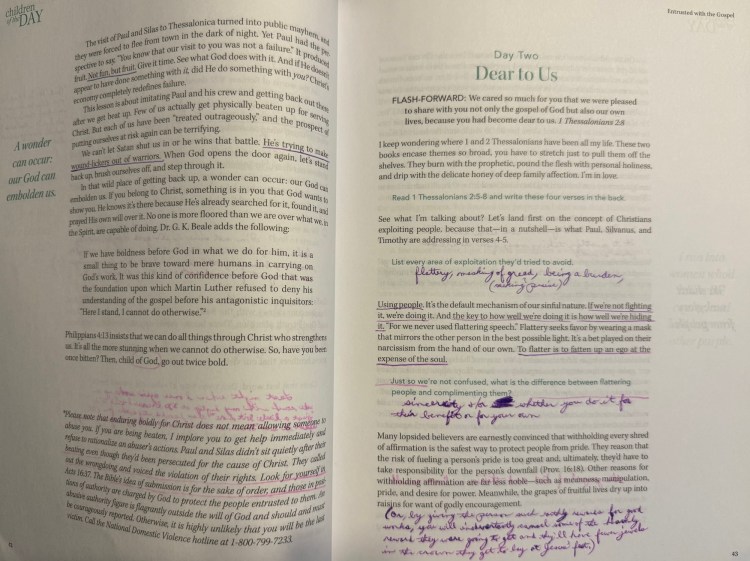
List every area of exploitation they’d [Paul, Silvanus and Timothy] tried to avoid.
“flattery, masking of greed, being a burden (seeking praise?)”
Using people. It’s the default mechanism of our sinful nature. If we’re not fighting it, we’re doing it. And the key to how well we’re doing it is how well we’re hiding it.
To flatter is to fatten up an ego at the expense of the soul.
Just so we’re not confused, what is the difference between flattering people and complimenting them?
“sincerity and/or whether you do it for their benefit or for your own”
Many lopsided believers are earnestly convinced that withholding every shred of affirmation is the safest way to protect people from pride. They reason that the risk of fueling a person’s pride is too great, and, ultimately, they’d have to take responsibility for the person’s downfall (Proverbs 16: 18).
“(Or, by giving the person such earthly rewards for good works, you will inadvertently cancel some of the heavenly reward that they were going to get and they’ll have fewer jewels in the crown they get to lay at Jesus’ feet.)”
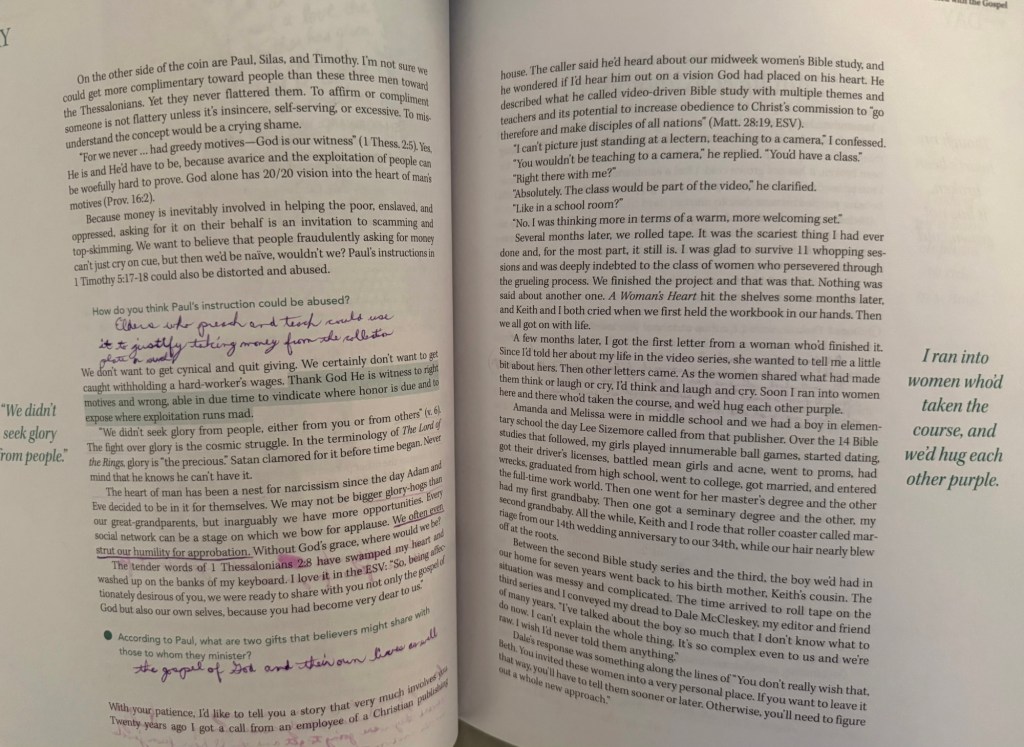
How do you think Paul’s instruction could be abused?
“Elders who preach and teach could use it to justify taking money from the collection plate or such”
We often even strut our humility for approbation.
According to Paul, what are two gifts that believers might share with those to whom they minister?
“the gospel of God and their own lives as well.”
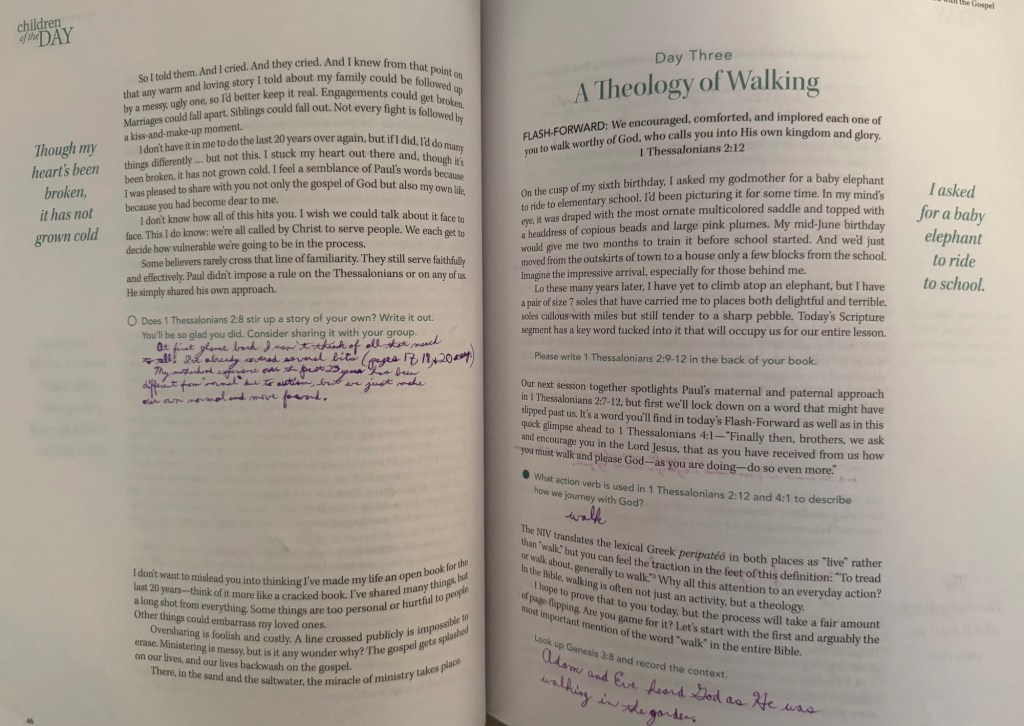
Does 1 Thessalonians 2:8 stir up a story of your own?
“At first glance back I can’t think of all that much to tell. I’ve already covered several bits. My motherhood experience over the past 23 years has been different from ‘normal’ due to autism, but we just make our own normal and move forward.”
Dearest Rachel –
For all that I treasure your study notes as examples of your voice that you’ve left behind, some of the most precious bits are the marginalia that you fill in where no prompt exists. You weren’t answering a question being posed to you by the author; on the contrary, you would push back on an assertion she made, or add an argument she hadn’t listed herself (possibly because it hadn’t occurred to her). I’m sure it has to do with my own tendencies toward being the “well, ACK-chully” guy myself, but when I see it in your notes, I can’t help grinning and thinking “that’s my girl.”
Although, in this particular case, your pushback is fairly benign. Unlike the examples given by the author, you propose a relatively reasonable rationale for withholding praise; that of the subject being that much more deserving of heavenly acclaim, rather than the cheap (but instantaneous) substitute that is earthly praise. I say “relatively reasonable” because your suggestion isn’t delivered in a tone that suggests you firmly believe your option is right; just one that points out that there are other motives beyond the concern about inflating the praiseworthy person’s pride.
I will say that you were always quite self-effacing about the volunteer work you would do at and for church, but still enjoyed the appreciation nights they would put on annually (although now that I think about it, it’s been a while since they’ve done one; it’s probably difficult to arrange one over multiple locations). So in practice, you were quite agreeable with being offered the occasional “attagirl” here and there.
Of course, most of what you did that was praiseworthy in life flew under the radar; you tended to think of it as the normal course of your life. Even in the aspects in which you acknowledged that it wasn’t ‘normal’ per se – at least when compared to the typical family experience, if there truly is such a thing – you point out that we adapted to the circumstances we were given and made “our own normal,” as you put it. To you, it wasn’t any more commendable than for anyone else trying to raise a family and keep a household; you didn’t ask for or expect any special honor for it, even though you never refused it when it was given.
One would hope that you had your fair share on gems in your crown as a result. I would like to have seen that crown before you set it at Jesus’ feet, though.


One thought on “from Rachel: Dear to Us”