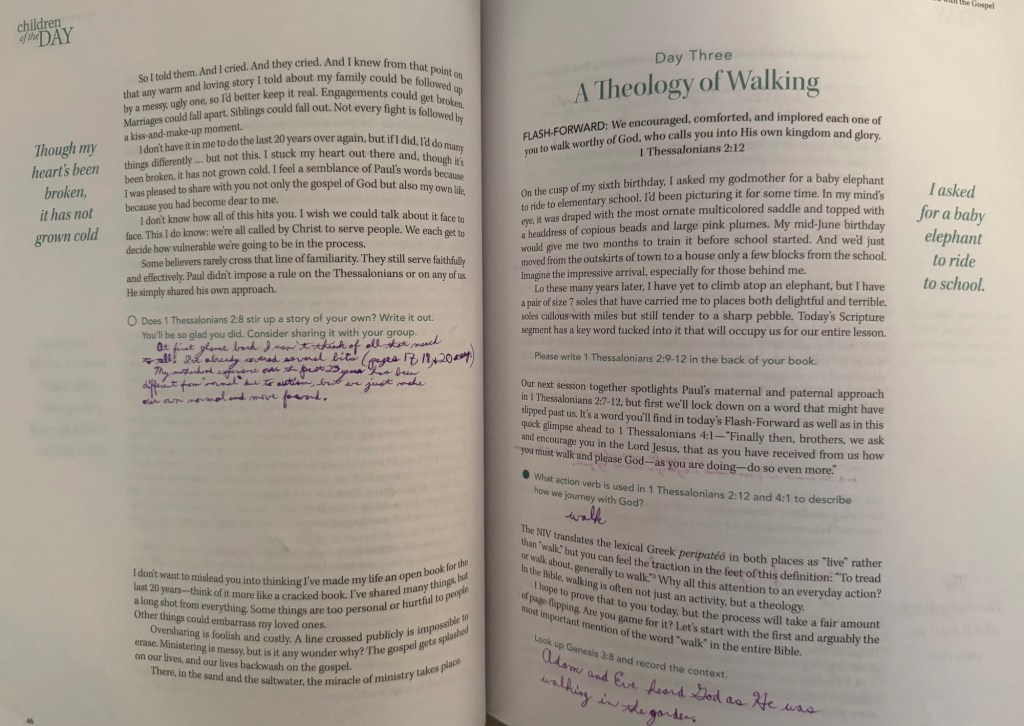
What action verb is used in 1 Thessalonians 2:12 and 4:1 to describe how we journey with God? “walk”
Look up Genesis 3:8 and record the context.
“Adam and Eve heard God as He was walking in the garden.”
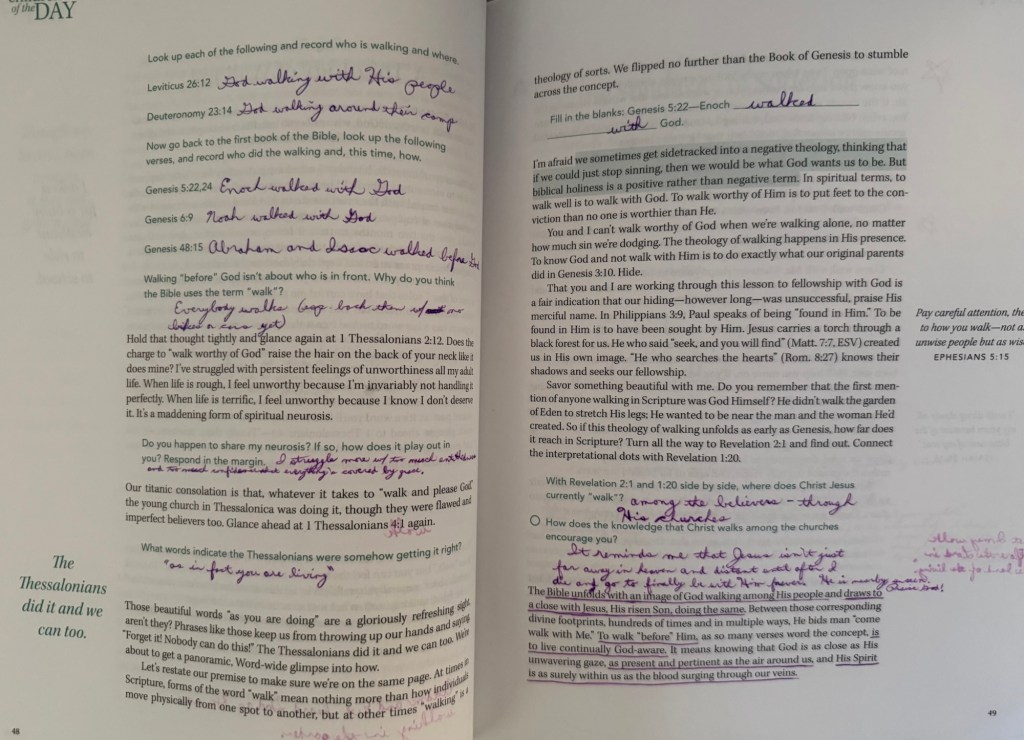
Look up each of the following and record who is walking and where.
Leviticus 26:12 “God walking with His people”
Deuteronomy 23:14 “God walking around their camp”
Now go back to the first book of the Bible, look up the following verses, and record who did the walking and, this time, how.
Genesis 5:22, 24 “Enoch walked with God”
Genesis 6:9 “Noah walked with God”
Genesis 48:15 “Abraham and Isaac walked before God”
Walking ‘before’ God isn’t about who is in front. Why do you think the Bible uses the term ‘walk’? “Everybody walks (especially back then with no bicycles or cars yet)”
Do you happen to share my neurosis [of feeling unworthy before God]? If so, how does it play out in you?
“I struggle more with too much entitledness and too much confidence that everything’s covered by grace.”
What words indicate the Thessalonians were somehow getting it right?
“‘as in fact you are living.’”
With Revelation 2:1 and 1:20 side by side, where does Christ Jesus currently ‘walk’?
“among the believers – through His churches”
How does the knowledge that Christ walks among the churches encourage you?
“It reminds me that Jesus isn’t just far away in heaven and distant until after I die and go to finally be with him forever. He is nearby, unseen. Praise God!”
The Bible unfolds with an image of God walking among His people and draws to a close with Jesus, his risen Son, doing the same. Between those corresponding divine footprints, hundreds of times and in multiple ways, He bids man ‘come walk with Me’. To walk ‘before’ Him, as so many verses word the concept, is to live continually God-aware. It means knowing that God is as close as His unwavering gaze, as present and pertinent as the air around us, and His Spirit is as surely within us as the blood surging through our veins.
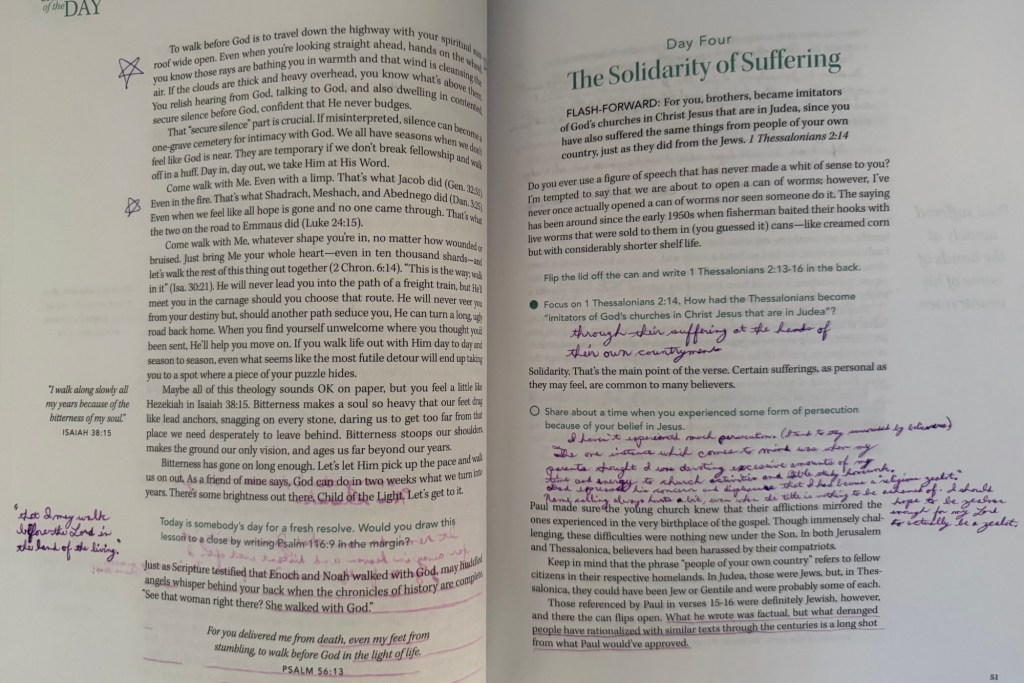
⚝ To walk before God is to travel down the highway with your spiritual sunroof wide open. Even when you’re looking straight ahead, hands on the wheel, you know those rays are bathing you in warmth and that wind is cleansing the air.
⚝ Come walk with Me. Even with a limp. That’s what Jacob did (Genesis 32:31). Even in the fire. That’s what Shadrach, Meshach, and Abednego did (Daniel 3:25). Even when we feel like all hope is gone and no one came through. That’s what the two on the road to Emmaus did (Luke 24:15).
Today is somebody’s day for a fresh resolve. Would you draw this lesson to a close by writing Psalm 116:9?
“‘that I may walk before the Lord in the land of the living.’”
Dearest Rachel –
This particular day’s homework is light on actual responses from you (although to be fair, very few of the questions here demand much in the way of detailed answers – I can guarantee that, were I in your place, I would have probably given this shorter shrift than you did here). Most of what’s included here are passages from the author herself that you either underlined or starred for emphasis, as if to highlight for your own future reference. I do wonder if that every came to pass that you did refer to them again.
I suppose it no longer matters at this point.
Interestingly, given that I mentioned you pushing back on the author in the previous entry, it seems you’re doing it again here; you were just in a contrary mood that week, weren’t you, honey? Of course, this is one about personal feelings as opposed to a rationale for what might be considered bad behavior. Here, you aren’t dismissive of Beth’s claim that she feels unworthy to be in God’s presence; you simply acknowledge that when it comes to standing before God, you have the exact opposite reaction.
To you, the fact that Jesus paid for you to be able to stand with Him in the presence of His Father means that you’re ‘entitled’ to do so no matter what. And to be fair, just as there is nothing we can do to make ourselves ‘worthy’ on our own to stand (or, as emphasized in this lesson, to walk) before Him, there is nothing we can do to negate God’s declaring us worthy through Jesus’ saving efforts; apart from rejecting Him and walking away, we can’t defile ourselves so much that we’re ‘unworthy’ of being in His presence. The last starred passage touches on that; we may walk imperfectly with Him (and our lives may be imperfect as we do so), but we are still invited to do so, just as we are.
Of course – and you’ll forgive the aside – this doesn’t mean that we’re to stay “just as we are” once we come and walk with Him. It may not be necessary to clean ourselves up in order to take a bath, but we are expected to get in the tub at some point. His cleansing power and presence ought to be reflected in our subsequent life; if not, even the outside human observer might question if you are in fact walking before God. But that’s a subject for another time.
For the moment, however, you took comfort that God, in the form of Jesus, “walks among the churches” here on earth; meaning that His presence is a here-and-now thing, and not just for the hereafter. I would be curious to know whether there’s a difference in the intensity between the one and the other (I assume there is, if only due to malign interference and our own inattention); you’re in a position now where you know, but cannot tell me, more’s pity. I suppose I’ll find out eventually – we all end up doing so on our own – but until then, keep an eye on me, and wish me well. I’ll need it.


