Dearest Rachel –
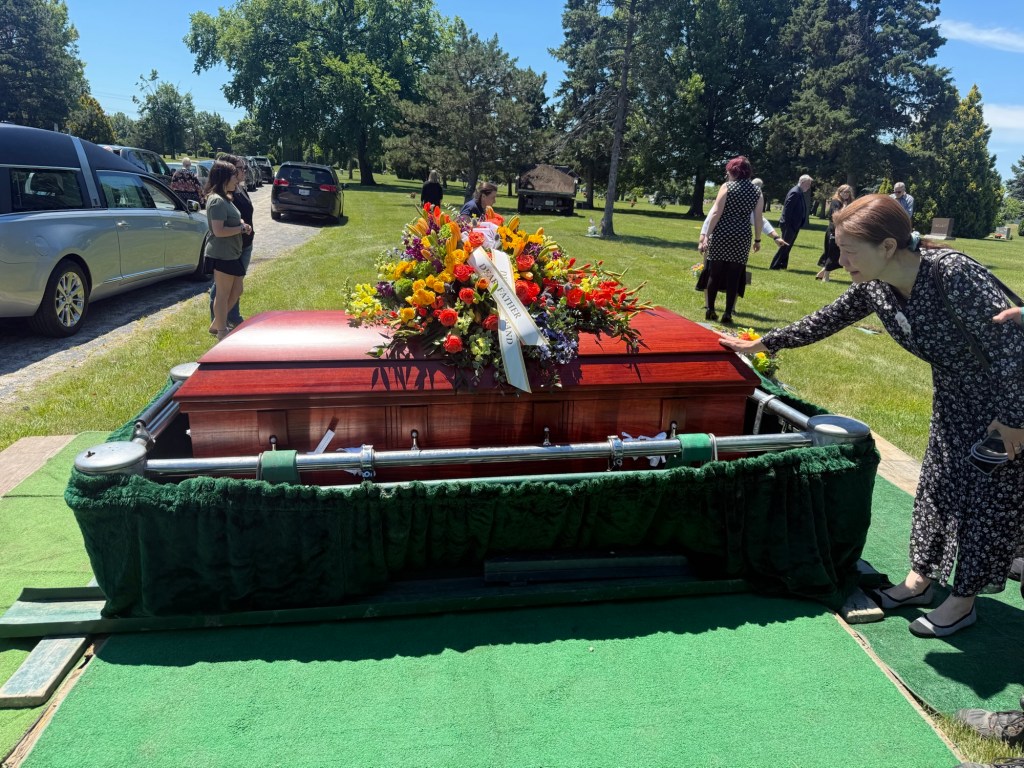
Well, we got through the funeral and the graveside service with as much composure as could be expected – although I didn’t hold it together as well as I thought I might once I got to the podium. Daniel had to come up and stand by my side when I asked permission to refer to Dad as “Dad” instead of “Ralph” as everyone else would have known him. You never know what is going to throw you off your stride.
Meanwhile, once I got up there, I realized that the notes I’ve written to myself were so hard to read off the iPhone that I just sort of dispensed with it; rather than reading it like a script, I’d just have to use it as an outline. I got most of the points that I had cobbled together the other day, but it wasn’t exactly what I’d actually written down. So this isn’t precisely what I said about him, but it’s close enough, and it will do in lieu of a transcription of what I actually said.
***
Over the past seven years, as Ralph – you all have no idea how weird it is to call him that – has endured several life-threatening crises in succession, he’s had the time and opportunity to put together a plan of pretty much the entirety of today’s service; everything, that is, but the scheduling. One of the things he stipulated was that there be no ‘open mike’ series of tributes. And while he didn’t say why, I think we all know that if we did, the tributes would keep us here until Independence Day.
As it is, I’m going to be hard pressed to summarize his life myself; how do you compress eighty years – or, given my perspective, fifty-plus years, anyway – in ten minutes? But I have to do it for the rest of you, and hopefully, you’ll learn something about him that you didn’t know before, at any rate.
For most of you, though, I don’t have to go into a lot of detail about Ralph; for those of you here to celebrate his life and impact, you’ve known him for a long time. He may have had a diminished presence over these last few years, but he was known as an elder in the church going back half a century. You’ll remember him as an advisor and a mentor, a man of quiet grace and dignity. A man who served as an example of how to live, how to lead, how to give, how to love, and finally, how to die, all as a follower of Christ.
But examples aren’t born, but made; and I thought I might spend my time here introducing you to the ones who served as examples to him, and made him who he was, and who you remember him to be.
I’ll start with the ones he didn’t choose to serve as such, but who he was blessed with nonetheless; his family. His own father, Harry, was a man of little in the way of financial wealth, but he was a generous man in the tradition of the Macedonian Christians. As a grandkid, I remember how he always had candy or gum to hand out to me and my peers every Sunday at church (Priorities, am I right?) But I learned that he was generous to those around him; and when he couldn’t help in terms of money, he would often perform various favors, saying with a twinkle in his eye that, if asked what he was owed for his service, he’d write it down in his little black book. More on that in a moment.
His oldest brother Wally, on the other hand, wasn’t nearly as much of a presence in his life, but his shadow hovered over it. Wally passed away when Ralph was nine; after serving in the occupation in Berlin after the war, he came home and went to work at Camp Honey Rock, where he suffered an accident while wiring the camp up for electricity. He was remembered as a saintly young man who never had a bad word to say about anyone, and I think Ralph strived to live up to that legend of his older brother.
With Wally gone, he did still have an older brother to protect and guide him as he grew up, but I rarely saw my Uncle Don, since he had gone and gotten a doctorate and rose to some of the highest ranks within academia, so most of what I can tell you about him was secondhand, just as with Wally. I willsay that, for all his erudition, Don didn’t quite seem to ‘get’ his father the way Ralph did; on his deathbed, Don asked Ralph about their father’s black book, much to Ralph’s incredulity. “Don… didn’t you know? There was never any ‘black book’! That was the whole point!”
These are the men he grew up with and who shaped him whether he asked for them to or not; I have more such stories, but this will have to do for now.
There are also those among the “great cloud of witnesses” of Hebrews that Ralph chose to observe and model his life after. JoAnna (will/has) read from the twenty-third psalm; Ralph, in one of his rare stints at teaching, would do a study on the meaning of this particular psalm, particularly as researched by Philip Yancey, who’d studied it from the perspective of an actual shepherd. The verses hit differently, with more meaning, when you understand what’s actually involved in things like ‘preparing a table’ for one’s sheep, for instance. But Ralph was also drawn to the characterization of David as “a man after God’s own heart,” and strove mightily to be worthy of that description. No disrespect to King David, but I’d suggest that Dad did him a bit better; sure, he may not have turned out a Solomon between Jenn and myself, but we’re no Absaloms, Amnons nor Adionijahs, either. Moreover, there was no Bathsheba in his life; Mary was “the wife of [his] youth,” even into their late eighties. And I apologize, Mom, for pointing out your age with that last line.
The other Biblical role model he patterned himself after was that of Barnabas, the “son of encouragement” who, while something of a quiet character in Acts in comparison to many of the apostles, but without whom there may not have been a Paul. I don’t think I really have to make much of this characterization, as those of you who received the notice of Dad’s passing from Pastor Scott will recall that he referred to him as “perhaps the most encouraging and godly man I’ve ever known.” I’m sure I’m biased when I say this, but for all the examples he had put before him, both through God’s hand and His Word, he very nearly surpassed them all.
In fact, I’m going to illustrate just how biased I am by one final comparison, and this is one we’re really all prone to. God describes Himself as our Father (who art in Heaven – I guess to distinguish Himself from our earthly fathers); and, since we all have fathers by virtue of biology, it’s through that lens that we view that particular title. No, I’m not saying that Dad surpassed, or was even on par with God, but I’ll say that I think I and Jenn understand the concept of God-as-Father better than most of you all here.
Setting aside Dad’s godly nature for a moment, I want to mention something that’s been an open secret about our family. It’s never been hidden, but it’s just not advertised, either. Jenn and I, as many of you know, are adopted. We are not Dad’s (or Mom’s) children; at least, not by birth. And they made a point of letting us know as soon as they thought we could understand that term; one of the books they would read to us as little kids was a book called “The Chosen Baby” about a couple that adopts a baby boy and later, a baby girl (In fact, that’s when they knew I was able to read on my own, because I pointed out that “that says Michael… and Elizabeth” rather than “Randy” and “Jennifer”).
And that’s the thing; they chose us, they wanted us, and they made that plain to us from the moment we could understand those concepts. So when the Scripture talks about us being adopted into God’s family, Jenn and I “get it” probably better than any of you here. We’re walking allegories, and that’s due to our earthly father emulating our heavenly Father. We understand a loving God, because we had a loving father, one who took us in even when we were of no relation to him. And yet, it was an unconditional love; we didn’t have to walk on eggshells lest we be thrown out of the family. Yes, I addressed him as “sir,” but that’s a story for another time, and he never asked that I call him that – in fact, he asked me if I was afraid of him, as he didn’t want me to be, and I told him no, it was just a respectful manner of address. What else should I have called him? Yes, he was “Dad” and “Pop” as well at various times, but more often than not, I thought he should be addressed as “sir.”
And so, I address you once again as that, sir. Thank you for the lessons you taught me, and all of us. Helsa hemm; greet those at home for us, and we will strive to follow your example in turn.
***
Anyway, now that it’s over, I can express my appreciation to you for having kept your eye on me, and wishing me well. I’d still ask you to continue with that, though, as I’m still going to need that going forward.


