Dearest Rachel –
It’s a strange thing to consider; while we’re well aware that the name Armageddon comes from a specific place – the valley of Megiddo, where we are now heading to – it goes against our understanding to think of the end of the world happening in a single specific place. Armageddon seems more of a concept, rather than a place – even if the blood were to run six feet deep throughout the valley…
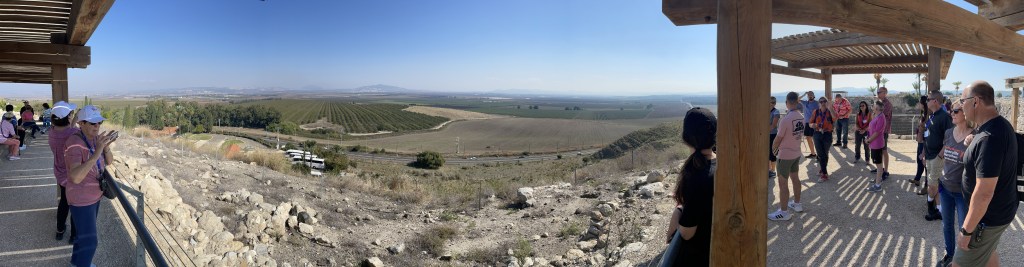
…how would that really affect those of us on the other side of the world? How would our lives be impacted back in the United States for some battle happening in this little corner of the world? It’s easier to wrap our heads around the idea of nuclear bombs raining down back and forth from one side of the world to the other, when it comes to envisioning the concept of Armageddon. At least that has the potential to destroy life all around the globe.
But anyway… it’s not for me to question, I suppose. Besides, if I understand how things are supposed to work, I won’t be here to have to deal with it, regardless which side of the world I might be on. This is what and where it’s said to happen, and until it does, there’s nothing for me to argue about. For now, we’re on the way to see what’s there.
In order to get to Megiddo we travel through the Valley of Salt, leading away from the coastline and further inland. This was the trade route for transporting the precious seasoning and preservative from the Dead Sea and other sources (which has existed since the days of antiquity, even pre-dating events mentioned in the Bible). As we drive along, Yael fills us in on a few miscellaneous facts:
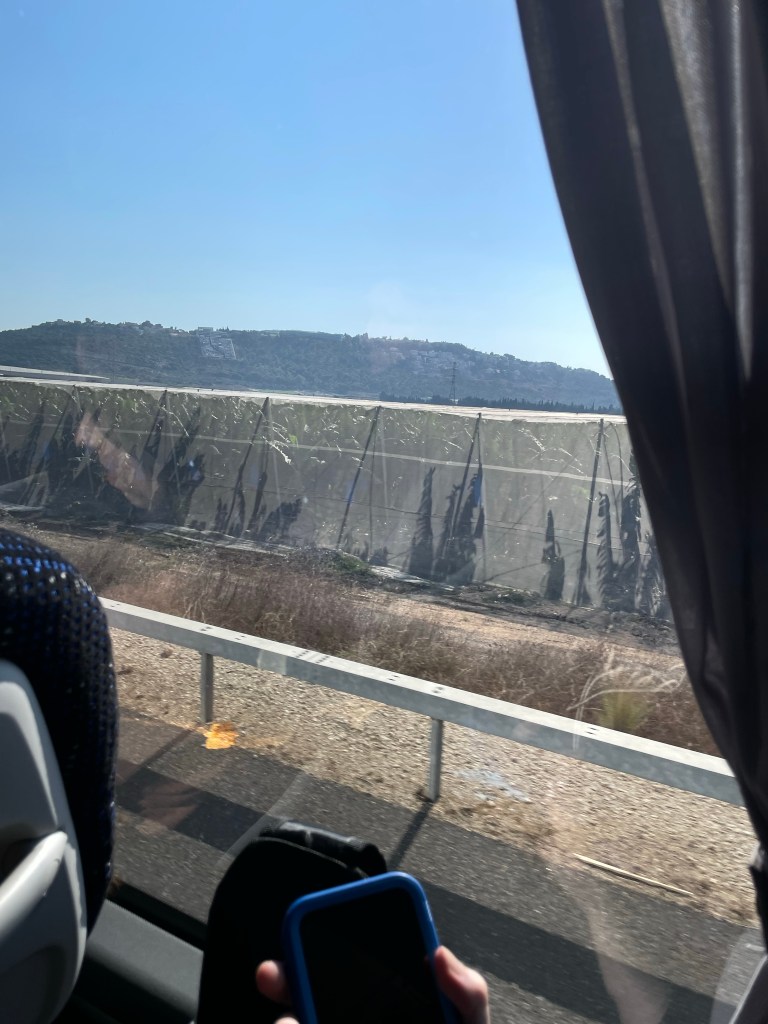
Also on the subject of food, she points out several carob trees as we pass them. Carob seeds in particular – known as ‘carats’ (and you can probably guess where this is going) – were believed in ancient times to be universally uniform in size and weight, leading to the carat being used as a measure of weight (specifically, for gemstones). I had to look up karat myself regarding gold, and how a weight could represent purity; apparently, it comes from a gold coin weighing 24 carats minted in Constantine’s day. Anything less than 24K served to indicate how much of the coin was actually gold. 14K gold, for instance, is barely more than half gold (well, okay 58⅓%, but still, that’s so far from pure…)
Also touched on is a discussion of Israel’s tech industry. The Silicon Valley of the Middle East, Israel hosts about 2,700 startups a year (of which 85% fail – but the ethos here is that failure is the risk you take toward innovation, and thereby accepted as part of commercial life). No other country comes close, apart from the U.S., and we have so much larger of a talent pool to work with. Israel is a tiny commercial powerhouse, surrounded by too many countries that… well, aren’t. One wonders if a certain amount of envy might come into play when it comes to triggering the apocalypse.
Yael speaks of the geographical significance of this area, and part of the reason for conflict going back even to before the times of Mohammed, Jesus or Moses. This is, after, hardly a resource-rich area; why’s it such a big deal? Why does everybody insist on going to war over this silly little slice of land. Well, as a realtor could tell you, it all boils down to “location, location, location.” Standing as it does between Africa (represented historically by Egypt), Asia (Mesopotamia) and Europe (Anatolia), the Levant is essentially the crossroads of the world. Just where it happens to be gives it significance – and people have been fighting for their piece of the place since time immemorial.
And will, until the literal end of days; that geographical confluence will likely factor into why the armies of the world will meet here one day.
Megiddo is also the largest ‘tel’ in the country. Tels are archeological sites, upon which cities were built in ancient times – with one city after another built upon previous versions of the same city (often by conquering civilizations who destroy a culture but like the location – which is, after all, the chief virtue of real estate). There are twenty-six layers of civilization, extending from 5,000 years ago until the second century A.D. But with the rise of Hellenic culture, and its requirements for more space for amenities such as bathhouses, arenas and the like, hilltop cities like Megiddo didn’t hold the same usefulness as they did in the days when it was a strategic advantage to see your enemy coming from a long way off. And so, the place was left to time and decay, much as a great deal of what is modern Israel.
The first world war, if you could call it that, was fought here between Thutmose III of Egypt against the kings of Canaan. During what we refer to as the First World War, Lord Allenby, heading the British army, conquered the Ottoman Empire in a battle here as well. But it has also served as a place of peace: the reconciliation between the Catholic (under John XXIII) and the Orthodox churches took place here in 1964.
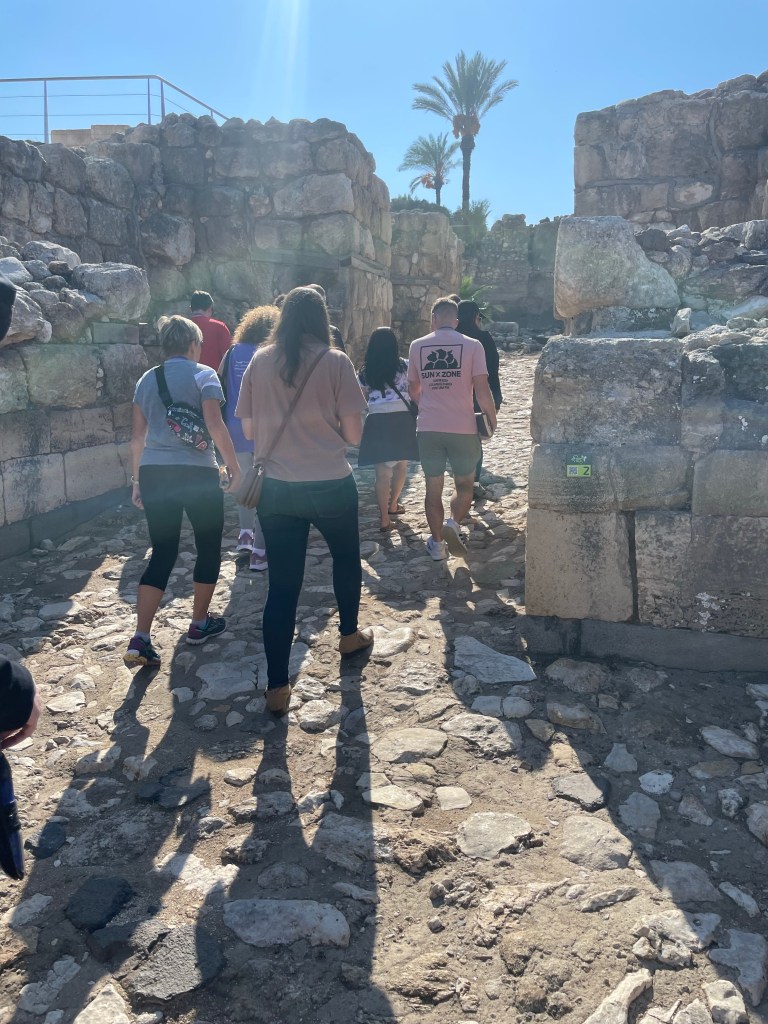
Of course, you’re aware of the fact that the gates were the place where everything happened in a city; the market was there, and the city elders sat there, rendering judgement on various legal matters.
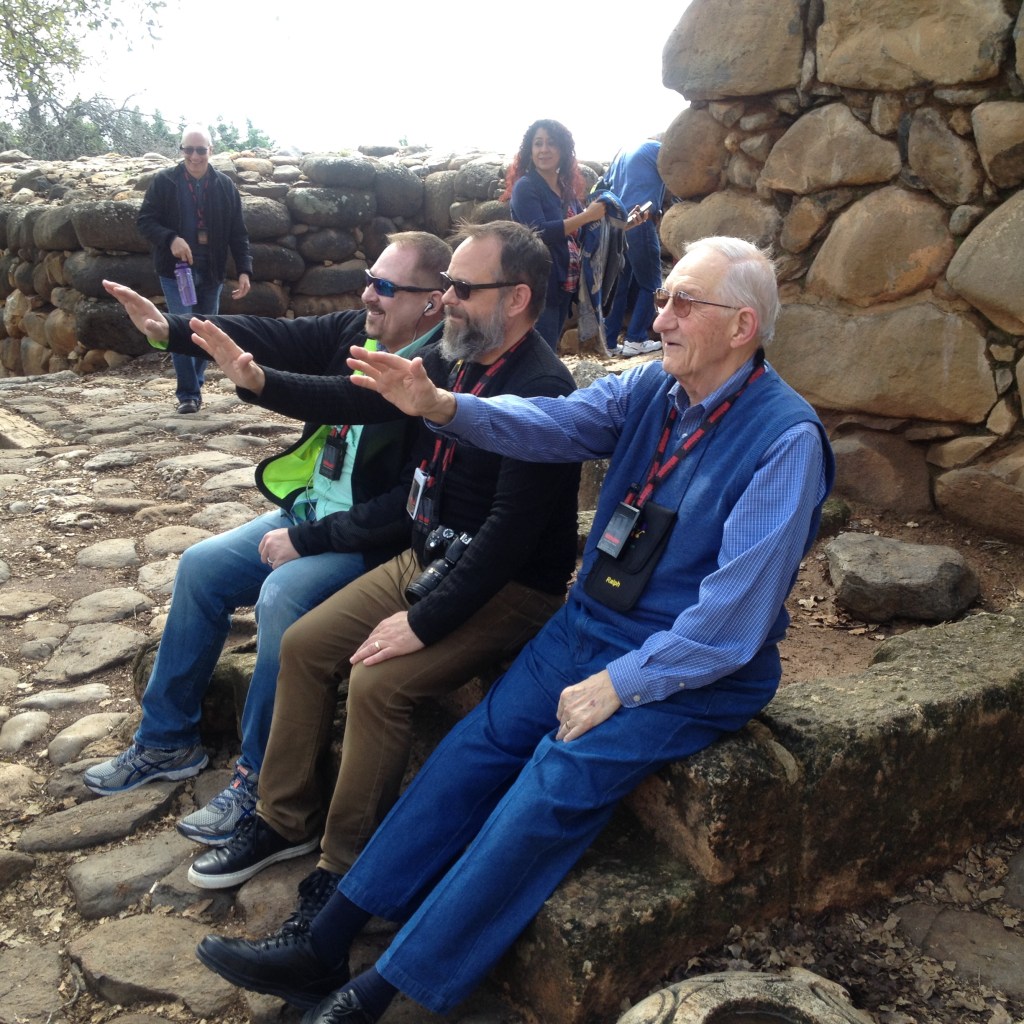
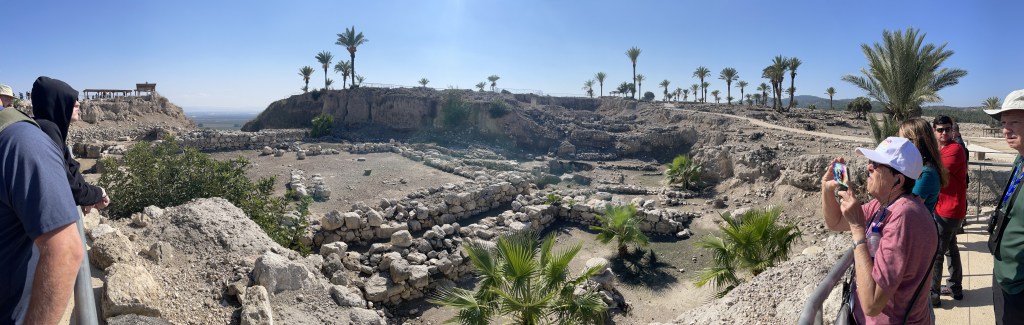
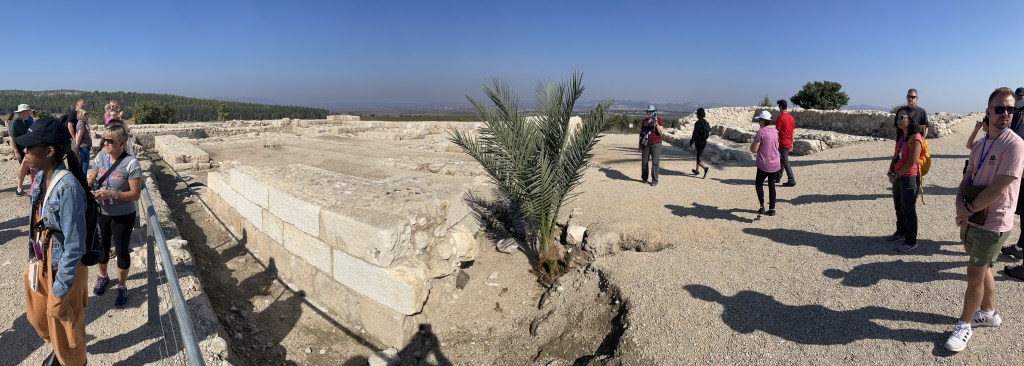
One spot has a temple with bones left upon it, which prove (by what animals they belonged to) that it was a pagan altar, rather than a Jewish one.
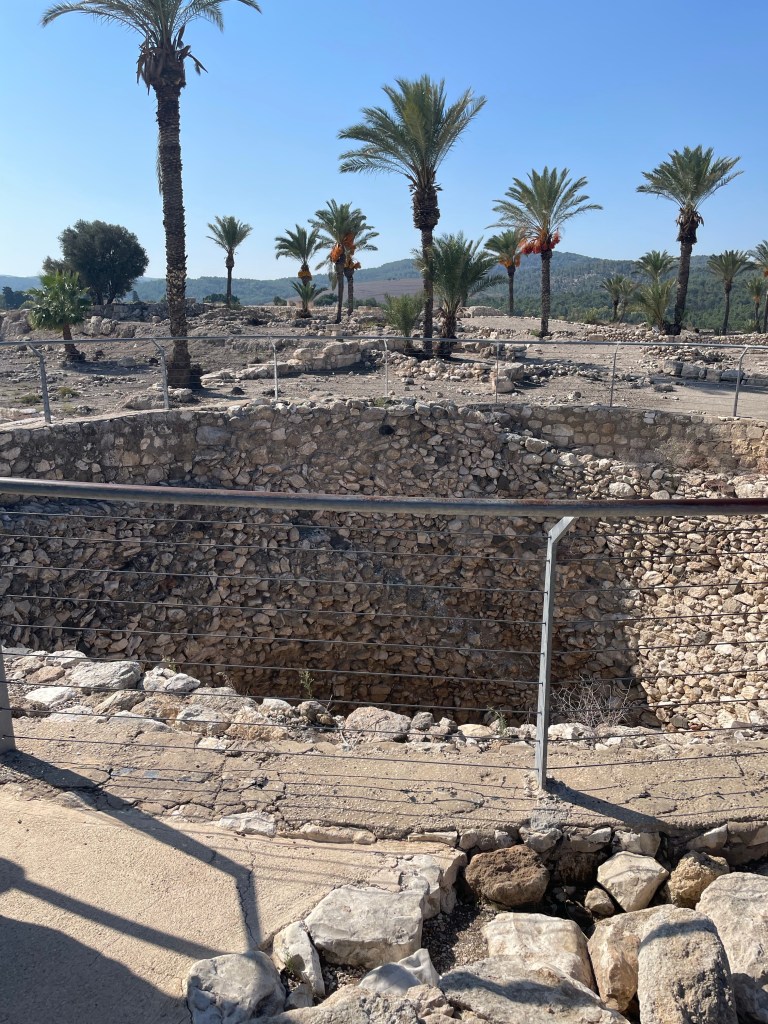
The water source for Megiddo is coming from a fountain outside the city. This would ordinarily constitute a strategic vulnerability, but they built a tunnel system, and a cistern in order to bring the water inside the city.
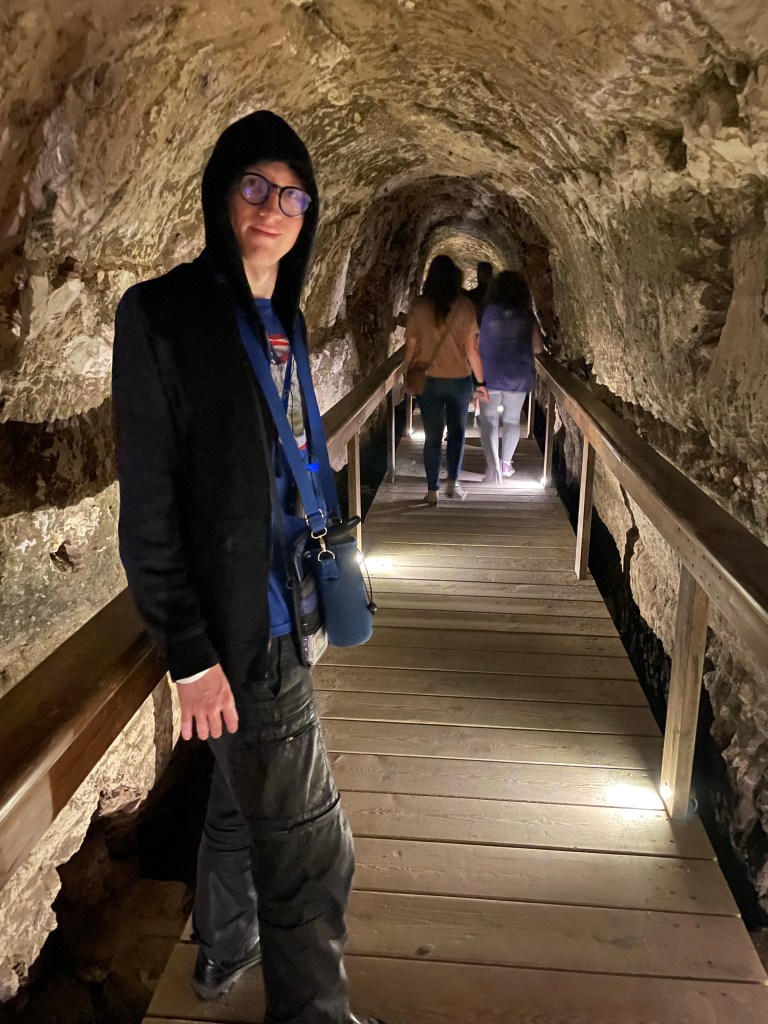
After climbing down into the cistern, through the tunnel and back out, we’ve definitely gotten our steps in today – and it’s not even noon. Well… it is by the time we make the bus, but still…
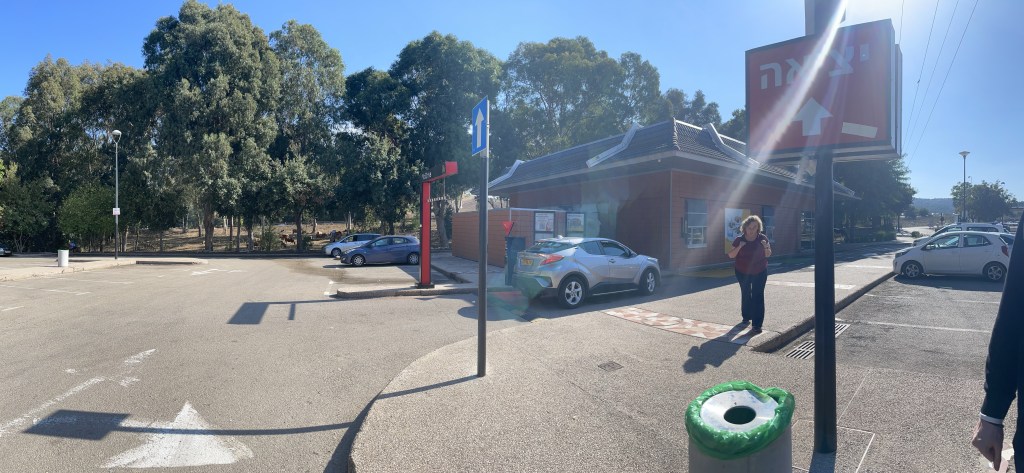
As we take our leave of Tel Megiddo, there’s one more thing for Yael to inform us of, and it’s as we pass the local prison, which is hard to miss, surrounded as it is with razor wire and guard towers. Evidently, they attempted to expand the facility recently, but of course, they struck antiquities in the process. Among the mosaics they found was one with the word ‘Christ’ written on it. The significance to that is that they believe they might have found one of the first ‘house churches’ from the first or second century, when Christianity was a banned religion (rather than being grudgingly tolerated as an offshoot sect of Judaism) and people met secretly in their homes.
There’s always something new being found here, honey. Sorry that you’re missing out. Then again, you probably know about everything from up there, don’t you?


One thought on “The Site of Armageddon?”