Dearest Rachel –
For all that we bother to head back upstairs after breakfast to brush our teeth and make sure we’ve gotten everything out of the hotel room, we’re still not the last ones down to the bus. Granted, it looks like we are, as the lobby is all but empty as we pass through it. But once outside, there seem to be others behind us.
We debate about whether our backpacks should go underneath with the luggage, or if we should keep them with us. As we’re leery about taking care of our electronics, we decide not to throw them under the bus, and bundle ourselves aboard with them on our backs. I manage to fit mine on the shelf above us, but somehow, Daniel’s is too wide. And to think, he’s only got one computer with him; I’ve got two – one in my name, the other in that of my abandoned channel. At the recommendation of a fellow passenger, we set his pack in the aisle; once we disembark, we can lift it onto our seat, since we won’t be using them at that point.
That resolved, we are effectively introduced to our guide, Yael. She is named after the woman who killed the Canaanite general Sisera (as prophesied by Deborah, when Barak refused to go to war without her). She promises to go into further detail about it later today.
After acknowledging that most of us are still recovering from the effects of our travel, she begins to describe our first destination; or rather, the history of our first destination. It actually doesn’t go back all that far, relatively, as it only begins with Herod the Great (rather than, say, going back into the Old Testament). For all his alleged power – right down to having ‘the Great’ as part of his name – he was woefully insecure in it, as the Massacre of the Innocents should well demonstrate. An Edomite by maternal lineage, he never quite felt accepted by the Jewish community – and despite rebuilding the Temple (or maybe in part due to the heavy taxes imposed to build it and other projects), he really wasn’t – and spent much of his reign trying to prove himself to the people he reigned.
But when you’re the king, you can get stuff done whether you’re liked or not, and the city of Caesarea Maritima was his baby. Herod built it from scratch into the major trading port it was at by time of Christ and Paul, complete with all the social and cultural amenities that a Roman trader (or governor) would have expected, such as a circus, hippodrome and bathhouse
Even setting aside its historical significance, Caesarea Maritima is in a beautiful location. The section of the town that isn’t part of the archaeological site is some of the most exclusive (read, expensive) real estate in Israel. Some things don’t change, even over millennia.
Of course, not everything this far north (or near the Mediterranean) is all that wonderful. En route to Caesarea Maritima, we drive through a city that was built upon a swamp in the early 1900s. The colony lost 75% of their population within its first two years due to malaria, until they hit on planting Australian eucalyptus trees to soak up the swamp water. Of course, now the tree is considered an invasive species, but that beats having to deal with malaria, doesn’t it?
As a brief aside, I decide to leave my notebook behind in the bus; I expect to be taking more of my notes on the phone this time around. It definitely saves my wrist from carpal tunnel syndrome. I do regret having left my cap behind in my suitcase; it’s not raining (like it was last time), but the sun is beating down, and in any event, they aid in identification, as I hardly need to mention how we’re not the only tour group here by any measure.
According to Yael, not all of Caesarea Maritima has been excavated. Part of that is due to financial reasons; excavation and preservation costs money, after all. Part of it, however, has to do with the fact that basically all of Israel is sitting on ancient ruins of one sort or another. If they preserved everything they found, they would never be able to build houses, business, and cities for the modern era.
As we enter the Caesarea Maritima National Park (you’ll recall that nearly all of Israel’s archeological sites are under the jurisdiction of their national park system), our first stop is the theatre. Yael points out the differences between this building, which is decidedly Roman, as opposed to a typical Greek theatre. Greek theatres were built on a slope, to take advantage of the topography to create the amphitheatrical arrangement. The Romans, with their advanced engineering and architectural technology, could build their theatres anywhere, without having to rely on a hill or mountain to support their audience. The other difference is the semi-circular ‘orchestra’ area. This was where the stage was in Greece; but in Rome, this was where the best (read again, most expensive) seats were, with the stage set further back.
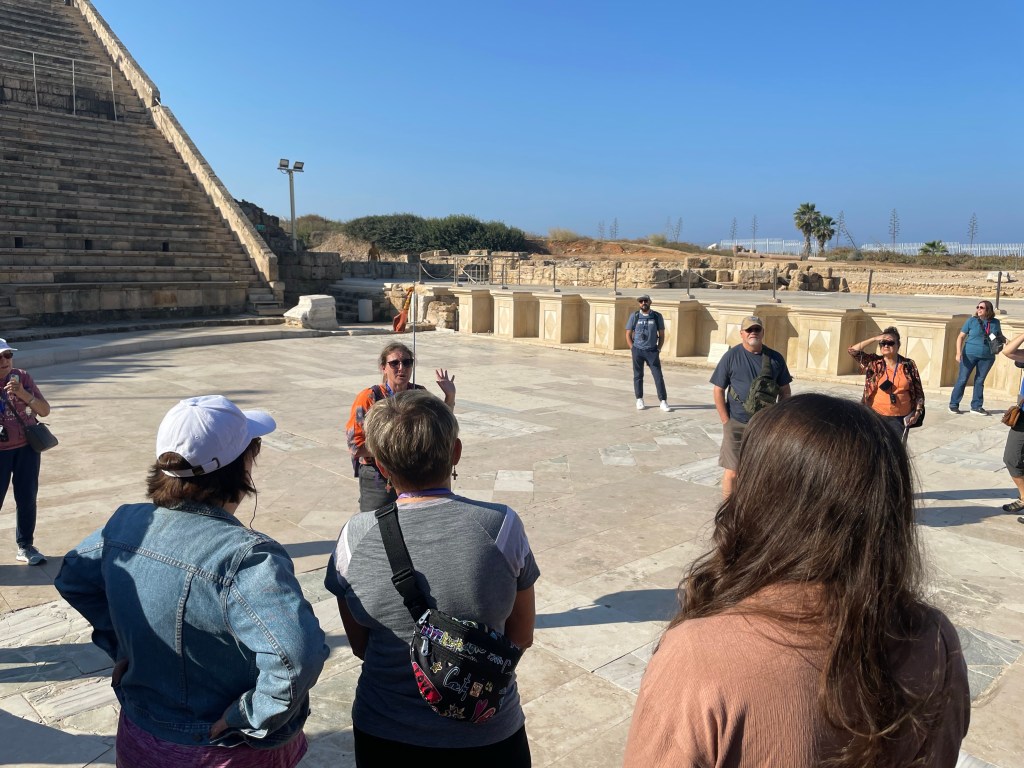
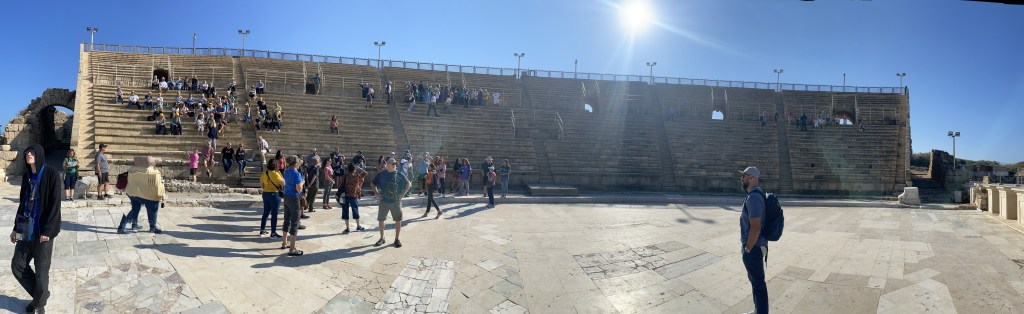
Interestingly enough (and I suppose this is on me for not asking), there’s no indication as to where the orchestra sat in either theatre.
Theaters were also used for trials as well as entertainment (although there was some confluence of the two, especially when taking guilty verdicts and the summary punishments thus meted out into account), including that of Paul – although his audience before Agrippa likely took place in the palace, where he was also kept in a cell awaiting further government action. Yael mentions that certain sects of Judaism had issues with attending the theatre, but made an exception for trials, as the audience might essentially act as jury – and without fellow Jews in the audience, there would be no way for a Jew to receive a fair trial. So attendance to the judicial performances were considered one’s patriotic duty as a Jew.
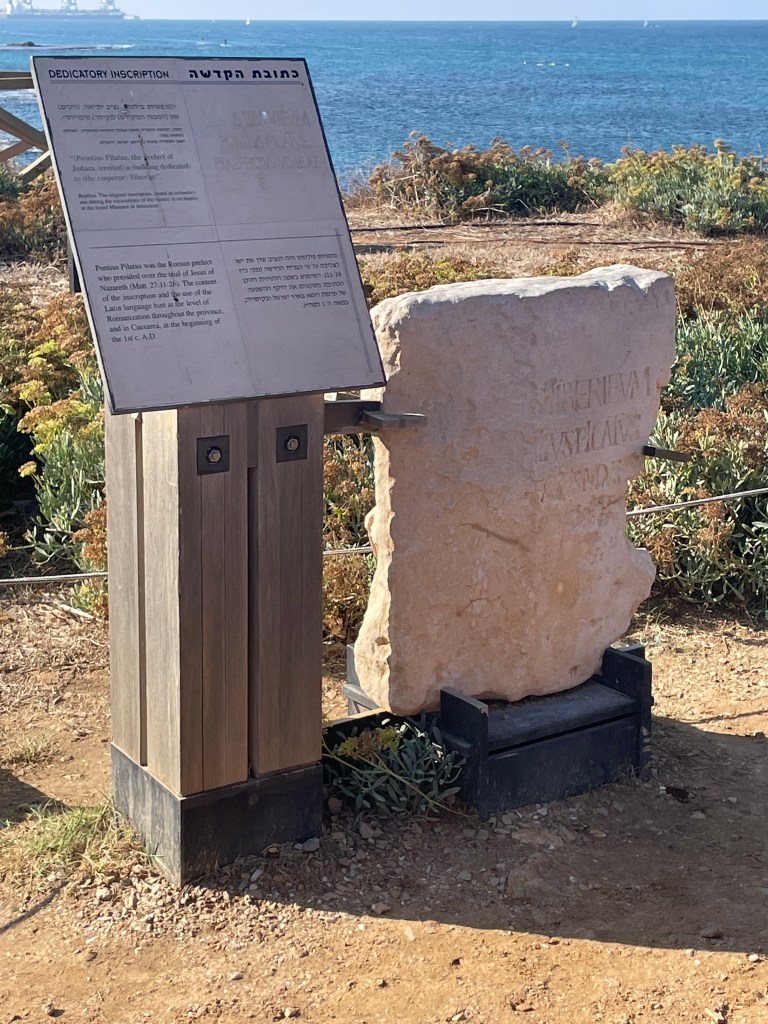
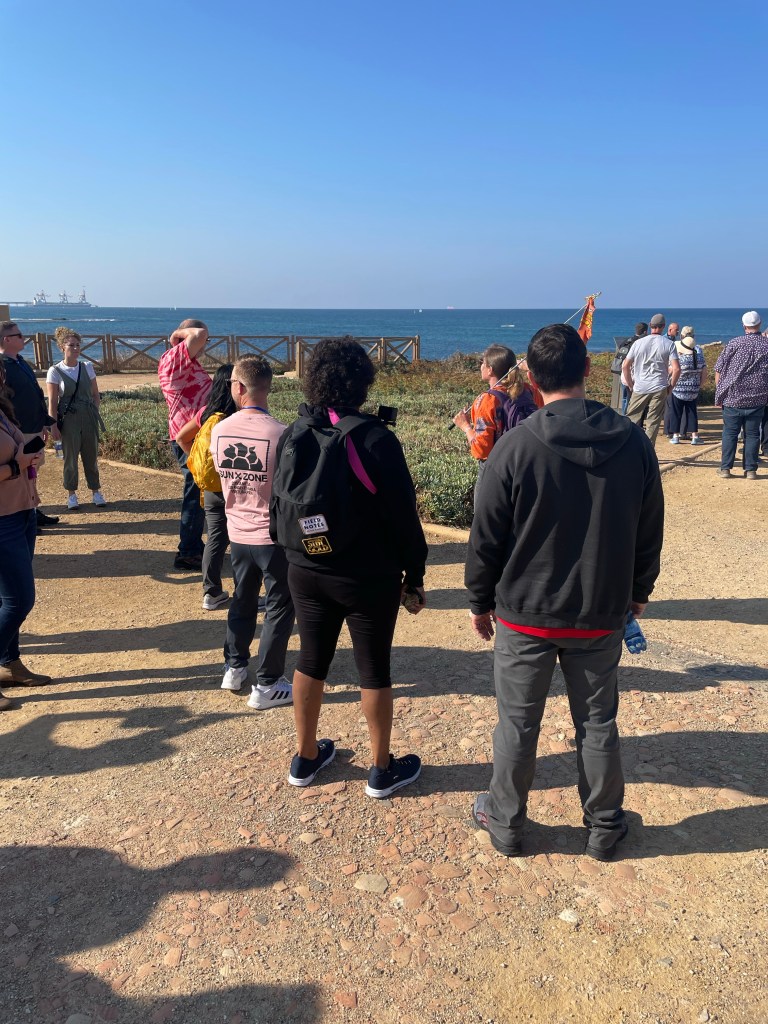
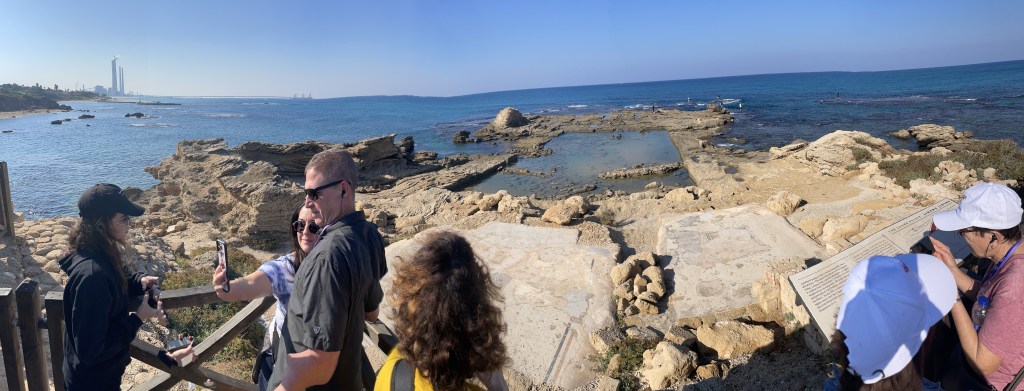
Yael speaks a lot about the various mosaics in each of the sites we visit today. And while there aren’t many to see here, she takes pains to note that those in Herod’s palace are of particular note, more for what they don’t contain rather than what they do. Despite the fact that there are sculptures and mosaics in the many Roman sections of the city. In his own home, he was following the proscriptions against graven images in the Second Commandment, and his floors included only geometric designs, as he did his little part here and there to try to be a ‘good Jew.’
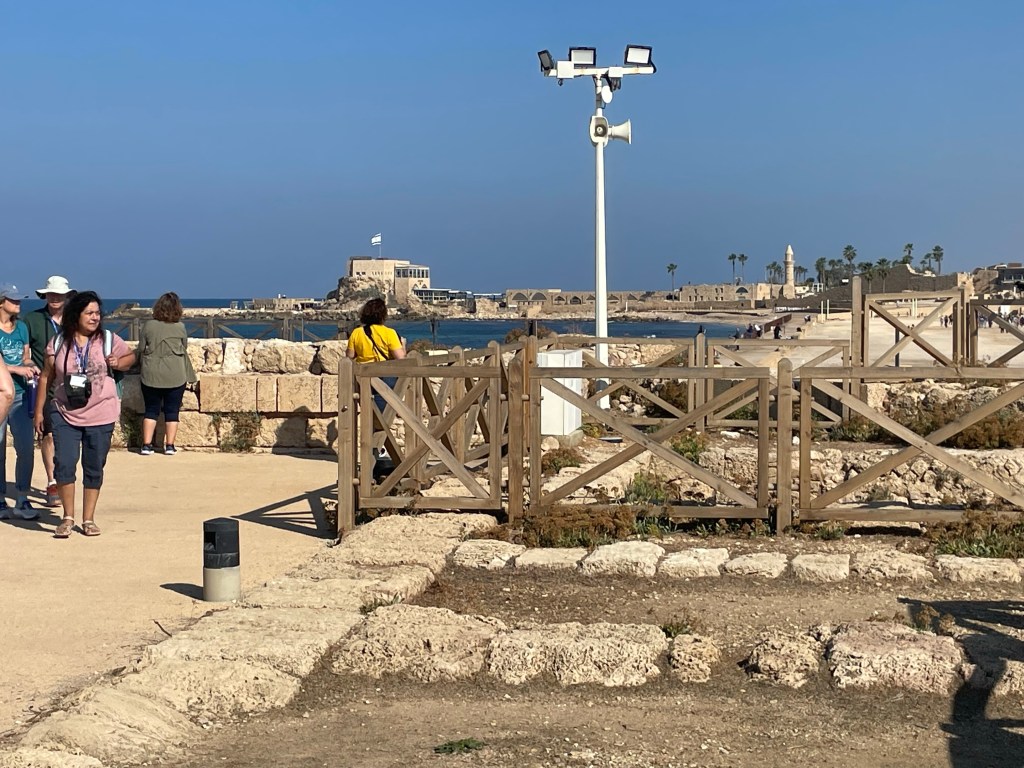
While I hadn’t bothered to take a picture of it, that shot of the lighthouse was taken from the floor on the hippodrome arena, where we’re told all the chariot races took place – much like the NASCAR or Indy races of the day. As with the theatre, Yael points out once again where the best seats are in the house – at the curve, where one can seethe entirety of both straightaways, but more importantly, the crashes. Just like with NASCAR and Indy, that’s what the people come to see. In fact, Yael also mentions the fact that the term ‘arena’ comes from the sand on the floor – which is specifically there to soak up the blood from those mishaps.
Here’s to hoping we don’t have any of those ourselves; keep an eye on us, honey, to that end.


One thought on “Caesarea Maritima”