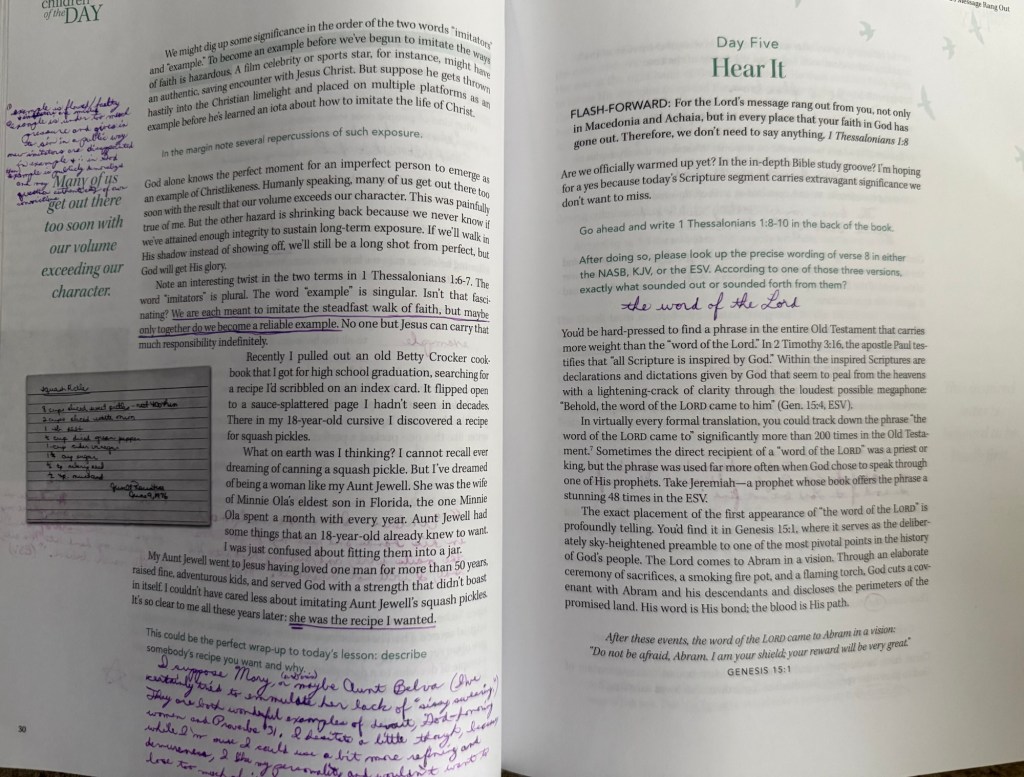
Please look up the precise wording of verse 8 in either the NASB, KJV, or the ESV. According to one of these three versions, exactly what sounded out or sounded forth from them?
“the word of the Lord”
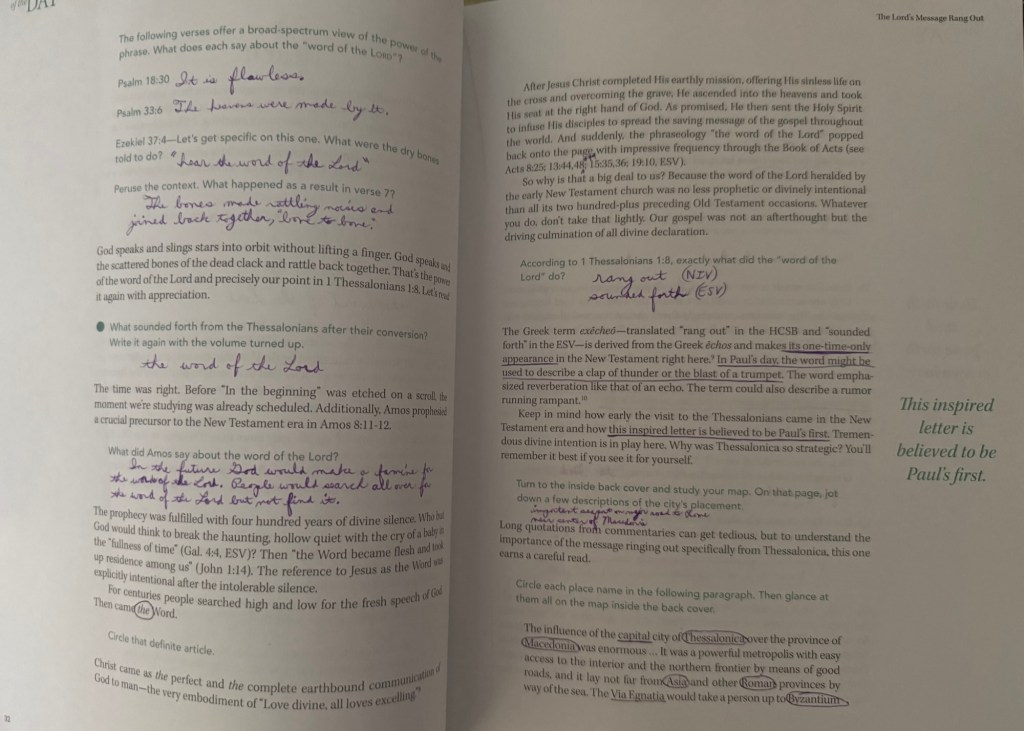
The following verses offer a broad-spectrum view of the power of the phrase. What does each say about the ‘word of the Lord’?
Psalm 18:30 – “It is flawless.”
Psalm 33:6 – “The heavens were made by it.”
Ezekiel 37:4 – Let’s get specific on this one. What were the dry bones told to do? “‘hear the word of the Lord’”
Peruse the context. What happened as a result in verse 7? “The bones made rattling noises and joined back together, ‘bone to bone’”
What sounded forth from the Thessalonians after their conversion? Write it again with the volume turned up.
“the word of the Lord”
What did Amos say about the word of the Lord?
“In the future God would make a famine for the word of the Lord. People would search all over for the word of the Lord but not find it.”
According to 1 Thessalonians 1:8, exactly what did the word of the Lord do?
“rang out (NIV)
“sounded forth (ESV)”
The Greek term exēcheō – translated ‘rang out’ in the HCSB and ‘sounded forth’ in the ESV – is derived from the Greek ēchos and makes its one-time only appearance in the New Testament right here. In Paul’s day the word might be used to describe a clap of thunder or the blast of a trumpet.
Keep in mind how early the visit to the Thessalonians came in the New Testament era and how this inspired letter is believed to be the be Paul’s first.
Turn to the inside back cover and study your map. On that page jot down a few descriptions of the city’s placement.
“important seaport on major road to Rome
“near center of Macedonia”
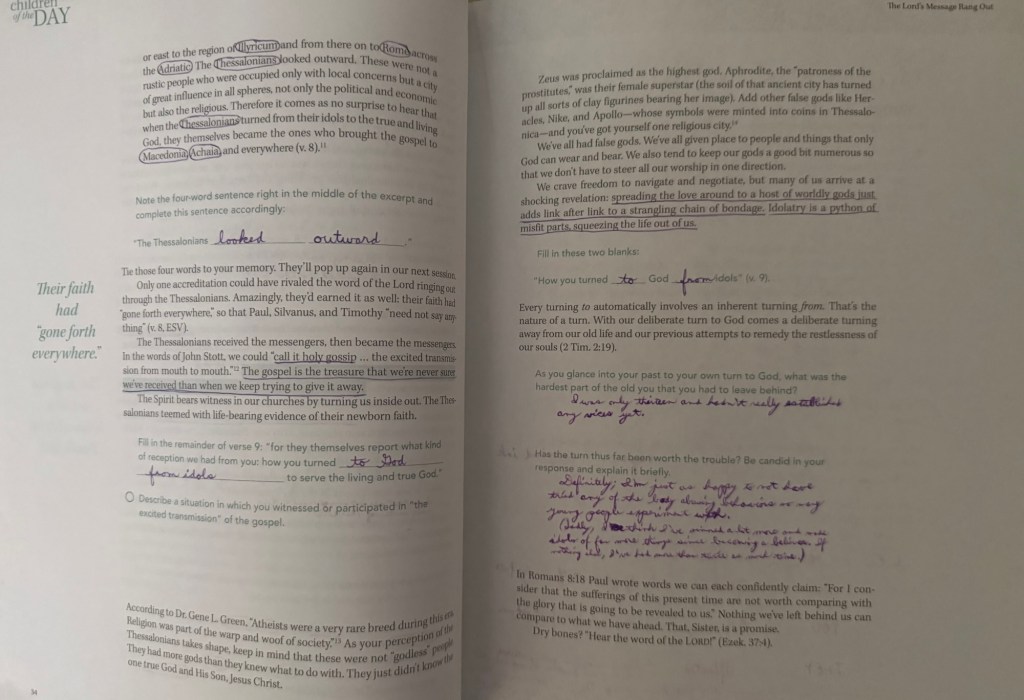
Note the four word sentence right in the middle of the excerpt and complete the sentence accordingly: ‘The Thessalonians “looked outward”’
The Thessalonians received the messengers, then became the messengers. In the words of John Stott we could ‘call it holy gossip… the excited transmission from mouth to mouth.’ The gospel is the treasure that we are never surer we’ve received than when we are trying to give it away.
Fill in the remainder of verse 9: ‘for they themselves report what kind of reception we had from you: how you turned “to God from idols” to serve the living and true God.’
We crave freedom to navigate and negotiate, but many of us arrive at a shocking revelation: spreading the love around to a host of worldly gods just adds link after link to a strangling chain of bondage. Idolatry is a python of misfit parts, squeezing the life out of us.
As you glance into your past to your own turn to God, what was the hardest part of the old you that you had to leave behind?
“I was only 13 and hadn’t really established any vices yet.”
Has the turn thus far been worth the trouble? Be candid in your response and explain it briefly.
“Definitely; I’m just as happy to not have tried any of the body abusing behaviors so many young people experiment with.
(Sadly, I think I’ve sinned a lot more and made idols of far more things since becoming a believer. If nothing else, I’ve had more than twice as much time.)”
Dearest Rachel –
This day’s entry, while longer than some, is a little different than most in that much of the words copied are because you highlighted or underlined them as important to you as opposed to actual answers coming from you directly. I don’t know if any more comment is needed for those underlined passages apart from transcribing them as such.
But the last two questions focus on a situation I’ve touched on before that I deal with, too; that of not having much of a “before” and “after” comparison. It’s what comes of being raised in the faith and choosing not to rebel; you don’t see an “old you” to put up against the “new you,” such as it is, and use it as a measurement of how you’ve changed during your walk with Christ. The questions are turned inside out, as there was never anything to ‘leave behind,’ no ‘trouble’ to have been worth dealing with to do so.
Of course, it generates a different sort of ‘trouble,’ as you point out; being the prodigal’s older brother (or would it be sister, in your case?) doesn’t make one virtuous, it just makes one less spectacularly sinful. Given the original’s resentment, one might simply harbor a different collection of sins which are no less insidious; indeed, they might be that much worse, since they aren’t as obvious (and might even be justified by the one dealing with such attitudes), thereby suppressing repentance.
Moreover, you also add that even without such attitudes, the passage of time is sufficient that we both have committed far more (and varied, if not strictly “original”) sins than we had since coming to Him in the first place. It’s the nature of fallen humanity, after all. We can’t perfect ourselves – on the contrary, in fact – and if at any time we choose not to listen to our Father, well…
Then again, you also mention that some day, He will silence Himself; so we need to listen while He still speaks.


