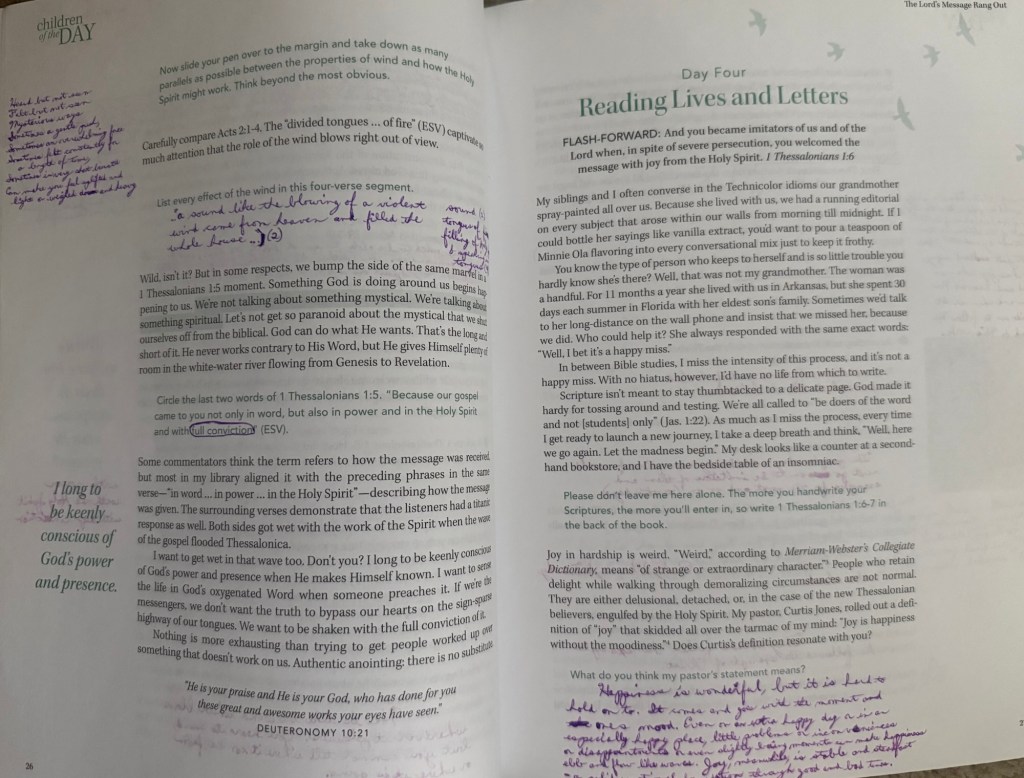

What do you think my pastor’s statement means?
“Happiness is wonderful, but it is hard to hold onto. It comes and goes with the moment and one’s mood. Even on an extra happy day or in an especially happy place, little problems or inconveniences or disappointments or even slightly boring moments can make happiness ebb and flow like waves. Joy, meanwhile, is stable and steadfast – a solid emotional foundation through good and bad times.”
We need a sustainable quality that shows who we really are, and to whom we belong. This side of heaven, happiness doesn’t qualify. Biblical joy does. 
Do you embrace or struggle with the fact that our God is filled with joy? Why?
“I embrace that. There’s plenty in this world to grieve Him terribly: rejection of His love, (all sin), horrible mistreatment of His children by others and sometimes by each other; but He’s not just sad and angry, He also has joy when we get saved and become His children, and when we let Him guide us to follow His will and do His work.”
According to 1 Thessalonians 1:6-7, the Thessalonian believers became what two things?
“imitators of them, and of the Lord
“a model to all the believers.”
Those two became make a great pair, but the parts they play are beautifully distinct. Can you think of a tie between an ‘imitator’ and an ‘example’ (NIV, ‘model’)?
“The people they were being examples for would next go on to be imitators of them and examples for the next and so on (to this day).”
Who exactly did the Thessalonians imitate? “Paul, Sylvanus, and Timothy” and “the Lord”.
Paul hung the safety net securely under the precarious prospect of following any mortal man. What did he say about following him in 1 Corinthians 11:1?
“They should follow his example as he followed the example of Christ.”
What kind of people does Hebrews 6:11-12 exhort us to imitate?
“‘those who through faith and patience inherit what has been promised’”
If we decide not to opt out in fear or cave to constant self comfort, others following below us may see how we imitate lives of great faith.
One of the most fascinating occurrences of the word [túpos] appears in John 20:25. What did Thomas claim? Please copy it word for word.
“‘Unless I see the nail marks in His hands and put my finger where the nails were, and put my hand into His side, I will not believe it.’ (NSV)”
✮ My mark was left on Him that day too, and so is yours, with every pounding of a nail. We have indelibly marked one another.
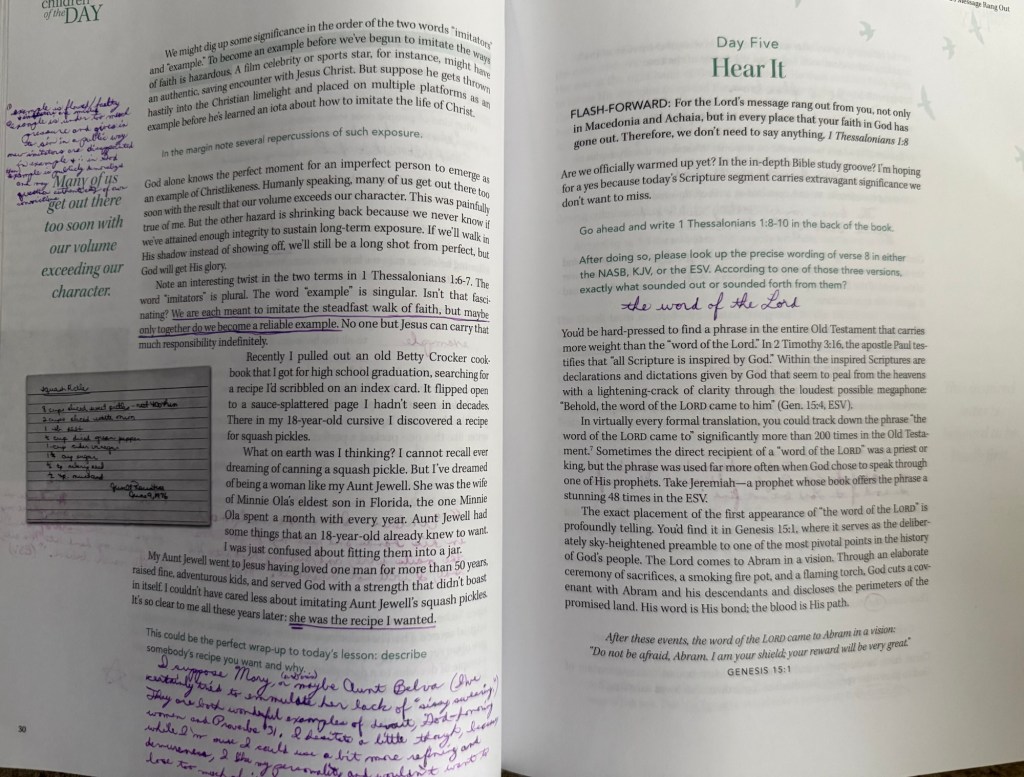
…Note several repercussions of such exposure.
“1. example is flawed/faulty and imitators are misled
“2. example is under too much pressure and gives in to sin in a public way. New imitators are disappointed in example, and therefore in God, then example is public publicly demoralized and may question authenticity of own convictions”
We are each meant to imitate the steadfast walk of faith, but maybe only together do we become a reliable example.
I couldn’t have cared less about imitating aunt Jewell’s squash pickles. It’s so clear to me all these years later: she was the recipe I wanted.
This could be the perfect wrap up to today’s lesson: demonstrate describe somebody’s recipe you want and why.
“I suppose Mary (or Doris) or maybe aunt Belva (I’ve certainly tried to emulate her lack of ‘sissy swearing’). They are both wonderful examples of devout, God-fearing women and Proverbs 31. I hesitate a little though, because while I’m sure I could use a bit more refining and demureness, I like my personality and wouldn’t want to lose too much of it.”
Dearest Rachel –
In my life, I’ve heard this interpretation of the difference between what we refer to as ‘happiness’ and ‘joy,’ as well as the theory that they are essentially synonymous; where we can choose to be happy just as we can choose to be joyful, in particular. And while I agree with the latter proposition to an extent – we can control how we react to any given situation, at least over the long term (although in the instant something happens to us, whether good or bad, we will react instinctively in a certain way) – I think it’s more useful to keep the distinction between one’s emotion and one’s mindset, so we might as well maintain the difference between the two words. Otherwise, why have the other word in the first place?
But most of this lesson has to do with imitating others as a means to imitate Christ. It can be difficult to act in the manner of a particular Person if you’ve never seen Him in the flesh, and how He might react to a given situation – so many people claim that He would act this way or that, often reaching diametrically opposite conclusions – but you can watch those that follow Him in righteousness, see how they respond to circumstances, and do likewise yourself.
Now, the real question that remains is the one you pose at the end of the lesson; the fact that you had two or three examples of what the Christian life should be, as modeled by three different women in the family you were grafted into. And while you recognized their value as such, you were concerned that in following their examples, you might lose certain aspects of your own personality. You mention a need to be more ‘refined’ and ‘demure’ in particular (although I don’t of Aunt Belva in those terms, myself, especially the latter; although perhaps in comparison to your mother and grandmother, that would be the case), but feared that this would knock too many corners off of a persona that you’d cultivated and grown fond of. having.
While I don’t have a proper answer to the question you posed, I would note that while we are called ‘blessed’ to be ‘meek,’ we’re also called to be ‘bold’ in certain situations, as well, which would seem to be contradictory. I think it’s up to us to interpret when to be which. I would add that make of your notes suggest that you knew perfectly well when to be self-effacing; perhaps not as much as you could have been, but more than sufficient when the situation called for it. You never saw yourself as being ‘above’ a certain task, for instance.
As for sanding off the flaws in your personality that you didn’t want to lose, I’d point out that at this point in time, those have been stripped from you whether you wanted them gone or not, and I doubt that you miss them. At the same time, it’s quite possible that there are some aspects of your self that you may have been surprised to have kept, and others you didn’t expect to lose. The real problem is that you got your final answer the same way we all do (or rather, will); after you could do anything about it here.
I do wonder how different you will be from the Rachel I knew when I meet you again; then again, I wonder how different the Rachel that I still recall is from both who you were and who I can expect to be reunited with. Until then, though, continue to keep an eye on me, honey, and wish me well. I’m going to need it.


