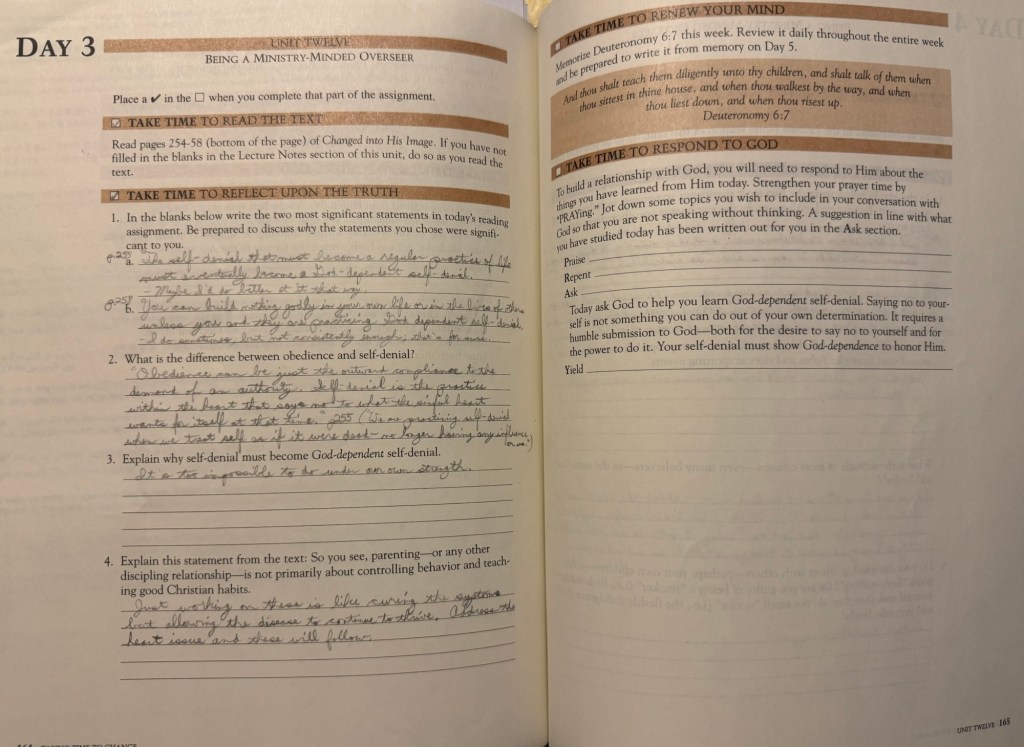
In the blanks below write the two most significant statements in today’s reading assignment. Be prepared to discuss why the statements you chose were significant to you.
“The self-denial that must become a regular practice of life must eventually become a God-dependent self-denial. – maybe I’d do better at it that way.
“You can build nothing godly in your own life or in the lives of others unless you and they are practicing God-dependent self-denial – I do sometimes, but not consistently enough; that’s for sure.”
What’s the difference between obedience and self-denial?
“‘Obedience can be just the outward compliance to the demand of an authority. Self-denial is the practice within the heart that says no to what the sinful heart wants for itself at that time.’ p255. (‘We are practicing self denial when we treat self as if it were dead – no longer having any influence on us.’)”
Explain why self-denial must become God-dependent self-denial.
“It’s too impossible to do under our own strength.”
Explain this statement from the text: So you see, parenting – or any other discipling relationship – is not primarily about controlling behavior and teaching good Christian habits.
“Just working on these is like curing the symptoms, but allowing the disease to continue to thrive. Address the heart issue and these will follow.”
Dearest Rachel –
This particular day’s work of yours is rather quote-heavy; there’s very little in here that’s in your voice, as such. It happens; there are days where there isn’t all that much to add to a question aside from what you’ve read or heard in preparation for the class.
It’s interesting that I would be examining this work just as I’m about to take off on a ministry of my own (well, not my own, exactly, as it’s someone else’s organization, but the contribution I make to it to it is uniquely mine), especially since this passage talks about self-denial, and the need to depend on God to effect that self-denial. Like your own comments indicate, I’m not particularly good at denying myself what I want; I’m not even constrained by your presence and own desires to redirect the resources I have to more worthy purposes than mere gratification.
To be sure, this trip isn’t particularly gratifying, at least on a personal level; it’s meant to fill a need that, for now, only I can fill, with regard to expertise in finances and record keeping. Even then, I’m only an expert by comparison; I’ve spent years being reminded of my own inadequacies by Mohinder as to call into question any value I might bring to the table. But hopefully I can pass on what knowledge I have to those who are willing to learn from me, as it’s certainly better than nothing.
Like you, though, I’m not sure if this isn’t a case of mere obedience (this being something I ‘have’ to do) as opposed to true God-dependent self-denial (where I’m doing this – and more to the point, wanting to do it – because He wants me there). It’s the wanting where I’m pretty sure I fall short, just as you claimed that you didn’t practice that sort of self-denial consistently enough. Never mind that you volunteered to babysit so that other women could go to one Bible study or another, or that you cultivated friendships with people that most folks would have given up on long before; even you considered that you might be doing so out of a sense of duty as opposed to a God-focused desire.
Both of us have struggled with “fake it ‘til you make it” Christianity throughout our lives, always aware that, no matter how much we try, we can never get to the point where we’ve “made it” on this side of the veil. Moreover, we were both keenly aware that even if we were to “make it,” at any point, our hold on the pinnacle could and would be fleeting; we can’t make it on our own, and we’re not always aware of God’s hand guiding us in the direction He wants us to go. At the same time, one could be forgiven for arguing that doing is at least preferable to not doing, and there isn’t a question that, while you treasured your leisure time (as do I), when called to do something, you would do it. I am sure, despite not having been there when you were welcomed in, you heard His voice greeting you as the “good and faithful servant” you were, honey.
It’s true that controlling behavior and teaching good habits address the symptoms rather than the heart issue at the root of everything, but sometimes the plant needs to be gotten rid of before digging into the roots. Moreover, once the root is addressed, the behavior and habits that are to be built on the new, sturdy foundation still need to be taught. So there’s nothing wrong with working on them; it’s just that they can’t be the primary focus.
In any event, it’s another case where I do wish we had more answers on this side than on yours, where they’re effectively moot, and no longer able to be acted upon.
Regardless, though, please keep an eye on me, honey, and wish me well; I’m going to need it.

 Letters to Rachel