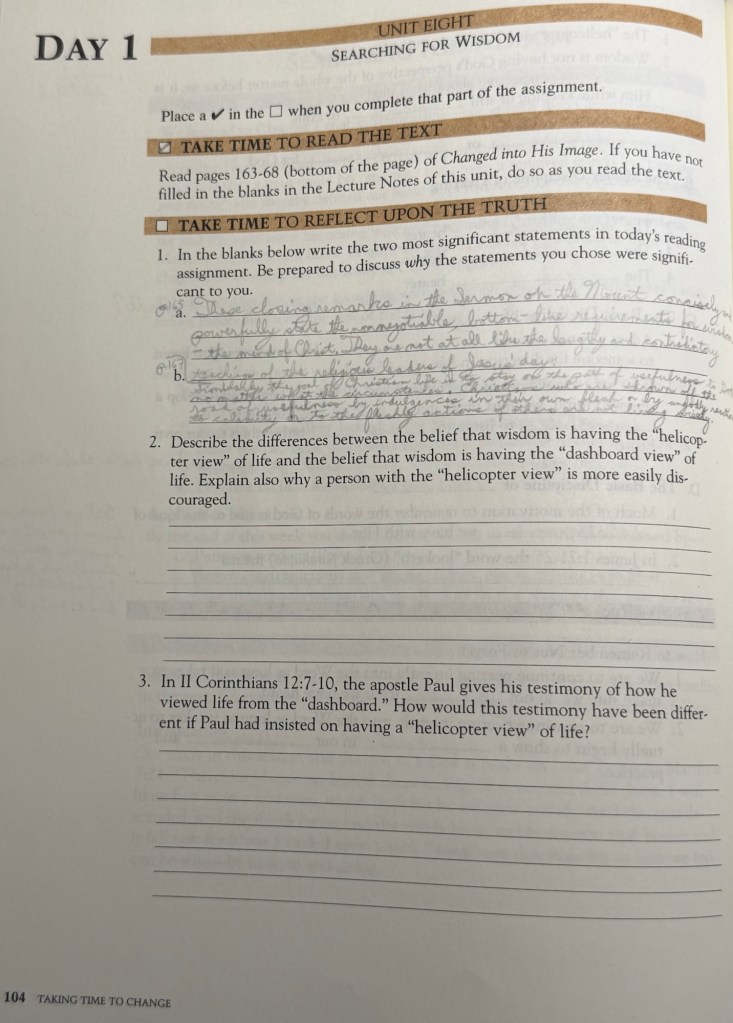
In the blanks below, write the two most significant statements in today’s reading assignment. Be prepared to discuss why the statements you chose were significant to you.
“These closing remarks in the Sermon on the Mount concisely and powerfully state the non-negotiable, bottom-line requirements for wisdom – the mind of Christ. They are not at all like the lengthy and contradictory teachings of the religious leaders of Jesus day.
“Similarly, the goal of Christian life is to stay on the path of usefulness to God, no matter what the circumstances. Christians who are thrown off of the road of usefulness by indulgence in their own flesh or by ungodly reactions to calamity or to the fleshly actions of others are not living wisely.”
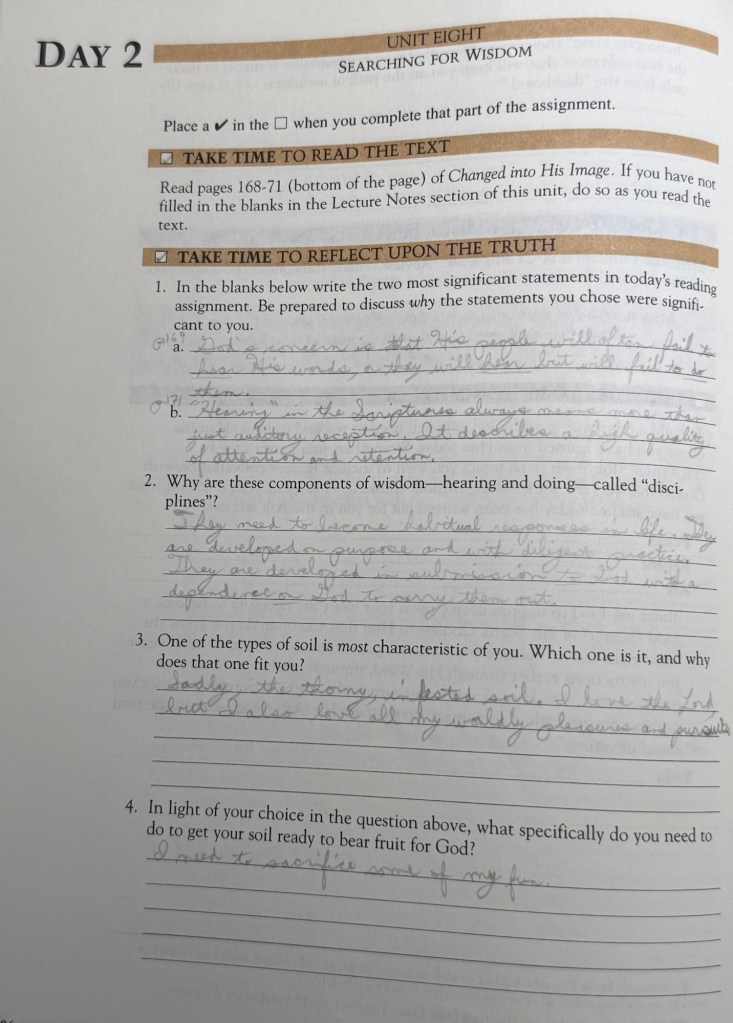
In the blanks below, write the two most significant statements in today’s reading assignment. Be prepared to discuss why the statements you chose were significant to you.
“God’s concern is that his people will often fail to hear his words, or they will hear, but will fail to do them.
“‘Hearing’ in the scriptures always means more than just auditory reception. It describes a high quality of attention and retention.”
Why are these components of wisdom – hearing and doing – called ‘disciplines’?
“They need to become habitual responses in life. They are developed on purpose and with diligent practice. They are developed in submission to God with a dependence on God to carry them out.”
One of the types of soil is most characteristic of you. Which one is it, and why does that one fit you?
“Sadly, the thorny, infested soil. I love the Lord, but I also love all my worldly pleasures and pursuits.”
In light of your choice in the question above, what specifically do you need to do to get your soil ready to bear fruit for God?
“I need to sacrifice some of my fun.”
Dearest Rachel –
There’s a certain irony in going over this series of questions and answers while on a cruise ship – and just after I sent you a letter telling you about the responsibilities, both internal and external, that keep me from feeling fully relaxed from day to day. I’m both putting enjoyment ahead of my service to Christ and having my walk and growth drowned out by “the cares of this world” at the same time. Clearly, I don’t have to work at ascertaining which soil I am, either, and it’s not the one with the “good seed,” now, is it?
Then again, I’d be willing to bet good money that either one or both of these conditions describe most Americans – in fact, most Westerners. We are far too wrapped up in our material concerns, no matter where we stand on the socioeconomic scale. Agur described the extremes over a millennium before Christ when he asked to be neither rich nor poor, but to have just enough for any given day:
If I ·have too much [am sated/satisfied], I might ·reject [deny] you
Proverbs 30:9, Expanded Bible
and say, ‘·I don’t know the Lord [L Who is the Lord?]’
If I am poor, I might steal
and ·disgrace [profane] the name of my God.
It’s why, elsewhere in the Sermon on the Mount, Christ talks about the birds and the flowers, and the fact that they don’t concern themselves with anything they need, because it is provided for them (of course, the birds in particular still have to go and get it – and I’ve often noted that, while one cannot fall to the ground without the Lord’s notice, He still will let them fall; He doesn’t always rescue them, which becomes a concern to us, because who will come to our rescue, if not Him?). Likewise, He also puts in a line about “daily bread” in His model prayer; we’re not to ask for more than that at any time. If nothing else, a lifetime’s supply would simply go stale or get moldy.
We know all this, of course. At yet, we still concern ourselves with the things of this world, because, for all that we believe a new and better world is coming (I mean, there has to be something better than this one, doesn’t there? A perfect God wouldn’t settle for a place like this), we can’t picture it; this is the only world we know and can relate to. As a result, we can’t grow, since our roots are tied up among the thorns and thistles that make of this life. Some of them might even be pretty – remember, a rose in a wheat field would still be considered a weed, since it’s not what’s supposed to be there – but if it’s interfering with what is supposed to be there, it’s of neither use nor value, in the long run.
Like you, I wish I could do something about it… although I do have moments where, like young Augustine, I find myself adding “…but not yet.” Which is probably also like you, now that I think about it – and how we got along so well together, because, for better or for worse, we had the same attitude about things (if not always the same exact things). But if I ever figure out how to get past the attitude of “not yet,” I will have achieved the wisdom this passage was searching for.
To that end, honey, I’ll ask you, as always, to keep an eye on me, and to wish me well, as I’m going to need it.


