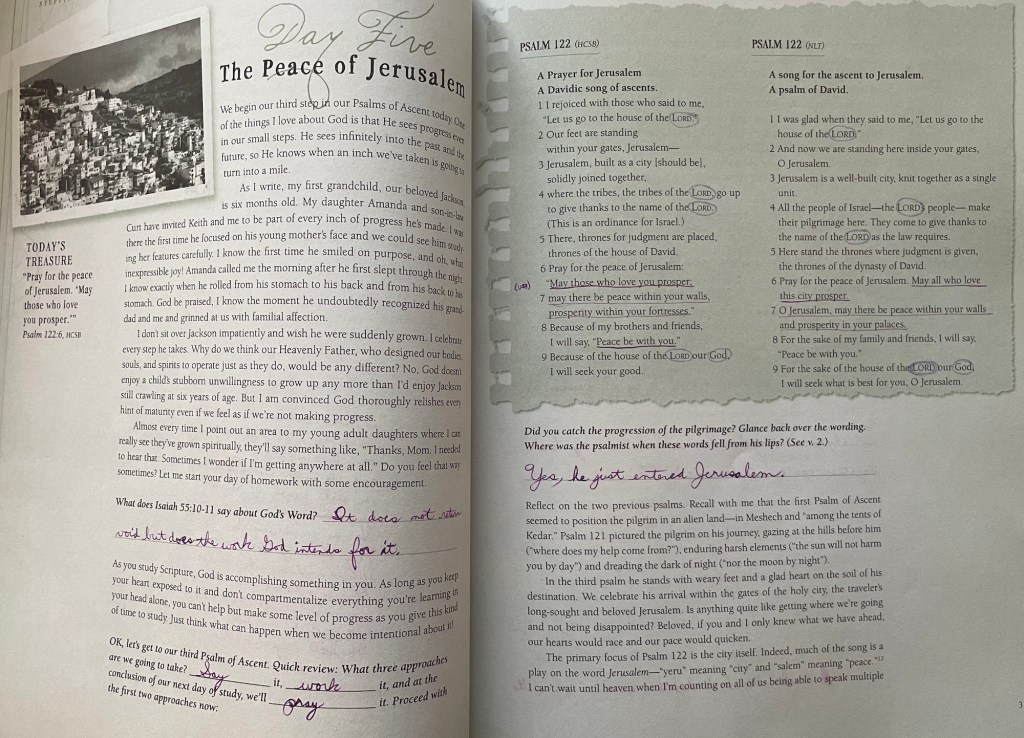
What does Isaiah 55:10-11 say about God’s Word?
“It does not return void, but does the work God intends for it.”
OK, let’s get to our third Psalm of Ascent. Quick review: what three approaches are we going to take? “Say” it, “work” it, and at the conclusion of our next day of study, we’ll “pray” it.
May those who love you prosper; “(USA)” May there be peace within your walls, prosperity within your fortresses.
Because of my brothers and friends, I will say ‘Peace be with you.’
Did you catch the progression of the pilgrimage? Glance back over the wording. Where was the palmist when these words fell from his lips? (See v. 2.)
“Yes, he just entered Jerusalem.”
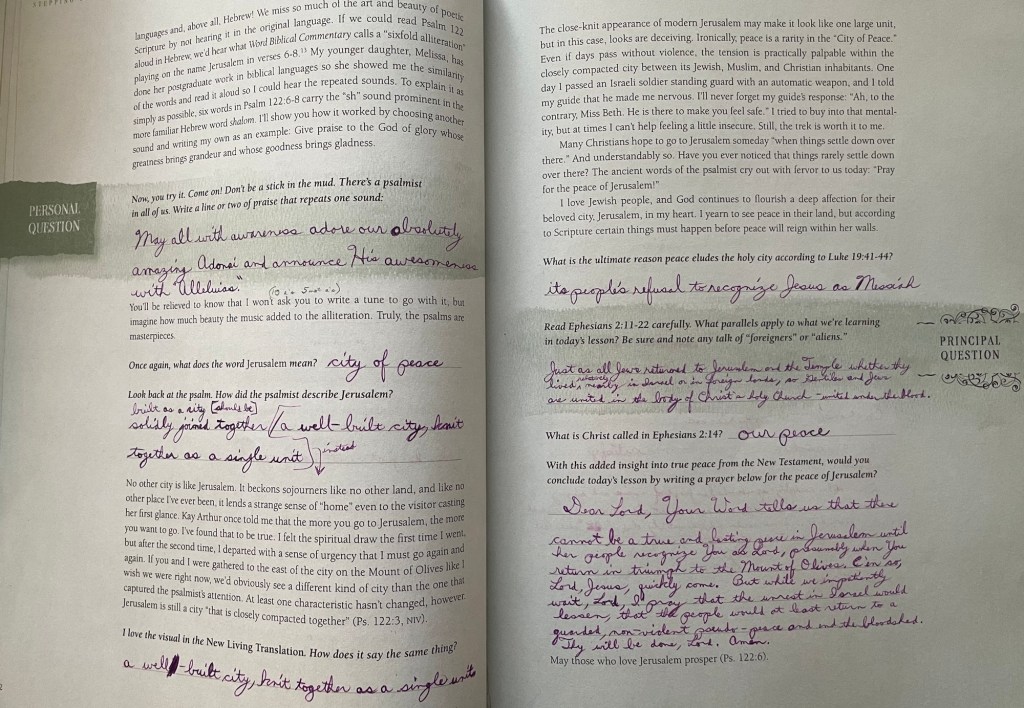
Now, you try it. Come on! Don’t be a stick in the mud. There’s a psalmist in all of us. Write a line or two of praise that repeats one sound:
“May all with awareness adore our absolutely amazing Adonai and announce his awesomeness with ‘Alleluias.’ (10 ‘a’s, five not ‘a’s)”
Once again, what does the word Jerusalem mean? “city of peace”
Look back at the psalm. How did the psalmist describe Jerusalem?
Built as a city [should be] solidly joined together
I love the visual in the new living translation. How does it say the same thing [as ‘closely compacted together’]?
“a well-built city, knit together as a single unit.”
What is the ultimate reason peace eludes the holy city according to Luke 19:41-44?
“its people’s refusal to recognize Jesus as Messiah”
Read Ephesians 2:11-22 carefully. What parallels apply to what we are learning in today’s lesson? Be sure and note any talk of ‘foreigners’ or ‘aliens.’
“Just as all Jews returned to Jerusalem and the temple, whether they lived relatively nearby in Israel or in foreign lands, so Gentiles and Jews are united in the body of Christ’s holy Church – united under the blood.”
What is Christ called in Ephesians 2:14? “our peace”
With this added insight into true peace from the New Testament, would you conclude today’s lesson by writing a prayer below for the peace of Jerusalem?
“Dear Lord, Your Word tells us that there cannot be a true and lasting peace in Jerusalem until her people recognize You as Lord, presumably, when You return in triumph to the Mount of Olives. E’en so, Lord, Jesus, quickly come. But while we impatiently wait, Lord, I pray that the unrest in Israel would lessen, that the people would at least return to a guarded, non-violent, pseudo-peace, and end the bloodshed. Thy will be done, Lord. Amen.”
Dearest Rachel –
Given that you did this study perhaps fifteen years ago or so, I suppose it’s only natural that you would have noted that the U.S. might be counted among those who love Israel and Jerusalem. Certainly, we were instrumental in helping set up the Jewish homeland as a nation-state in the wake of WWII, and we have had close ties with them ever since, despite the nation being surrounded by a host of countries that, if they didn’t outright say that wanted it destroyed, certainly saw it as a threat, despite its relatively small size and population – countries to whom we were beholden to for our energy needs. These were people that literally had us ‘over a barrel,’ and yet we continued to support Israel, both as the sole democracy in the region, and with the Judeo-Christian heritage we shared (that also, in the back of some people’s minds, may have suggested that those who bless Abraham’s children will find blessing from Abraham’s God).
These days, it doesn’t seem so much so, honey. Your prayer doesn’t seem to have been answered in the slightest, to be honest. Although, perhaps it could be questioned as to whether a ‘pseudo-peace,’ as you put it, is any peace at all. Perhaps it is better that one’s enemies scream their presence (all the better to be identified and singled out) than that they should perpetually hide in plain sight. The final one of the Ten Commandments, the one that Jesus effectively amplified in His Sermon on the Mount, was a condemnation of desires not otherwise acted upon; a state of pseudo-peace would have these enemies of Israel constantly violating this commandment without anyone knowing (not that, to be sure, they hew to any of the others; although they might in theory agree in the soundness of the list, just as nearly every allegedly ‘moral’ civilization would. The word taquiyyah comes to mind, however, just as an example). Better the open opposition than a silent betrayal.
But what open opposition seems to be going on, honey! I know that politics was not something you dwelled on much, but this would probably not be something you would have ignored. It doesn’t help that some of it is almost too close for comfort; there is, after all, an enormous college campus barely twenty miles east that has been roiling with it, and it’s not alone by any means. In fact, it’s one of the tamer ones, in comparison to what’s been happening on either coast.
There’s probably a thought that things would settle if Jesus Himself would return, and sort out the sheep and the goats – and I suspect there are going to be a lot of goats who will try to claim that “I identify as a sheep” and aren’t going to be able to get away with it.
I wonder where that line between sheep and goat is… is it outright opposition? Is it silent envy? Is it a refusal to get involved? It kind of matters, doesn’t it?
I’m glad this wasn’t an issue that you would have to wrestle with, honey, but I hope that you would keep an eye on me and Daniel as we have to. Oh, and wish us luck – we’re going to need it.


