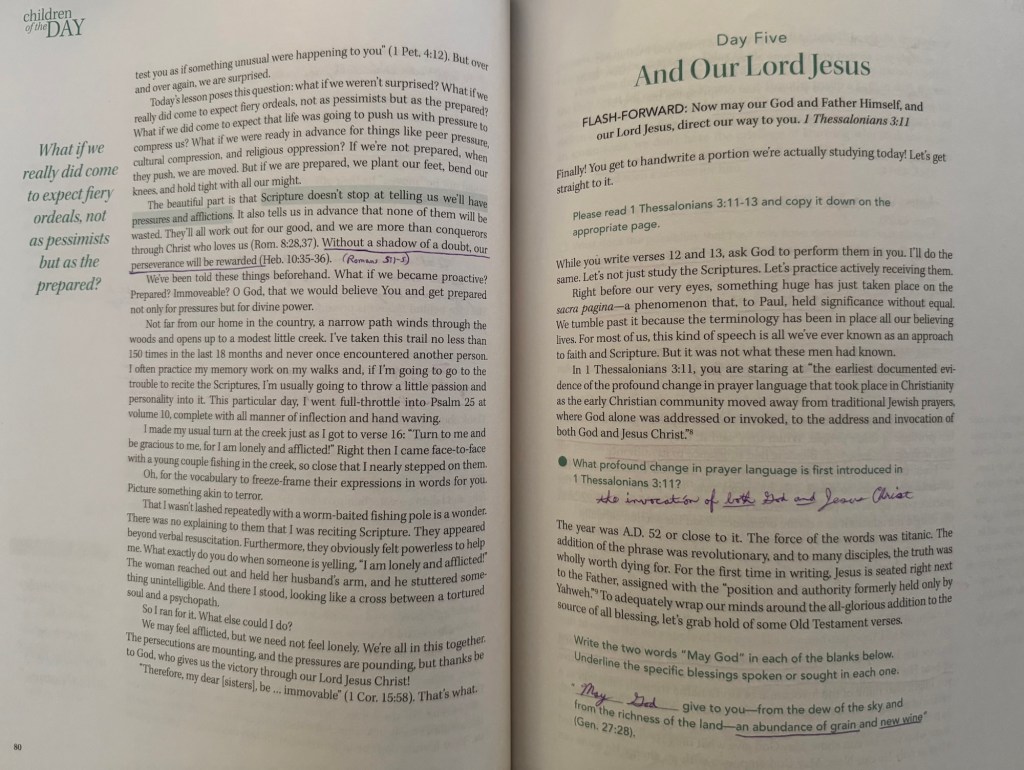
What profound change in prayer language is first introduced in 1 Thessalonians 3:11?
“the invocation of both God and Jesus Christ”
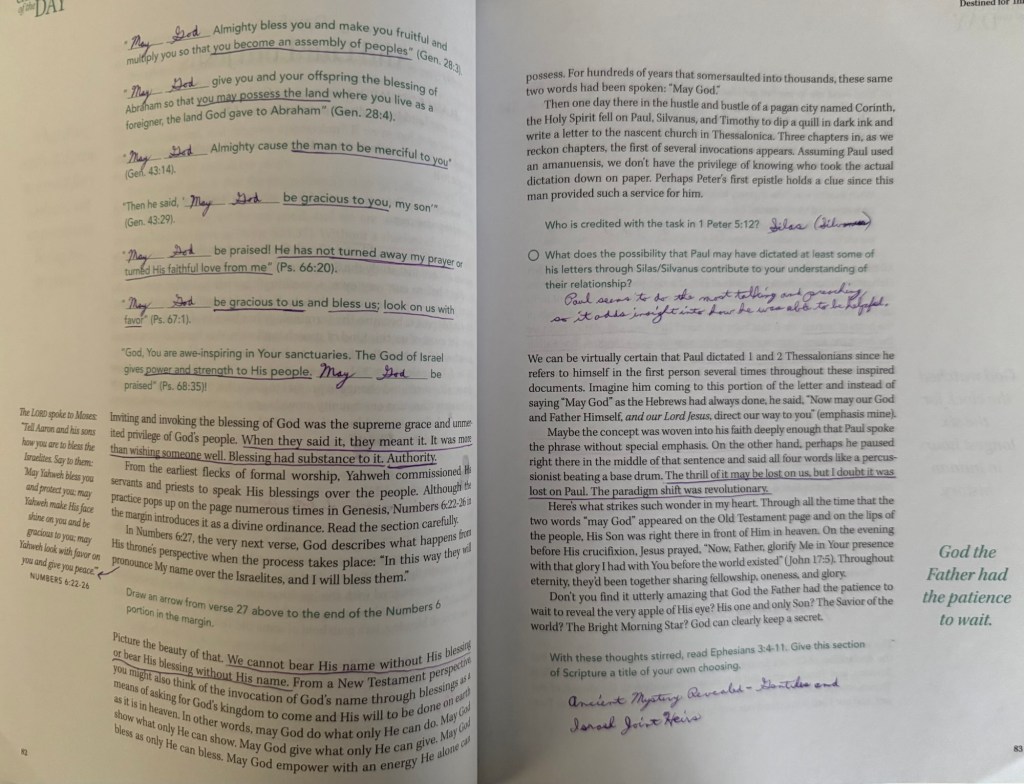
Write the two words ‘May God’ in each of the blanks below. Underline the specific blessings spoken or sought in each one.
● ‘“May God” give to you – from the dew of the sky and from the riches of the land – an abundance of grain and new wine.’ (Genesis 27:28)
● ‘“May God” Almighty bless you and make you fruitful and multiply you so that you become an assembly of peoples.’ (Genesis 28:3)
● ‘“May God” give you and your offspring the blessing of Abraham so that you may possess the land where you live as a foreigner, the land God gave to Abraham.’ (Genesis 28:4)
● ‘“May God” Almighty cause the man to be merciful to you.’ (Genesis 43:14)
● Then he said, ‘“May God” be gracious to you, my son.’ (Genesis 43:29)
● “May God” be praised! He has not turned away my prayer or turned his faithful love from me. (Psalm 66:20)
● “May God” be gracious to us and bless us; look on us with favor. (Psalm 67:1)
● God, you are awe-inspiring in your sanctuaries. The God of Israel gives power and strength to His people. “May God” be praised! (Psalm 68:35)
Inviting and invoking the blessing of God was the supreme grace and unmerited privilege of God’s people. When they said it, they meant it. It was more than wishing someone well. Blessing had a substance to it. Authority.
Picture the beauty of that. We cannot bear His name without His blessing or bear His blessing without His name.
Who is credited with the task [of the amanunesis/stenographer] in 1 Peter 5:12?
“Silas (Sylvanus)”
What does the possibility that Paul might have dictated at least some of his letters through Silas/Sylvanus contribute to your understanding of their relationship?
“Paul seems to do the most talking and preaching, so it adds insight into how he was able to be helpful.”
The thrill of [adding the phrase and our Lord Jesus] may be lost on us, but I doubt it was lost on Paul. The paradigm shift was revolutionary.
With these thoughts stirred, read Ephesians 3:4-11. Give this section of scripture a title of your own choosing.
“Ancient Mystery Revealed – Gentiles and Israel Joint Heirs”
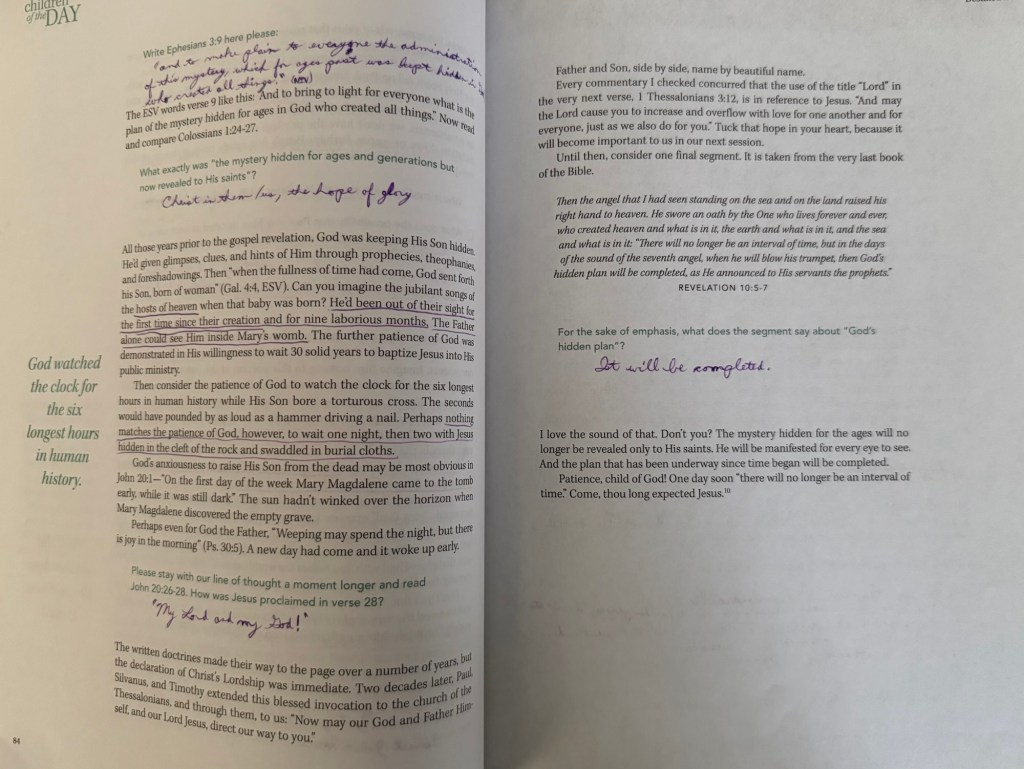
Write Ephesians 3:9 here, please:
“‘and to make plain to everyone the administration of this mystery, which for ages past was kept hidden in God, who creates all things’ (NIV)”
What exactly was the mystery hidden for ages and generations but now revealed to his saints?
“Christ in them/us, the hope of glory.”
Can you imagine the jubilant songs of the hosts of heaven when that baby was born? He’d been out of their sight for the first time since their creation and for nine laborious months. The Father alone could see him inside Mary’s womb.
Perhaps nothing matches the patience of God, however, to wait one night, then two with Jesus, hidden in the cleft of the rock and swaddled in burial cloths.
Please stay with our line of thought a moment longer and read John 20:26-28. How is Jesus proclaimed in verse 28?
“‘My Lord and my God!’”
For the sake of emphasis, what does the segment say about God‘s hidden plan?
“It will be completed.”
Dearest Rachel –
This has got to be one of the latest entries, in terms of your own personal responses, that I’ve seen in a very long time. I suppose it has to do with being the last one in a given week, one in which you were probably rushing to finish so as to complete it before your class. I don’t know that for sure, obviously, but I can surmise from what I recall of how you operated with this; more than once would I find you on the bed, poring over your workbook, either when I came home from the office or while we were watching stuff in the bedroom. There’s no shame in it; the fact that you continued to fill it out is to your credit (I’ve said before that today’s sort of work is what I would have done myself). But I do know you would run out of energy when you got to the last part from time to time. It is how it is.
Was. Whatever.
To be fair, there are a lot of blanks to fill in, and little in the way of questions to provoke the marginalia that I’ve always been overjoyed to find. Even the underlined sections, which would give indication of certain passages you would, unprompted, consider worth emphasizing, are in at least the opening section, part of the instructions, so that’s not exclusively ‘yours’ this time around as a result.
Then again, you still took a moment to underline sections talking about the perspective of heaven during the most critical (and yet overlooked) periods of theological history; the gestation and entombment of Jesus, when He was out of sight of (if not the Father Himself, who is everywhere and can see everything) the heavenly host. It’s probably overlooked in part because we can’t imagine, from our point of view, what the angels might have thought was going on, so more often than not, we don’t bother to try. That, or we give them human thoughts and emotions, which are as alien to them as they and theirs are to us.
Ironically, you’re now in a situation where, one might think, you could ask them directly, as they are effectively peers of yours. But that does us down here little good, as whatever you might learn from them – as opposed to what you might be able to teach them, since concepts like ‘grace’ and ‘mercy’ were never part of their personal experience – can’t be relayed back to us on earth. Some things, I suppose, we will have to experience for ourselves in order for it to make any sense; like with the difference between a photograph and the actual scene it records. And when we do, it will probably be more wonderful than any clickbait headline can make it sound.


