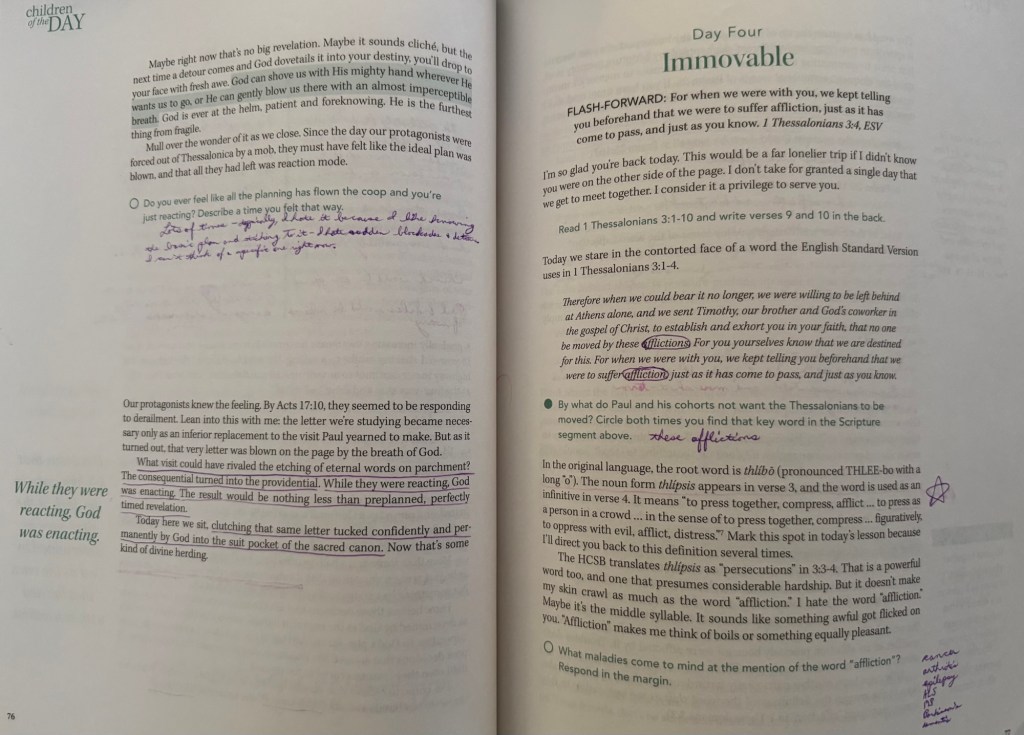
By what do Paul and his cohorts not want the Thessalonians to be moved? “these afflictions”
⛥ In the original language the root word is thlíbō. The noun form thlípsis appears in verse 3, and the word is used as an infinitive in verse 4. It means ‘to press together, compress, afflict… to press as a person in a crowd… in the sense of to press together, compress… figuratively to oppress with evil, afflict, distress.’
What maladies come to mind at the mention of the word affliction?
“cancer
“arthritis
“epilepsy
“ALS
“MS
“Parkinson’s
“dementia”
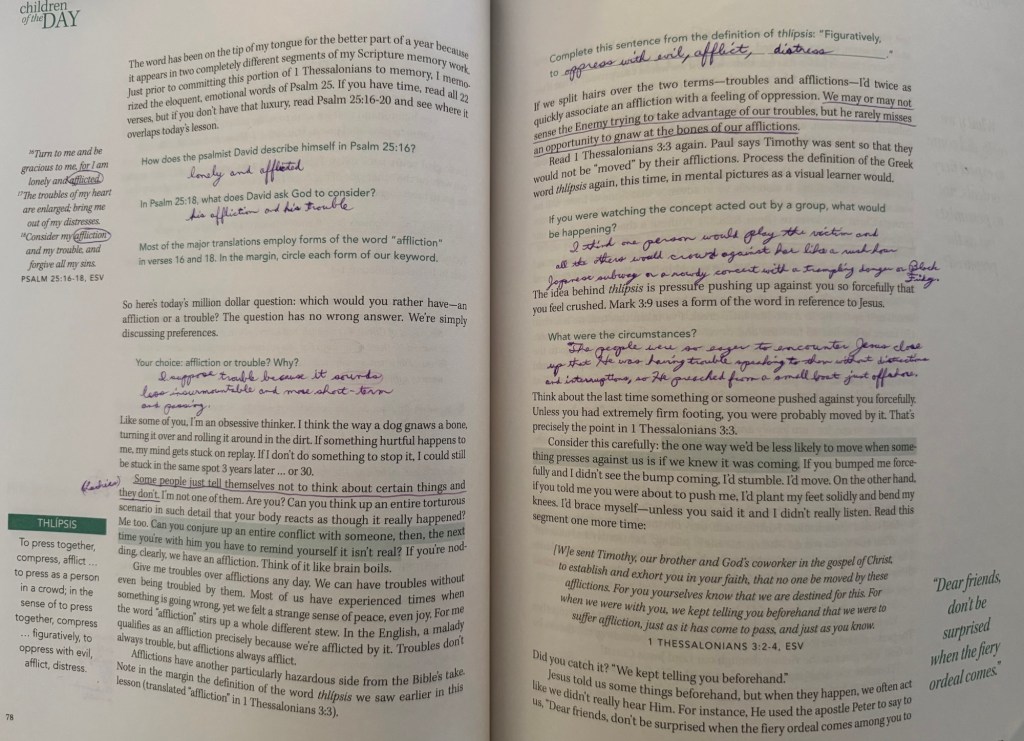
How does the psalmist David describe himself in Psalm 25:16? “lonely and afflicted”
In Psalm 25:18, what does David ask God to consider? “his affliction and his trouble”
So here’s today’s million dollar question: which would you rather have – an affliction or a trouble?
“I suppose trouble because it sounds less insurmountable and more short term in passing.”
Some people just tell themselves not to think about certain things and they don’t. “(Ladies)”? or “(Luckies)”?
Complete this sentence from the definition of thlípsis: Figuratively, “to oppress with evil, afflict, distress”
We may or may not sense the Enemy trying to take advantage of our troubles, but he rarely misses an opportunity to gnaw at the bones of our afflictions.
If you were watching the concept acted out by a group, what would be happening?
“I think one person would play the victim and all the others would crowd against her like a rush hour Japanese subway or a rowdy concert with a trampling danger or Black Friday.”
Mark 3: 9 uses a form of the word in reference to Jesus. What were the circumstances?
“The people were so eager to encounter Jesus close up that He was having trouble speaking to them without distractions and interruptions, so He preached from a small boat just offshore.”
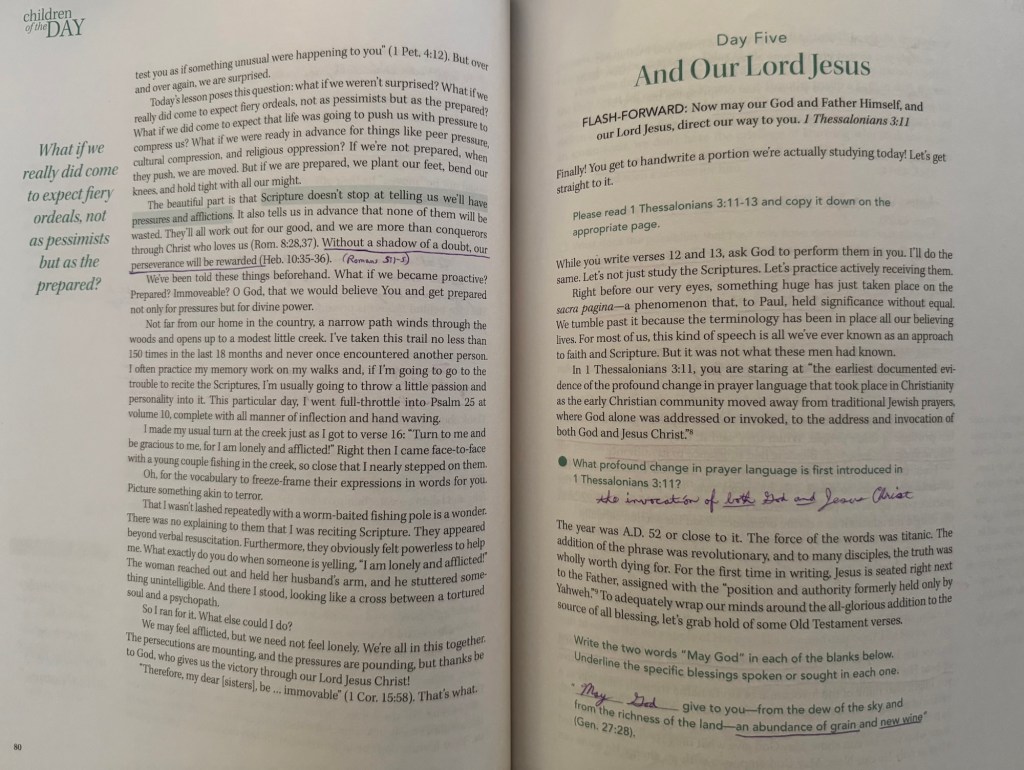
Without a shadow of a doubt, our perseverance will be rewarded. “(Romans 5: 1-5)”
Dearest Rachel –
It’s difficult to think about ‘trouble’ as we’re winding up a vacation trip like this. Then again, there are certain specifics about this past week that I don’t go into because of how certain people who might read this over your shoulder would react to the group we were down here with. I’ve said it before, but politics is a blood sport, and it’s not something I would prefer to bleed over; there are more important hills to die on, if die one has to (and of course, we all eventually will).
And before that comes to pass (for most of us), there are the maladies you list that you associated with the concept of ‘affliction.’ I’d say it was interesting to note – but in fact, it makes perfect sense – that each of these were ailments that you had personal, if generally secondhand familiarity with. Be it the one that your folks’ struggled with as they aged, or various illnesses that Ellen, Dana and Tom (in particular) fought or continue to fight to this day, these were battles you personally witnessed people waging at the time you wrote this down, so you knew just how hard those fights could be.
Even so, you mentioned preferring the term ‘trouble’ to ‘affliction,’ since that word suggested difficulties that wouldn’t last so long as all that. But from this vantage point, there’s a realization that even a lifetime of dealing with one thing or another is still temporary – just on a larger, more cosmic scale that the human one we’re confined to.
On the other side of the coin, for all that list contained, it would seem that it didn’t occur to you to list any afflictions you had dealt with, whether temporary in human terms or cosmic ones. This would include everything associated with the tumor that had been on your brain (I hesitate to call it a “brain tumor,” as such, since it was on the outside of it rather than within, but it did need to be excised, and after that, checked regularly to ensure that it was neither returning nor growing), which I know had taken place before you went through this study.
But that’s how afflictions and troubles can be, once they’ve been lived through; they don’t seem like they were all that bad, especially when they’ve been survived.
Or maybe you just see what other people have or had, and think “they’ve had it so much worse than I have; I shouldn’t complain about mine.” A commendable attitude to have – and one that more people ought to, to be sure – but it’s almost funny how you downplay your own sufferings, such as they were, in comparison. You went through things – including the loss of both your parents (which I have yet to endure), along with the uncertainty of their eternal state (which I will never have to) – and yet you made it through with minimal complaint. Certainly nothing that shows up here.
It may press for a time, but ultimately, the weight is lifted, and when the crowd clears, we can see Jesus through it all. Here’s to that day – one that has come for you, and you experience it daily; and one that I can only wait and hope for, for now.


