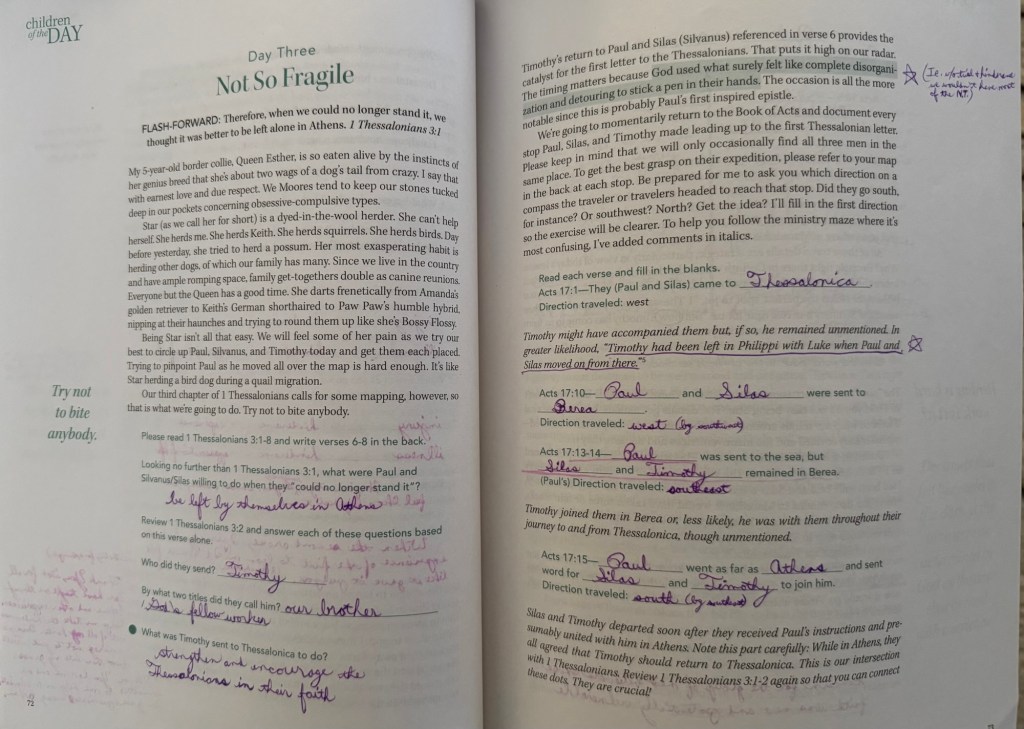
Looking no further than 1 Thessalonians 3:1, what were Paul and Silvanus/Silas willing to do when they ‘could no longer stand it’?
“be left by themselves in Athens”
Review 1 Thessalonians 3:2 and answer each of these questions based on this verse alone.
Who did they send? “Timothy”
By what two titles did they call him? “Our brother / God’s fellow worker”
What was Timothy sent to Thessalonica to do?
“strengthen and encourage the Thessalonians in their faith”
⛥ God used what surely felt like complete disorganization and detouring to stick a pen in their hands. “(i.e., without trial and hindrance we wouldn’t have most of the New Testament)”
Timothy might have accompanied them but if so he remained unmentioned. In greater likelihood, ‘Timothy had been left in Philippi with Luke when Paul and Silas moved on from there.’
Read each verse and fill in the blanks.
Acts 17:1 they (Paul and Silas) came to “Thessalonica”.
Direction traveled: west
Acts 17:10 “Paul” and “Silas” were sent to “Berea”
Direction traveled: “west (by southwest)”
Acts 17:13-14 “Paul” was sent to the sea but “Silas” and “Timothy” remained in Berea.
(Paul’s) direction traveled: “southeast”
Acts 17:15 “Paul” went as far as “Athens” and sent word for “Silas” and “Timothy” to join him.
Direction traveled: “south (by southeast)”
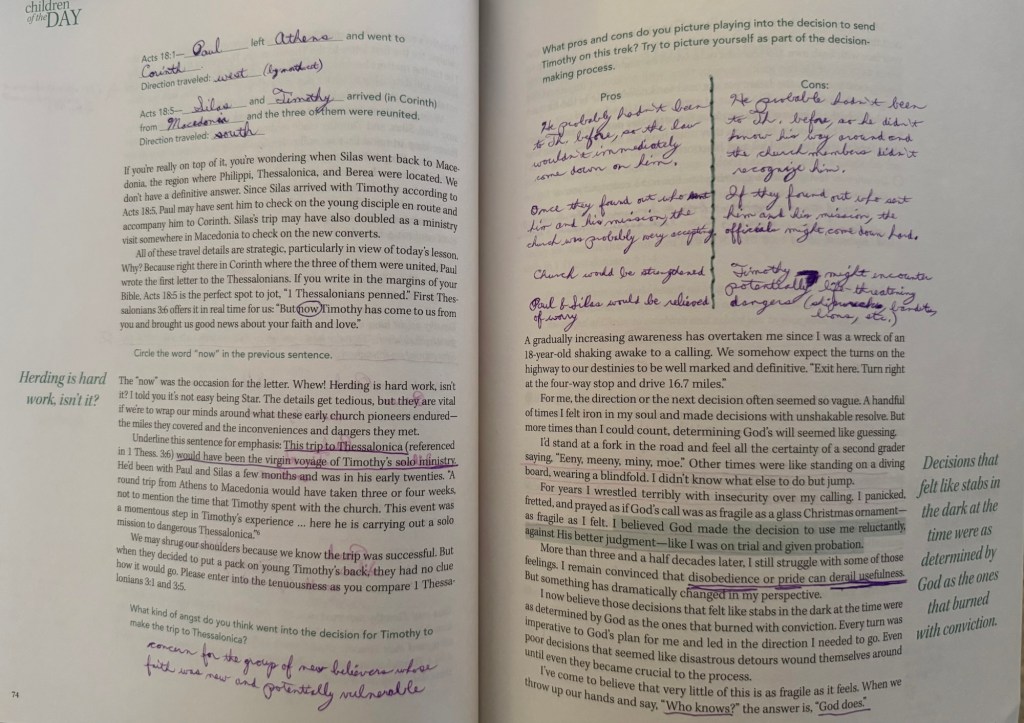
Acts 18:1 “Paul” left “Athens” and went to “Corinth”.
Direction traveled: “West (by northwest)”
Acts 18:5 “Silas” and “Timothy” arrived in Corinth from “Macedonia” and the three of them were reunited. Direction traveled: “south”
This trip to Thessalonica (referenced in 1 Thessalonians 3:6) would have been the virgin voyage of Timothy’s solo ministry.
What kind of angst do you think went into the decision for Timothy to make the trip into Thessalonica?
“concern for the group of new believers whose faith was new and potentially vulnerable”
What pros and cons do you picture playing into the decision to send Timothy on this trek? Try to picture yourself as part of the decision making process.
Pros:
“He probably hadn’t been to Thessalonica before, so the law wouldn’t immediately come down on him.
“Once they found out who sent him and his mission, the church was probably very accepting.
“Church would be strengthened.
“Paul and Silas would be relieved of worry.”
Cons:
“He probably hadn’t been to Thessalonica before so he didn’t know his way around and the church members didn’t recognize him.
“If they found out who sent him and his mission, the officials might come down hard.
“Timothy might encounter potentially life threatening dangers (shipwrecks, bandits, lions, etc.)”
More than three and a half decades later, I still struggle with some of these feelings. I remain convinced that disobedience or pride can derail usefulness.
I’ve come to believe that very little of this is as fragile as it feels. When we throw up our hands and say “Who knows?” the answer is, “God does.”
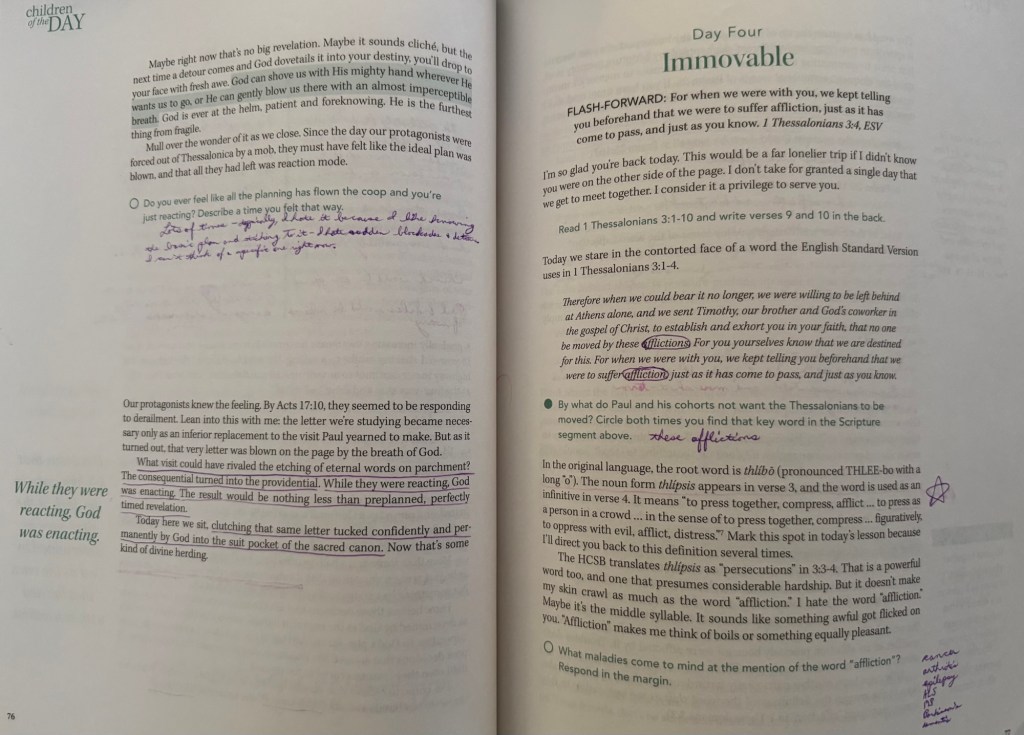
Do you ever feel like all the planning has flown the coop and you’re just reacting? Describe a time you felt that way. “Lots of times – typically, I hate it because I like knowing the basic plan and sticking to it – I hate sudden blockades and detours but I can’t think of a specific one right now.”
What visit could have rivaled the etching of eternal words on parchment? The consequential turned into the providential. While they were reacting, God was enacting. The result would be nothing less than pre planned, perfectly timed revelation.
Today here we sit, clutching that same letter tucked confidently and permanently by God into the suit pocket of the sacred canon. Now that’s some kind of divine herding.
Dearest Rachel –
I won’t ever go so far as to claim the notes you left behind were some sort of holy writ, but the fact that you left them behind, with responses in your own words as opposed to just filling in here and there as part of the bare minimum needed to get by (like I probably would have done) has been every bit as precious to me as the epistles Paul sent to the churches when he would have much rather been there in person to talk directly to them (By contrast, John’s shorter letters include a desire to meet face to face with the person he’s addressing, and therefore, he cuts them as short as they are. Maybe there was more insight that we miss out on by not having been at that meeting personally, but we’ll never know now).
Ironically, you probably thought of them as something of a chore, especially the night before you were to attend your weekly class. I remember how I would catch you putting together answers for several days’ worth of unfinished lessons, so that you would be permitted to contribute to the discussion – I don’t know if it was a hard-and-fast rule of the class itself, or something you internalized personally. But even then, you wouldn’t just put in a perfunctory word here and there so as to say you did it; you actually gave thoughtful answers to them, as well as underlining passages you considered particularly meaningful.
I don’t know who these notations were meant for when you did this – I’m pretty sure that, wherever these books ended up when Jan and I found them, you hadn’t looked at them since the class ended (and you certainly never intended for me to find and go through them) – but here they are, allowing you to speak even after you’re gone. Just as I need to be grateful for the fact that the past few days have gone as smoothly as they have (especially when compared to that of others), I want to express gratitude once again for these little treasures from you as well.


