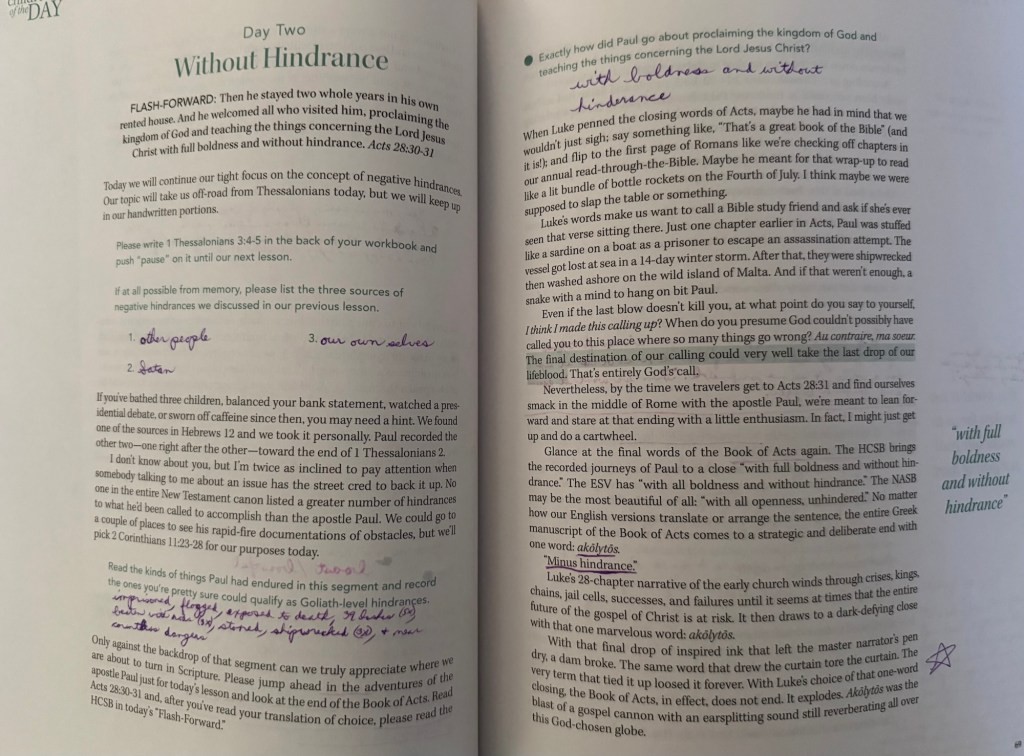
If at all possible from memory, please list the three sources of negative hindrances we discussed in our previous lesson.
1. “other people”
2. “Satan”
3. “our own selves”
Read the kind of things Paul had endured in the segment and record the ones you’re pretty sure could qualify as Goliath-level hindrances.
“imprisoned, flogged, exposed to death, 39 lashes (5x), beaten with rods (3x), stoned, shipwrecked (3x), and near countless dangers”
Exactly how did Paul go about proclaiming the kingdom of God and teaching the things concerning the Lord Jesus Christ?
“with boldness and without hindrance”
✮ With that final drop of inspired ink that left the master narrator’s pen dry, a dam broke. That same word that drew the curtain tore the curtain. The very term that tied it up loosed it forever. With Luke’s choice of that one-word closing, the book of Acts, in effect, does not end. It explodes. Akōlytōs was the blast of a a gospel cannon with an ear splitting sound, still reverberating all over this God-chosen globe.
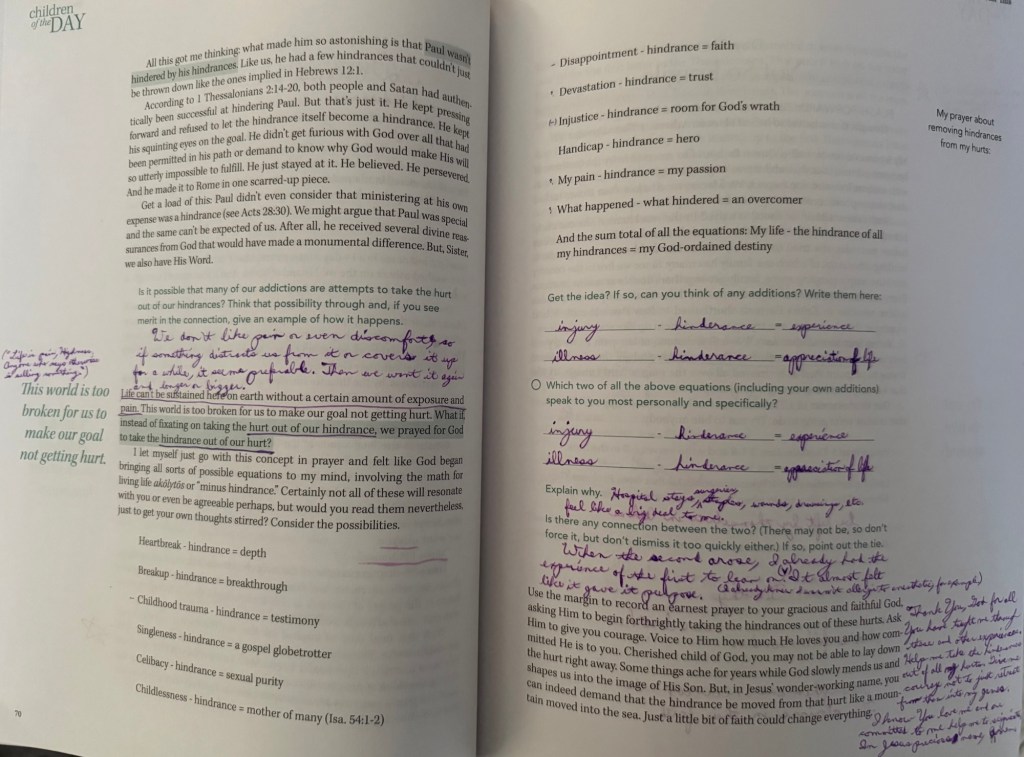
Is it possible that many of our addictions are attempts to take the hurt out of our hindrances? Think that possibility through and, if you see merit in the connection, give an example of how it happens.
“We don’t like pain or even discomfort, so if something distracts us from it or covers it up for a while, it seems preferable. Then we want it again and longer or bigger.
“(‘Life is pain, Highness; anyone who says otherwise is selling something.’)”
Get the idea? If so, can you think of any additions? Write them here.
“injury – hindrance = experience
“illness – hindrance = appreciation of life”
Which two of all the above equations, including your own additions, speak to you most personally and specifically?
“injury – hindrance = experience
“illness – hindrance = appreciation of life”
Explain why.
“Hospital stays, surgeries, staples, wounds, dressings, etc. feel like a big deal to me.”
Is there any connection between the two? There may not be, so don’t force it, but don’t dismiss it too quickly either. If so point out the tie.
“When the second arose, I already had the experience of the first to lean on. (I already knew I wasn’t allergic to anesthetic, for example.) It almost felt like it gave it purpose.
“Thank You, God, for all You have taught me through these and other experiences. Help me take the hindrances out of all my hurts. Give me courage not to just retreat from them into my games. I know You love me and are committed to me; help me to reciprocate. In Jesus’ precious name, Amen.”
Dearest Rachel –
I have to admit; seeing these pages for the first time like this, I can understand why you push back in different sections. Not in this one, in particular, but when you do, I get it. I find it interesting that the author asks you (and your fellow classmates) not to ‘force’ your answer ‘connect[ing]… the two,’ when some of her examples of ‘x – hindrance = y’ equations seem a little forced themselves. Not all of them – some, like handicap to hero, seem positively inspired – but some seem like a stretch, like pain to passion.
Then again, it’s just possible I don’t understand the concepts as she means them; I’ve had issues with the word passion before, as you’ll recall.
But that aside, despite the dozen or so options she gives you to work with, you created your own equations from your own experience with your brain tumor (and prior to that, your pregnancy). Moreover, you considered those to be the ones that spoke to you the most personally and specifically – which when you think about it, ought to have been the case for any student coming up with their own equations. If you’re coming up with something from your own personal experience, that should be the one that truly speaks to you.
Looking at the list, I can see a few that might be applied to my own situation at the moment, although I’m not entirely sure as to what it would look like to remove the hindrances in my life, or how I would go about doing so in the first place. It would be so much easier to find some way to conceal or ignore those hindrances, and just move on with day-to-day life, than to try to find and remove them, as if I were to perform spiritual surgery on myself. Sometimes, it feels like all that can be done is a form of palliative care toward these things.
But that analogy falls apart when one remembers that the earthly body will inevitably break down and die (“Life is pain,” as the Dread Pirate Roberts puts it) – leaving palliative care as the only option, when the cure is too much to handle – while our spiritual self is designed for immortality. Everything that hinders it will eventually be removed, either here or in the hereafter, so it were best that it be done sooner, that we more quickly could accustom ourselves to that unshackled way of living.
But that continues to beg the question; how to do it? It doesn’t always seem obvious, and it certainly isn’t always going to be easy. Like with my efforts at diet and exercise, it takes work, often when one doesn’t really feel like it. I don’t have the answers you do, honey, and since you can’t give me yours to cheat off of, I’m stuck with turning in a paper that’s likely to get filled with red marks from the Great Teacher, but for now, it’s all I can do.


