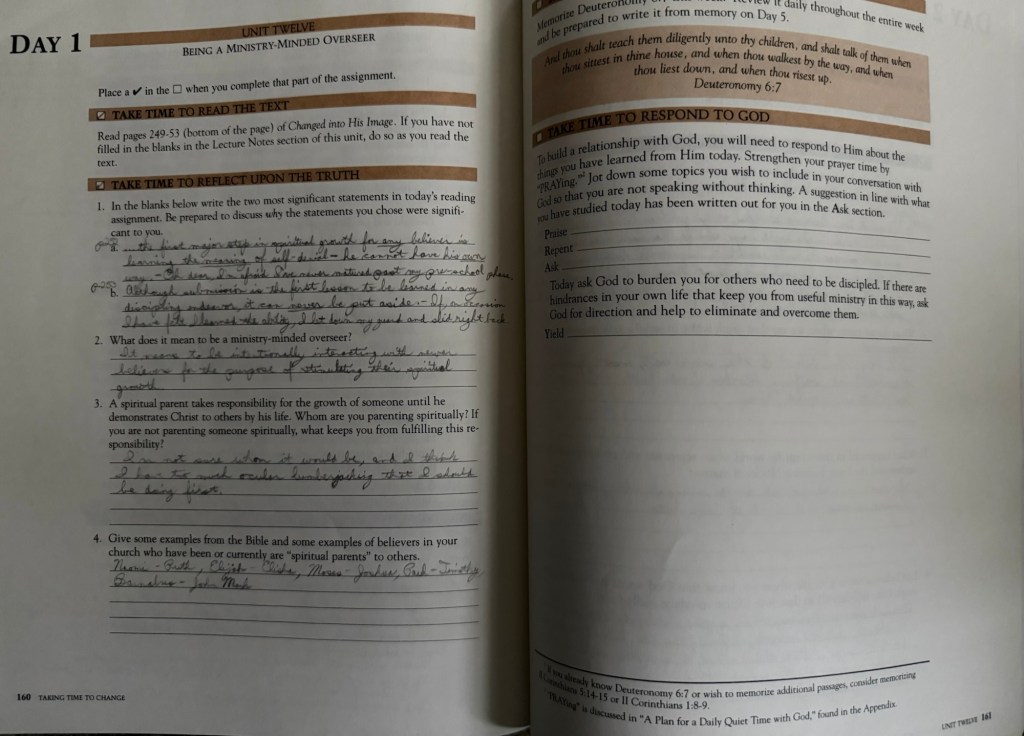
In the blanks below write the two most significant statements in today’s reading assignment. Be prepared to discuss why the statements you chose were significant to you.
“…the first major step in spiritual growth for any believer is leaning the meaning of self-denial – he cannot have his own way. – Oh dear, I’m afraid I’ve never matured past my pre-school phase.
“Although submission is the first lesson to be learned in any disciplining endeavor, it can never be put aside. – If, on occasion I have felt I learned the ability, I let down my guard and slid right back.”
What does it mean to be a ministry-minded overseer?
“It seems to be intentionally interacting with newer believers for the purpose of stimulating their spiritual growth.”
A spiritual parent takes responsibility for the growth of someone until he demonstrates Christ to others by his life. Whom are you parenting spiritually? If you are not parenting someone spiritually, what keeps you from fulfilling this responsibility?
“I’m not sure whom it would be, and I think I have too much ocular lumberjacking that I should be doing first.”
Give some examples from the Bible and some examples of believers in your church who have been or currently are ‘spiritual parents’ to others.
“Naomi-Ruth, Elijah-Elisha, Moses-Joshua, Paul-Timothy, Barnabas-John Mark”
Dearest Rachel –
Working backward on this daily reply, while it saves me from trying to decipher the pairs from our own personal history that have come into and subsequently left our orbit, it’s interesting that you don’t note anyone you know of personally as being in a spiritual parent-child relationship. It seems hard to believe that there wouldn’t be any going on that you would recognize. Despite not having seen but occasional glimpses in the past decade or two, I could see Mr. P as being one on a personal level (and while you didn’t meet with him in the mornings before work like I did, the monthly – or was it weekly? – meetings we would have with him and his wife would have you agree on this matter). And while I might not be as observant about other people as myself, I’m sure there are others.
Then again, the Biblical pairings are written down in such a way as to be more memorable (which, I suppose, is one more reason to keep writing these letters to you, in order to have a more permanent record of life down here than most relationships do), even if some of them aren’t always the best of examples. Naomi, in particular, had her moments when she wouldn’t have been the best of mentors, attempting to send Ruth and Orpah away, and complaining about her lot when she returned to her hometown – negative traits that Ruth, to her credit, didn’t seem to pick up, and became a exemplary convert to the One True God.
And maybe that’s part of the reason that you didn’t include any modern examples, either. One hesitates to call a job ‘done’ until it IS done; without a confirming “well done, good and faithful servant” at the end (by means of their inclusion into scriptural canon), it’s hard to say whether someone has been properly mentored. Even if a mentor does everything right, in terms of sowing the seed of the gospel, there are the soils in which the plant takes root and grows for a time, but other things, such as rocks and weeds, interfere with the growth process through no fault of the mentor. Although, to extend the metaphor, it’s possible that the mentor-as-sower bears some responsibility to clear the rocks and pull the weeds as best he can.
Which leads back to your line about ocular lumberjacking, and your explanation as to why you didn’t feel qualified to mentor someone else in their faith journey. It’s hard to help someone else climb a mountain when you don’t feel like you have a steady foothold yourself. Meanwhile, I’ve seen more than my share of self-professed spiritual sherpas tumble off the Rock that is higher than all of us, and take others with them. Although, much as I might think I could do better than that from my armchair, I too can barely claim a firm grip on things from moment to moment; I wouldn’t want to be held responsible for another’s soul when I can hardly get my own to stay on track. Maybe it’s a spiritual form of imposter syndrome.
Of course, there’s also the whole requirement of interacting with others to stimulate their growth here and there. I have to admit, that doesn’t appeal to me all that much, nor do I think I’m any good at it. But at the same time, it’s something that we’re all supposed to do throughout our spiritual lifetimes, and the only way to get any better at it is to practice it. Presumably, the skill will come through effort and attempt.
I’ve always hated Yoda’s line about how one should “do or do not; there is no ‘try.’” It may apply to certain one-and-done activities, especially in life-or-death situations (as the saying goes, “if at first you don’t succeed, then skydiving might not be for you”), but most of life, including mentoring, requires ongoing effort, and gradual improvement through practice (sometimes on the part of both the student and the teacher, as the latter learns how to instruct better in the process). In order to “do,” one has to “try.” That little green man needs to stow his pseudo-profundities for some other situation. Then again, considering how he’s held up as a secular example of mentoring, that might just be proof that one can be a decent mentor and screw up now and then along the way – and the less said about how Luke turned out in the end, the better.
Anyway, thanks for bearing up through my comments on yours, honey. I’ll talk to you later, but until then, keep an eye on me, and wish me well. As always, I’m going to need it.


