Dearest Rachel –
Well, now we’re on our way to the capital; a town not even a third the size of our own, but which makes up nearly half the population of the entire… country?… of Greenland. Yes, that’s a contentious point, and I’ll get to it further along, as I put this together.
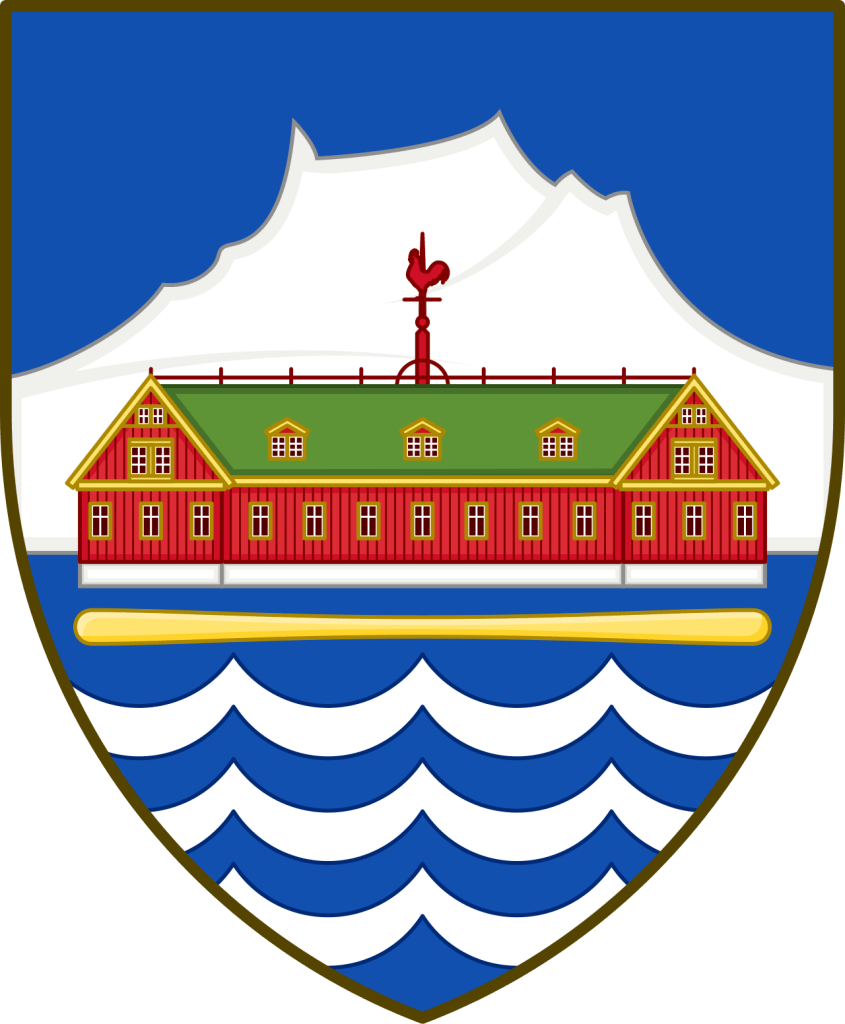
Yes, Nuuk is the capital of Greenland and, based on the fact that it took a whole day for our ship to crawl up the coast – and I can tell you, it was hugging the coast the whole time…
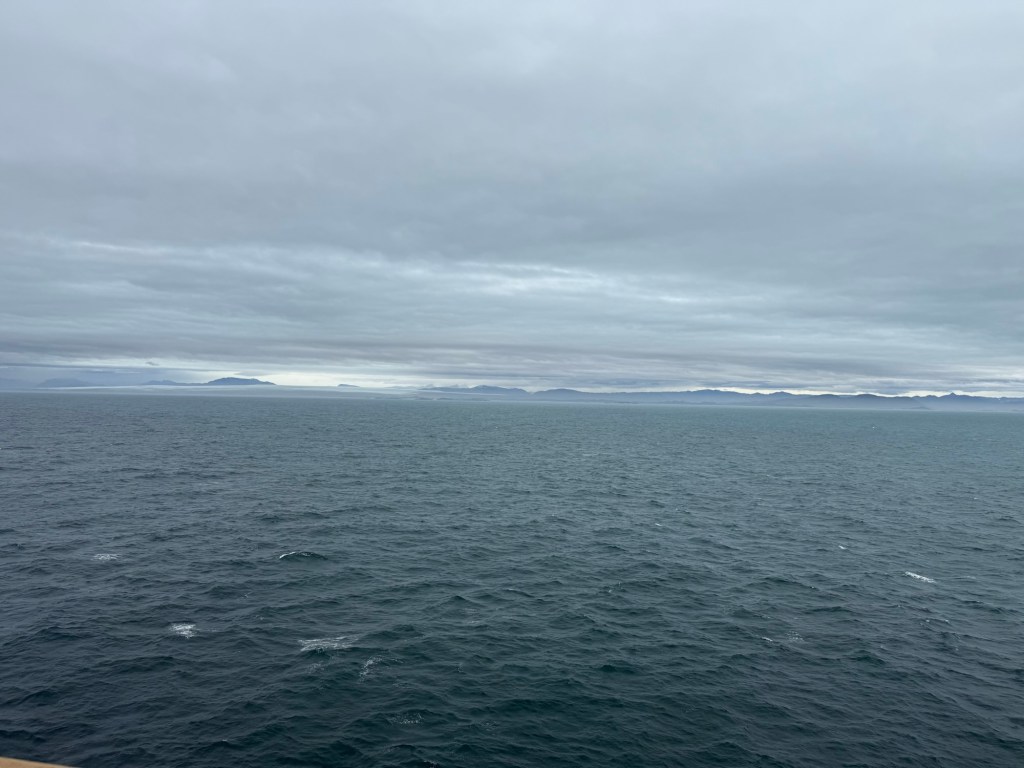
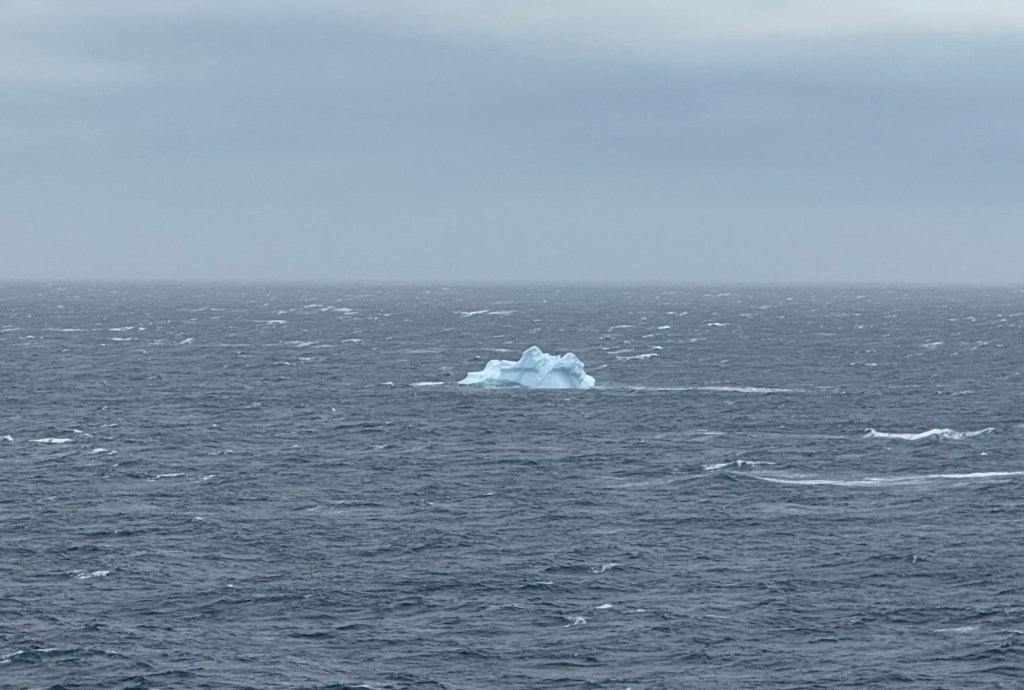
…you might guess that it’s as far north as we go on this trip. When I looked it up, however, I noticed that it’s situated at approximately 64.18°N latitude, which struck me as odd. There’s a clothing line offered for sale in Reykjavík – in fact, you got a fuzzy purple (because of course) coat from them when we were here last – called 66°North, so I assumed that referred to Reykjavík’s own latitude, thereby meaning that we’ve already been as far north as we’ll ever get. Turns out, the name simply refers to the Arctic Circle’s location (and rounding to the nearest degree allows them to use a shield logo reminiscent of the vaunted U.S. Route 66), which passes through the Westfjords region where they were founded. As for Reykjavík itself, it’s located around 64.13°N, just the tiniest bit further south than Nuuk, by about five kilometers or so. So… so much for that bit of ironic trivia; you can’t make light of something like that if it isn’t true.
Either way, we’re as close to the Arctic Circle as we’re likely to ever get in our lives, and yet, there are people who live their whole lives up here. To be sure, for generations, there was no where else to go, and not much way to get anywhere; as with Qaqortoq, there aren’t roads connecting one settlement to another, it’s basically all done by boat. But here we are, at the relative nerve center of it all. And it would seem that the Greenlanders – Nuummioqs in particular – would like to be the center of their own little world, from what I’ve heard.
Now, I’m by no means an expert on Greenlandic politics, but after having certain things explained by our guide in Qaqortoq, I have to admit to having a few opinions. There’s no question that Greenland is different, culturally, from Denmark. Its population centers are separated from Copenhagen by a flight of some six or seven hours (of course, Magnus may have been counting the flight from Qaqortoq to Nuuk as well as from Nuuk to Copenhagen. Either way, though, it’s an enormous distance for Denmark to administer over). That population is over eighty percent indigenous, with Danes making up less than ten percent. With that in mind, any desire for independence is more than understandable – especially to an American, with a liberty-minded character.
That having been said, for some fifty to sixty thousand people to tame this vast place – what would be the twelfth largest country in the world, if it were a country – with limited readily available resources borders on the ridiculous. For all the land there is, so little of it is arable that they aren’t able to feed what population they have on their own. Most of what they eat is imported, and at prices subsidized by Denmark, so as to even be affordable.
That’s not the only thing so provided, either. Magnus spoke of free education and healthcare being available, but it’s only ‘free’ insofar as the Greenlanders aren’t paying for it, but rather the Danish crown (and presumably, the Danish taxpayers, but let’s ignore them for the moment). Meanwhile, what’s available is limited to what would be considered the ‘urban’ areas of the nation. Any major surgeries would require being airlifted to Copenhagen, for instance; meanwhile, getting a doctor to work in the hinterlands (and Greenland is little more than hinterlands, let’s face it – even Qaqortoq looks and feels a bit like Cicely, if you think about it) would be like a real-life version of Northern Exposure, just with a Scandinavian accent. For now, Greenland is far too dependent on its parent country to truly survive on its own, no matter what its people might think.
However, it’s been known for some time now – and with time and discovery proceeding apace, more and more is being revealed – that Greenland is as rich in natural resources, such as various minerals and oil, as its Pacific counterpart, Alaska. It’s possible that, with exploration and infrastructure, enough could be recovered from beneath the bedrock that could mitigate the expense of whatever the land cannot produce on its own. No place, no matter how barren, is so desolate that there isn’t something of value in it; it just has to be found, and brought to those that would value it.
And there’s the rub. Greenland is a vast, unspoiled wilderness, and there are those that want to keep it that way. This basically involved locking away whatever riches the land may hold beneath the surface, forever, in order to preserve it as it is. Which is, indeed, a choice that can be made, but it does rather condemn the local population to lifetimes of dependency on one nation or another – whether Denmark, China or the U.S. – for its sustenance, and puts paid to any dreams of any sort of independence. Theoretically, some parts of the country could be left pristine – it is a vast expanse, after all – and others could be allocated for exploration and – it’s not a pretty word, but it fits here – exploitation, but often, those on either side of the argument seem to want it all, which is where it gets really contentious.
To be sure, it’s not an argument that concerns me, except insofar as I happen to be here in the moment. Let’s see what develops over time. Until then, maybe you can keep an eye on ALL of us up here for now, and wish us all luck; we’re going to need it.

 Letters to Rachel