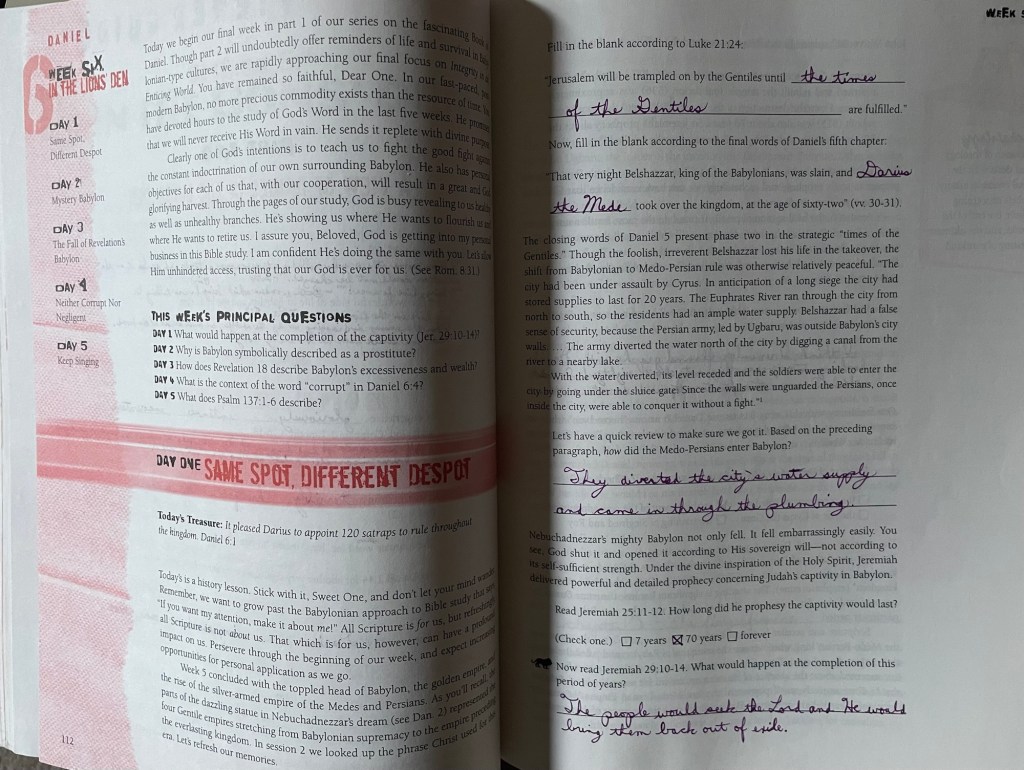

Fill in the blank according to Luke 21:24:
‘Jerusalem will be trampled on by the Gentiles until “the times of the Gentiles” are fulfilled.
Now, fill in the blank, according to the final words of Daniel‘s fifth chapter:
‘That very night Belshazzar, King of the Babylonians, was slain, and “Darius the Mede” took over the kingdom, at the age of sixty-two.’ (vv. 30-31)
Let’s have a quick review to make sure we got it… how did the Medo-Persians enter Babylon?
“They diverted the cities water supply and came in through the plumbing.”
Read Jeremiah 25:11-12. How long did he prophesy the captivity would last? “70 years”
Now read Jeremiah 29:10-14. What would happen at the completion of this period of years? “The people would seek the Lord and He would bring them back out of exile.”
Did God give you any new insight into the well-loved account during the session?
“I think I remember flannelgraphs with Daniel looking twenty-something, not about eighty! I don’t think I ever thought to stop and do the math.”
Please read Daniel 6:1-3. What do those verses entail?
“establishment of the new administration”
Look ahead to Daniel 9:1 for a moment and fill in the blank (NIV):
‘in the first year of Darius, son of Xerxes, a Mede by descent, who “was made ruler” over the Babylonian kingdom.’
Read Daniel 6:4-9.
Do jealousy, selfish ambition, and conspiracy against God’s faithful ones sound familiar in the book of Daniel? “yes” If so, where have you encountered it before? “chapter 3 – the fiery furnace.”
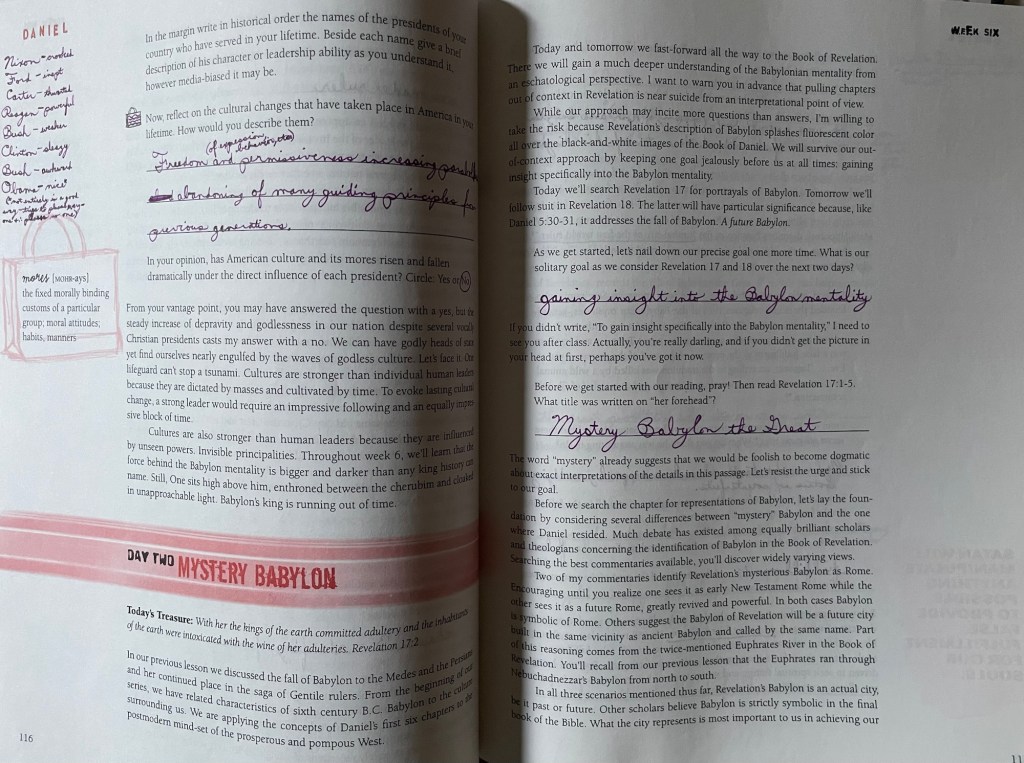
…Write in historical order the names of the presidents of your country who have served in your lifetime. Beside each name, give a brief description of his character or leadership ability as you understand it, however media-biased it may be.
“Nixon – crooked
“Ford – inept
“Carter – thwarted
“Reagan – powerful
“Bush – weaker
“Clinton – sleazy
“Bush – awkward
“Obama – nice*
“(*not entirely in a good way – tries to please everyone and pleases no one)”
Now, reflect on the cultural changes that have taken place in America in your lifetime. How would you describe them?
“Freedom (of expression, behavior, etc.) and permissiveness increasing parabolically, abandoning of many guiding principles from previous generations.”
In your opinion, has American culture and its mores risen and fallen dramatically under the direct influence of each president? “no”
Dearest Rachel –
At this point in your study, things transition from one kingdom on Nebuchadnezzar’s dream statue to another; from gold (Babylon) to silver (Medo-Persia). I found myself musing once again about the absurdity of the structure he envisioned; not only would it be impossible for it to stand on such literal weak footing (to say nothing about how terracotta and iron could be mixed together to form the feet in the first place), but how does each of the other parts merge from one to the next? How does gold transition to silver, and then to bronze and finally iron? I always imagined them gradually changing from one to the other, since history seems to be such a slow transformative process when looked at from a distance.
Then again, Belshazzar was slain and the Babylonian kingdom fell in a single night; maybe the changes are more abrupt than I think of them as being, looking back from two and a half millennia or so. Perhaps each material was simply welded to the one beneath it, on which it rested.
In any event, Daniel appears to remain in place, despite the upheaval involved with the conquest of the king and kingdom he served. It would seem that Darius recognized competency and wisdom despite supposed allegiances; or perhaps he understood that Daniel was no Babylonian to begin with, and was simply performing a job for a leader (and would do it well, no matter who was on the throne). These are details behind the scenes that aren’t discussed – let’s face it, they’re hardly relevant to the story at hand – but which might have been of scholarly interest had they been included.
Speaking of which, I don’t know if I’d noticed the passive voice before being used in describing Darius’ takeover of the crown; that he “was made ruler” suggest it was less due to his efforts than that of others. Granted, an army had just poured into Babylon and destroyed it, but in order to be given the leadership of the place, one would expect that he would at least have been head of that army to be worthy of the honor (even at the advanced age of sixty-one; despite still feeling young at fifty-seven myself, I recognize how old that would seem to be in the ancient world). Then again, I’m sure that the text uses the voice to emphasize that history was being written by the same Hand that scrawled Belshazzar’s doom on the plaster the night before; no one takes a crown – whether then or now – but rather is given it by the Author of History Himself.
Of course, that leads us to the final few questions, where you applied the concept to our own time (at the time). One wonders what you would have written about the last two leaders, in a word, but even so, it probably would not have changed your final answer. It could be argued that our national moral compass started to spin more dramatically, but to suggest that it was under any control of the men supposedly leading it is to give them far more credit than they are due, or ever could be due. As Beth says, one lifeguard cannot stop a tsunami. Then again, maybe it should be considered comforting that no one man can provoke one, either.
With that final thought, though, honey, keep an eye on us, and wish us luck. We’re going to need it.

 Letters to Rachel