The image in King Nebuchadnezzar’s first prophetic dream was a statue. What was the image in the second dream (today’s segment)?
“a flourishing, sheltering tree“
According to the definition, what is the word luxuriant used to describe?
“luxuriant or flourishing trees”
How did the first tree symbolize Nebuchadnezzar‘s reign in Babylon up to that time?
“The nation was at peace and opulently, wealthy and comfortable.”
According to Daniel 2:37-38 why was King Nebuchadnezzar so incomparable in his day?
“The God of heaven had given him his dominion and power and might and glory.”
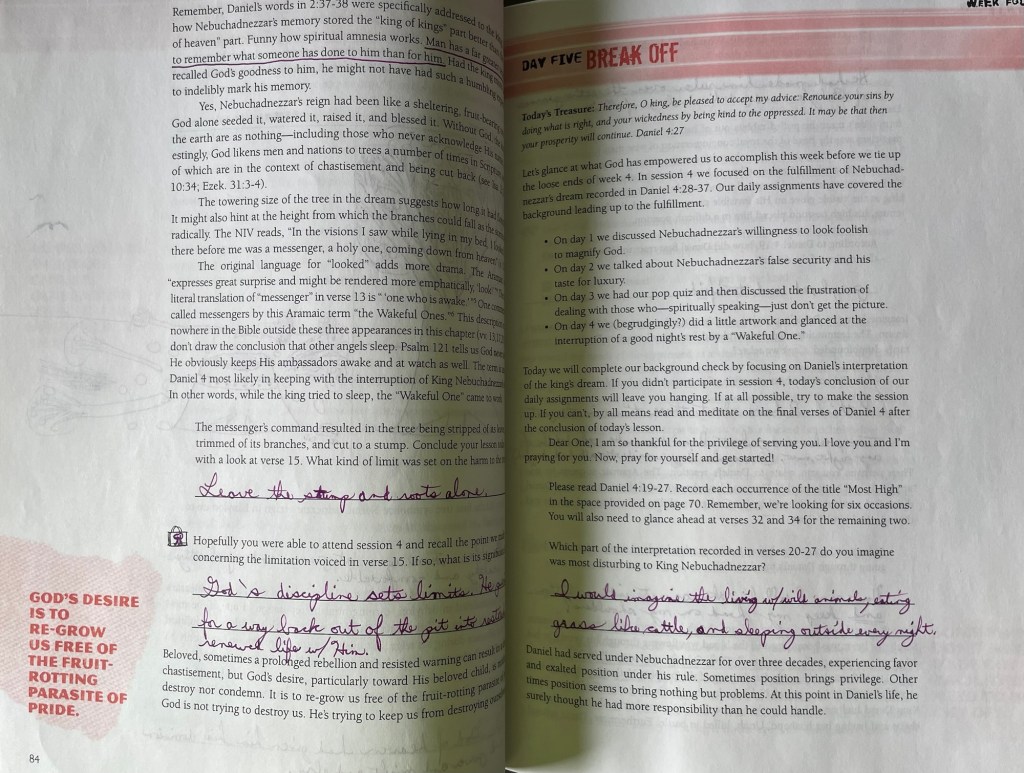
Man has a far greater tendency to remember what someone has done to him than for him. 
The messenger’s command resulted in the tree being stripped of its leaves, trimmed of its branches, and cut to a stump. Conclude your lesson today with a look at verse 15. What kind of limit was set on the harm to the tree?
“Leave the stump and roots alone.”
Hopefully you were able to attend session 4 and recall the point we made concerning the limitation voiced in verse 15. If so, what is its significance?
“God’s discipline sets limits. He provides for a way back out of the pit into restored, renewed life with Him.”
Dearest Rachel –
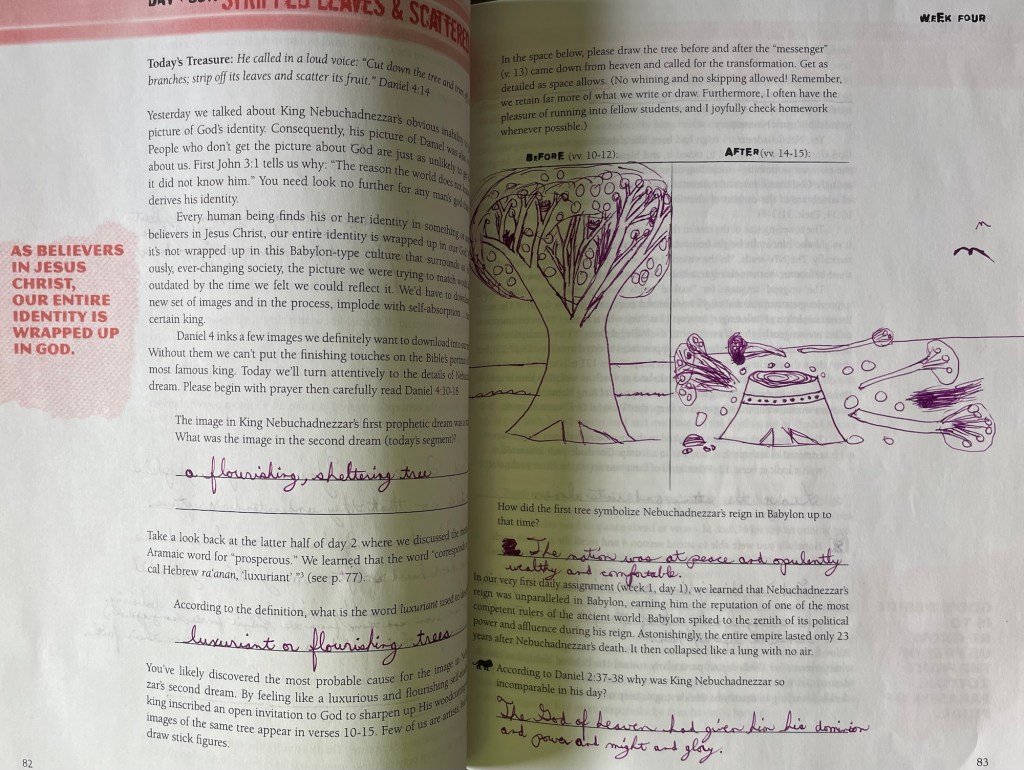
I was going to refrain from comment about your rendition of the tree representing Nebuchadnezzar (both before and after the ‘messenger’’s instructions were carried out), but I have to mention the author’s admonition of “no whining and no skipping allowed! Remember, we retain far more of what we write or draw.” And to your credit, you did so, and left one more record of your industry towards remembering what you were trying to learn here, on top of the fact that your written notes have proven invaluable for my memory of you and what you’d been studying.
To be fair, this particular day’s worth of notes was otherwise pretty scant. The two takeaways from it aren’t earthshattering – the fact that what plenty and peace we have are bestowed upon us by God, rather than being the fruit of our own labor; and that even when disciplining us for our insolent presumption, He will allow us to remain and hopefully learn from the harsh lessons He may put us through – but we need to be reminded of them nevertheless.
Beth’s observation that we tend to remember harm done to us as opposed to blessings bestowed on us is worth bearing in mind as well. I’m sure she’s speaking in terms of the effectiveness of aversion therapy; we learn more from pain and injury what to avoid. On the other side of the coin, we tend to think of the good things that come to us as being due to our own efforts, but the bad things must emanate from some external source; we blame God for our troubles while neglecting to credit Him for our success. So, too, did Nebuchadnezzar; and while he never did figure out that He was the One True God, he did acknowledge the fact that this was a teachable moment, and actually learned the humility God wanted him to… and as a result, he was restored to his position, all the wiser for his experience.
Honestly, I don’t know how to connect that to you or me, honey; maybe some lessons don’t apply to every situation. I think this is one we already knew – which might explain why we didn’t have to go through this. Or, maybe we never ascended high enough to get a sufficiently swelled head like King Nebuchadnezzar. I couldn’t begin to guess.
For now, though, keep an eye on me, honey, and wish me luck (and, perhaps, a little humility). I’m going to need it.

 Letters to Rachel