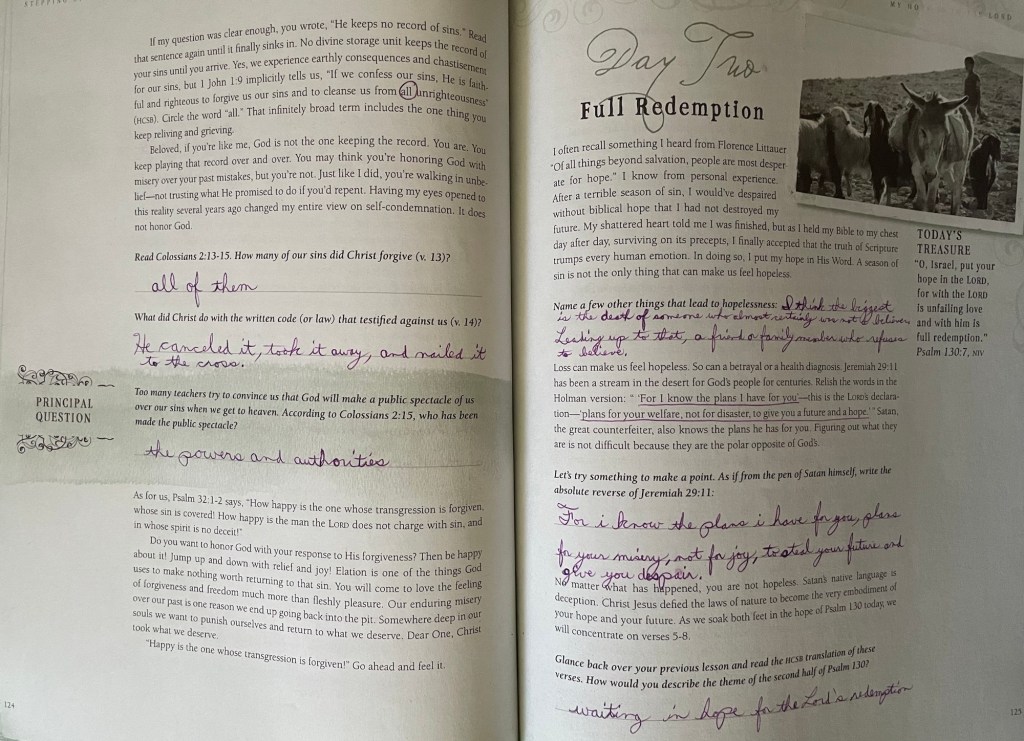
Name a few other things that lead to hopelessness:
“I think the biggest is the death of someone who almost certainly was not a believer. Leading up to that, a friend or family member who refuses to believe.”
For I know the plans I have for you – plans for your welfare, not for disaster, to give you a future and a hope
Let’s try something to make a point. As if from the pen of Satan himself, write the absolute reverse of Jeremiah 29:11:
“For I know the plans I have for you, plans for your misery, not for joy, to steal your future and give you despair.”
Glance back over your previous lesson and read the HCSB translation of these verses. How would you describe the theme of the second half of Psalm 130?
“waiting in hope for the Lord’s redemption”
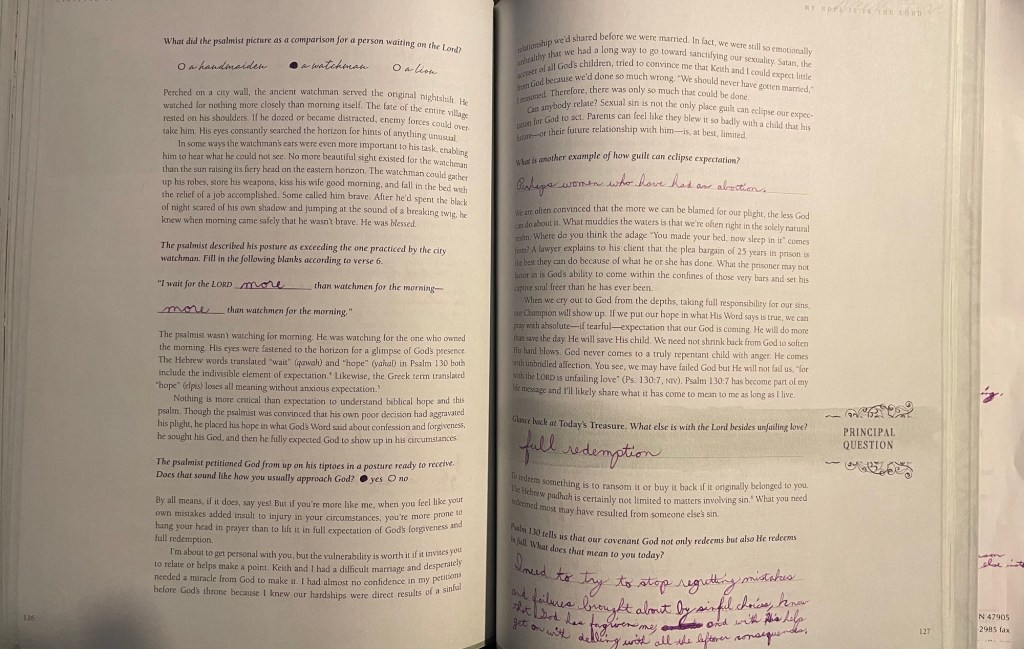
What did the psalmist picture as a comparison for a person waiting on the Lord? “a watchman”
The psalmist described his posture as exceeding the one practiced by the city watchmen. Fill in the following blank according to verse 6. ‘I wait for the Lord “more” than watchman wait for the morning – “more” than watchmen for the morning.’
The psalmist petitioned God from up on his tiptoes in a posture ready to receive. Does that sound like how you usually approach God? “yes”
What is another example of how guilt can eclipse expectation?
“Perhaps women who have had an abortion.”
Glance back at Today’s Treasure. What else is with the Lord besides unfailing love?
“full redemption”
Psalm 130 tells us that our covenant God not only redeems but also He redeems in full. What does that mean to you today?
“I need to try to stop regretting mistakes and failures brought about by sinful choices, know that God has forgiven me, and with His help get on with dealing with all of the leftover consequences.”
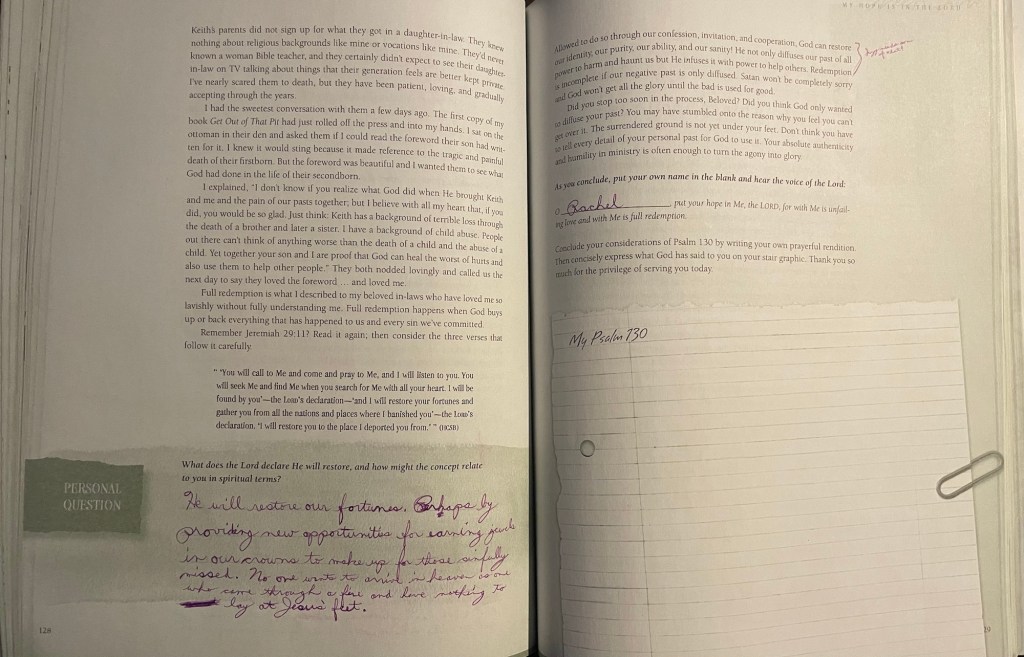
What does the Lord declare he will restore, and how might the concept relate to you in spiritual terms?
“He will restore our fortunes. Perhaps by providing new opportunities for earning jewels in our crowns to make up for those sinfully missed. No one wants to arrive in heaven as one who came through a fire and have nothing to lay at Jesus’ feet.”
Oh “Rachel”, put your hope in Me, the Lord, for with Me is unfailing love and with Me is full redemption. 
Dearest Rachel –
I couldn’t begin to guess, from this distance of about ten years, as to whether you were referring to a specific person lost at the time you were doing this study. I know you had concerns about both of your parents, and I know that you had (and still have) friends who fell in the category that you described with your first question, but I can’t recall us being parted with them like this with such finality at the time.
The Third Doctor was known to have said “where there’s life there’s hope” during his tenure; indeed they were very nearly his last words (the word “hope,” ironically, got cut off, as proof that his life was gone), and we try to operate with that in mind. As long as both we and the object of our concern still walk this earth, there’s a chance they can be brought to a saving faith in Christ. But there are those who seem more determined to neither hear or listen, much like the soil of the path in the parable of the sower.
It’s a story that we can both relate to and be puzzled by. On the one hand, if you’re scattering seed over a field, after the first saw, there is nothing but dirt as far as the eye can see. You don’t know where there might be rocks a foot or so beneath the surface, or where other, invasive seeds have already taken root – either of which would preclude the plant you’re trying to sow from growing and bearing fruit. But what’s this about the seed scattered on the pathway?  Who wastes good seed by throwing in it on the road? 
Of course, the modern imagination conjures up a very different image by the term “road”. Now, we think of a place that’s been paved over with asphalt or concrete (or even in that day, the cobblestone roads that all led to Rome , as the saying went). And, in a way, there are people like that (more so now than ever, in fact); even when little cracks appear in their worldview in which something might just sprout, these people take great pains to maintain their road, paving it over time and again so as to prevent such silly superstitions from ever taking root.
But in those days, the roads were generally every bit as much made of dirt and sod as the fields in which one planted; they were, at least to the untrained eye (and especially in the early planting season, when nothing had sprouted yet), indistinguishable from good soil. Without modern agricultural science and crop planning and the like, sowing was generally left up to chance. And so it is with people. We have to assume their hearts are open; certainly we have been taught that the Lord would rather “that nobody should perish, but that all should come to repentance.”
And yet, it doesn’t happen (or it doesn’t happen such that we know about it), and this causes more than mere frustration; this causes distress when it’s someone we know and love who refuses the offer of salvation. We don’t want to stand before God, knowing they aren’t there with us (and perhaps, feeling partially responsible for that fact – not that we should, as the choice is up to them, after all).
I know there was more to this study than your first answer, honey, but I have to admit that this is what stuck out to me, especially considering your efforts in their last years for you to reach out to your parents, as well as the ongoing efforts with various friends – some of the latter who may very well be into road maintenance, I’m afraid). At this point, as with the seeds scattered to the wind, they are in the hands of God. His plans are good, of course, but He has to be taken up on them.

 Letters to Rachel