
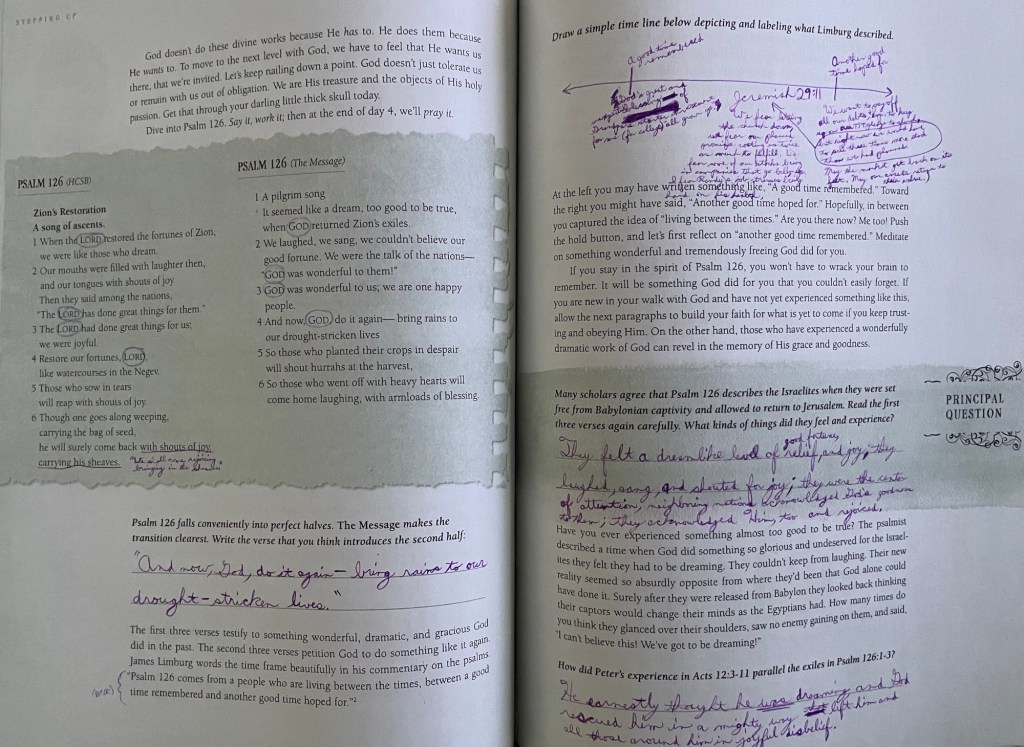
Though one goes along weeping,
carrying the bag of seed,
he will surely come back with shouts of joy,
carrying his sheaves
“‘We shall come rejoicing / bringing in the sheaves’”
Psalm 126 falls conveniently into perfect halves. The Message makes the transition clearest. Write the verse that you think introduces the second half.
“‘And now, God, do it again – bring rain to our drought-stricken lives.’”
Psalm 126 comes from a people who are living between the times, between a good time remembered and another good time hoped for. “(DPBC)”
Draw a simple timeline below, depicting and labeling what Limberg described.
“A good time remembered – God’s great and unexpected blessing of grandpa’s starter investment for me (for college) ‘all grown up’
“Another good time hoped for – we want to pay off all our debts, especially to keep up on our Tomorrow Starts Today pledge to church, but right now we would have to sell three times more stock than we had planned. May the market get back on its feet. May our assets return to their value.”
In the middle: “Jeremiah 29:11 – we fear letting the church down, we fear our planned promise costing us twice as much to fulfill. We fear some of our stocks being in companies that go belly up. I fear Randy‘s job stresses being hard on his health.”
Many scholars agree that Psalm 126 describes the Israelites when they were set free from Babylonian captivity and allowed to return to Jerusalem. Read the first three verses again carefully. What kinds of things did they feel and experience?
“They felt a dreamlike level of relief, good fortune, and joy; they laughed, sang, and shouted for joy; they were the center of attention; neighboring nations acknowledged God’s goodness to them; they acknowledged Him, too and rejoiced.”
How did Peter’s experience in Acts 12:3-11 parallel the exiles in Psalm 126:1-3?
“He earnestly thought he was dreaming, and God rescued him in a mighty way that left him and all those around him in joyful disbelief.”
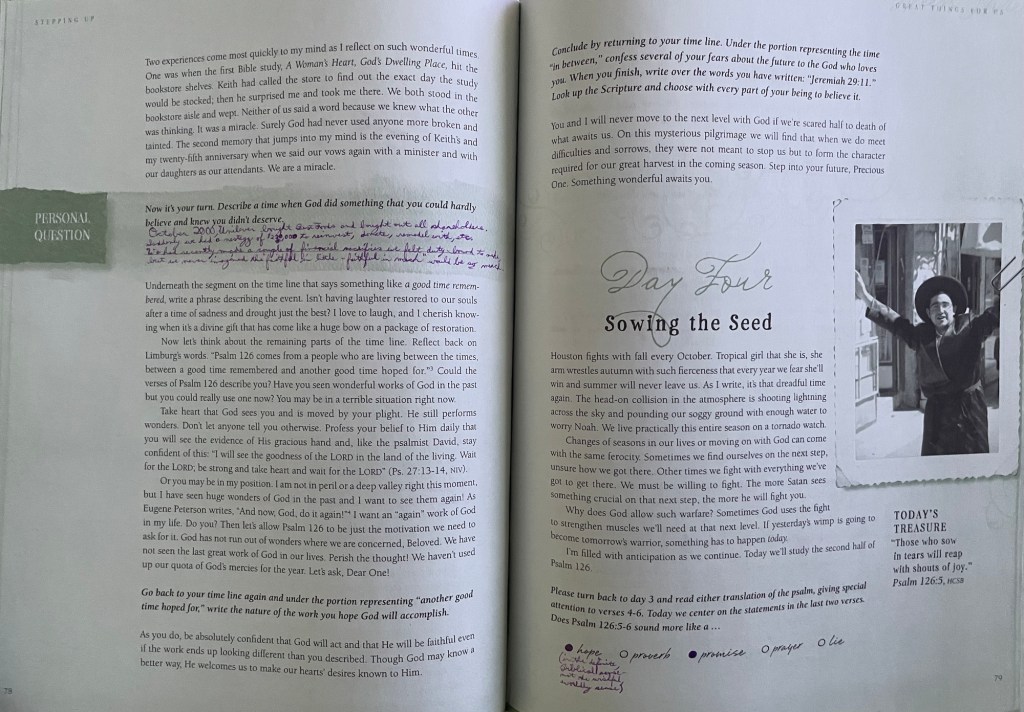
Now it’s your turn. Describe a time when God did something that you could hardly believe and knew you didn’t deserve.
“October 2000, Unilever bought Best Foods and bought out all shareholders. Suddenly we had a nest egg of $250,000 to reinvest, donate, remodel with, etc.  We had recently made a couple of financial sacrifices we felt duty-bound to make, but we never imagined the ‘faithful in little – faithful in much’ would be so much.”
Dearest Rachel –
It’s the bane of what seems like every marriage and every family; how to manage finances, especially when there’s not much to start with. We don’t deal with the threat of hostile countries on our border, like the Israelites (both past and present), but we certainly had our struggles, didn’t we? It’s been so long since we’d been in that position, that I’ve rather forgotten about how hard it was, and how much of a strain it was to try and balance our obligations, both those that were necessary to maintain a household, as well as the self-imposed ones that we thought we owed to God and His church.
I do remember the few months leading up to that stock buyout; we had promised a couple of our peers in the singles group who had gotten married and we’re heading out on the mission field that we would send a regular amount to them, but we had fallen behind. When they were in town, we wrote them a fairly large check, at least for us at the time, saying (pace Ebeneezer Scrooge) that “there were a great deal of back payments included in that number.” Of course, shortly after that, the events that you describe transpired, and well, God himself did not actually sign the check from Unilever, it was hard for us not to make the connection between what we had done and what he had done in return. Very rarely do we see events fall in such karmic sequence, and so when they do, we can’t help but seize on it as a sort of proof of all the promises that He has made to us in His word.
The thing is, however, that was something of a one time event; by the time you were working on this study series, we were dealing with more financial issues, including more such commitments that were getting harder to keep as the market suffered a downturn, as it does from time to time. I don’t have to explain more than you did; if nothing else, those days, too, seem far behind, and your descriptions from in the middle of it characterize it better than I could from this vantage point.
At the same time, my relationship with my boss was beginning to sour, as well, after the merger of the two sister companies. His belief that certain redundancies within the two would ultimately cause our department to be eliminated. became the basis for the daily harangues (“What’s your contribution?”, which translated to “I don’t see you making enough of one to be noticed, which means you should be out on your ear”), and it was already taking an effect on me – and as such, caused you so much worry in turn as you observed its effects on me. If I remember this study right (in terms of chronology), there would still be five more years before I would find relief. I still wish you had more time to see the period in which I have not had to concern myself so much finances and my job situation and so forth; the year and a half we had seems like so little in comparison to the overall amount of time we had together. Not to put too fine of a point on it, but it was so brief as to be almost like a dream.
And yet, I suppose that where you are, you don’t really have to worry about the many different things that trouble us here on this soggy rock, so even if you didn’t get enough time down here free from worry, it all comes down to the same bottom line. At the same time, if you’d be so kind as to keep an eye on me, and wish me luck, I’d still appreciate it. After all, I still need it. 


