Dearest Rachel –
Located in a part of New Zealand referred to as the Winterless North (which is a strange pair of words for anyone from the Northern Hemisphere to utter in tandem), the Bay of Islands is about a 150 mile drive up Route 1 from Auckland. While not a long distance – and certainly nothing as compared to our transits from Hawaii to Polynesia, or from there to New Zealand – it’s still considerably longer than that between Mo‘orea and Pape‘etē. There’s not exactly a specific city for us to tender to (and, for those keeping score, this is our third tendering port against four full-city gangway ports – although I expect this will start to shift dramatically once we get to Australia, apart from the possible exception of Newcastle). As far as I can tell, the tenders might be docking at Kerikeri, despite the historical and cultural significance of Waitangi.
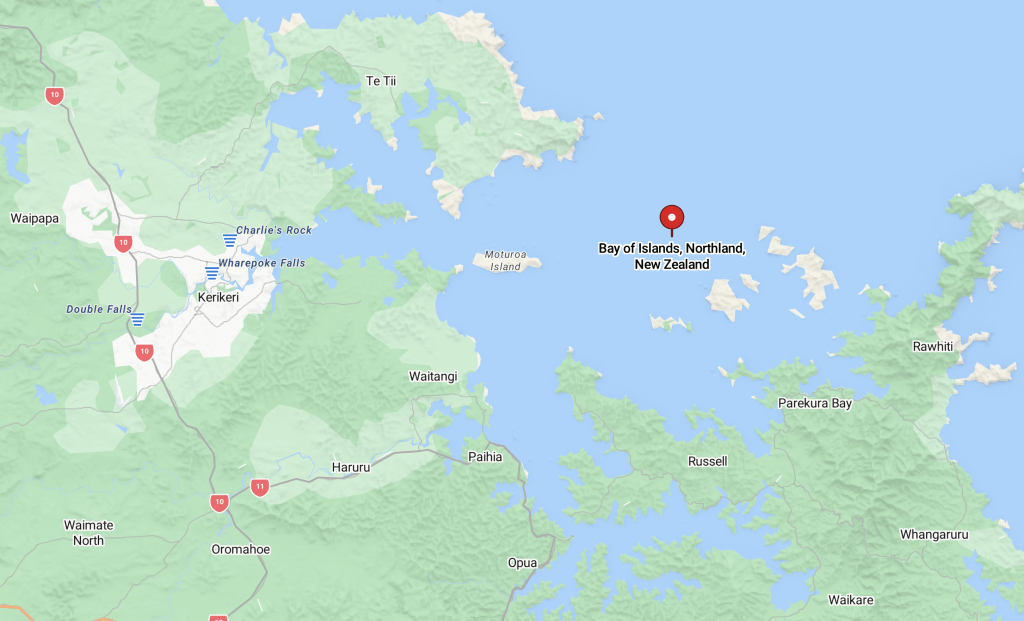
These are the ancestral lands of the Ngāpuhi tribe, the ones who got their hands on firearms first among the tribes, causing an imbalance among the Māori of the North Island in the early 1800s. Māori settled and multiplied throughout the bay and on several of its many islands to establish various tribes such as the Ngāti Miru (not to be confused with the Ngāti Whātua, located nearer to modern-day Auckland) at Kerikeri. Many notable Māori were born in the Bay of Islands, including Hōne Heke, who several times cut down the flagpole at Kororāreka (also known as Russell) to start the Flagstaff War, which ultimately caused the Crown to encourage the emigration of veterans of the Seven Years’ War to the North Island to defend its interests in the colony.
The name Waitangi might be familiar from yesterday’s report, as Te Tiriti (sound it out; it’s basically ‘the treaty’) o Waitangi was first signed here, and distributed throughout what would become New Zealand among the various Māori chieftains (over 500 in all). The document, while technically an agreement rather than a treaty, and therefore being legally effective only to the extent it was recognized by various statutes, has become something of a founding document to the nation, particularly in regard to the interaction between the British and the Māori. Essentially, it gave governance rights over the entirety of New Zealand to the Crown, but the right of chieftaincy to the various Māori leaders over their individual communities, while also granting the Māori people full rights and protections as British subjects. One major problem with the treaty (despite its shaky enforceability) was that certain legal concepts had no translation in the Māori language, leaving certain major ambiguities between how the British and the Māori interpreted Te Tiriti, resulting in some understandable friction between the two peoples. However, in terms of the interaction between the colonist British and the indigenous population, this was among the more amiable attempts at coexistence (especially when compared to the American and Australian experiences – to be sure, a low bar to clear, but clear it they did).
Now, given that we’re not all that far from Auckland at this point, I’ve written up a little more detail of the history I touched on yesterday because, as you might suppose, there’s not that much cultural difference between this area and that; while this is Ngāpuhi land as opposed to Ngāti Whātua to the near south, their history is rather intertwined (more so than, say, between the Polynesians of Mo‘orea and Tahiti, having at least eleven miles of ocean between them), with their conflicts prompting one tribe to request assistance from the British, who were more than happy to do so, and so much more.
Besides, I’m not sure how much more cultural stuff I’ll be able to soak up or indulge in, as tomorrow’s shore excursion will be considerably longer than that of Auckland, taking us from the Puketi Kauri Forest (where kauri trees that have stood since around the time of Christ extend over fifty meters into the sky, on trunks nearly sixteen meters around, and shelter a large number of New Zealand’s iconic kiwi birds) to the Kawiti glowworm caves of Waiomio, with their mesmerizing display of glowworms that adorn the cave ceilings.
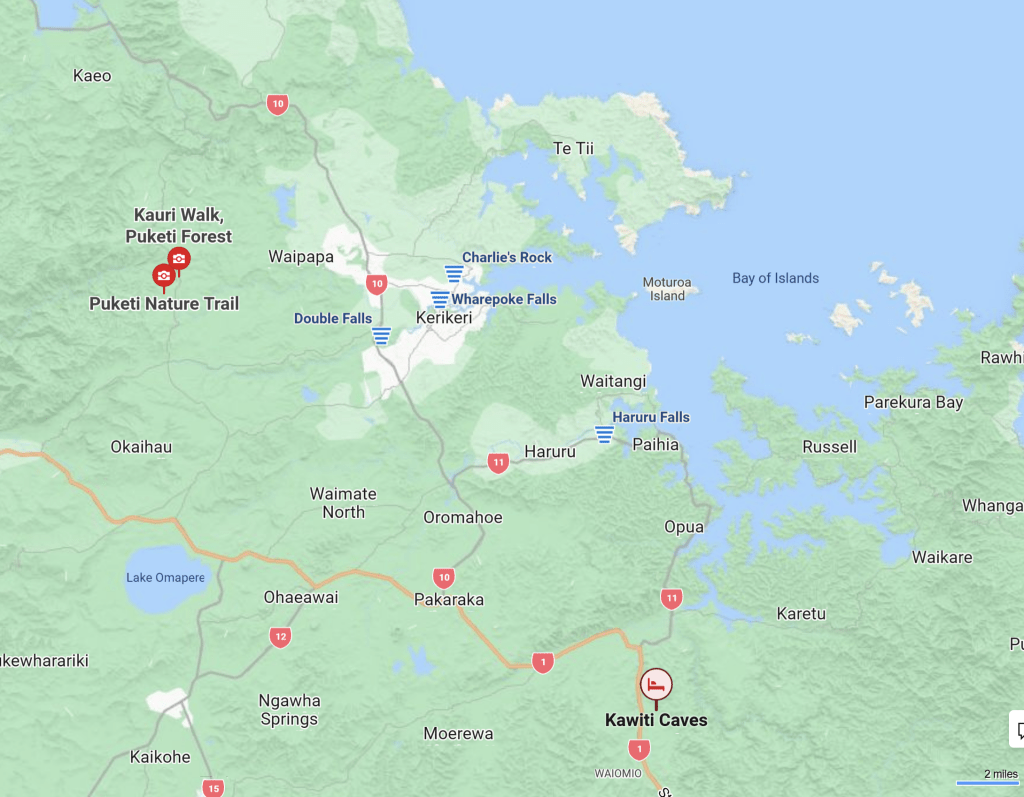
It so happens that the glowworms are the larvae of a species of fungus gnat, which emit a bioluminescent glow to attract prey. In the darkness of the cave, the glowworms create a beautiful starry sky-like effect that dazzles visitors. The cave name comes from the Kawiti family, who have been guardians of these particular caves for generations. As our guide will hopefully fill us in on the Māori traditions involved with this guardianship, I’ll not try to go into too much detail here, lest I get fact-checked by what I hear tomorrow from them, but I will note that at least one formation of glowworms is apparently referred to as ‘the Milky Way,’ for reasons that should be obvious, assuming I can get pictures and, hopefully, video of the place.
I’m actually concerned about that; it may be that cameras pose certain issues for the glowworms, and photography may be limited to one extent or another. As with the galley tour, I’m unsure about the ‘how’s and ‘why’s, but if I’m asked to, I’ll set my camera aside. I do realize that it’s not always able to do justice to what I’m able to see in person, in any event.
But with that being said, honey, keep an eye on me (it’s probably the best way to see what I’m seeing), and wish me luck. I’m going to need it.


