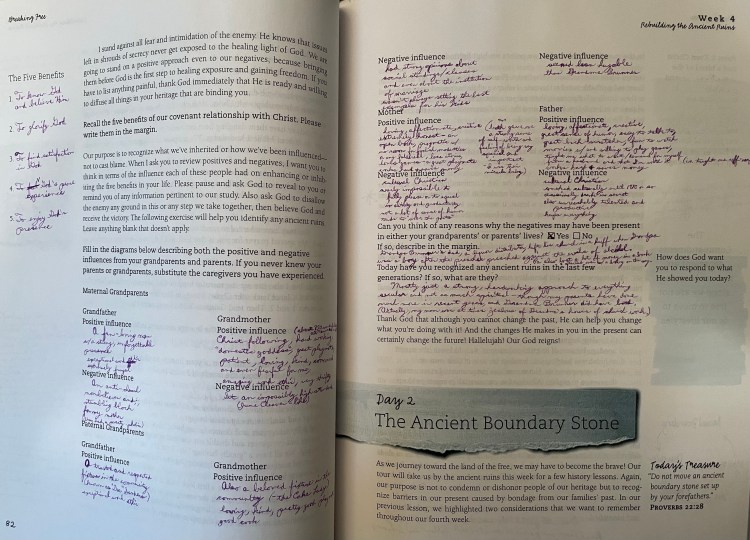

Point 1: Even Christ had a blend of the “negative” and “positive” in His lineage.
Point 2: We don’t have to “disinherit or dishonor” our physical lineage to fully “accept and abide in” our spiritual lineage.
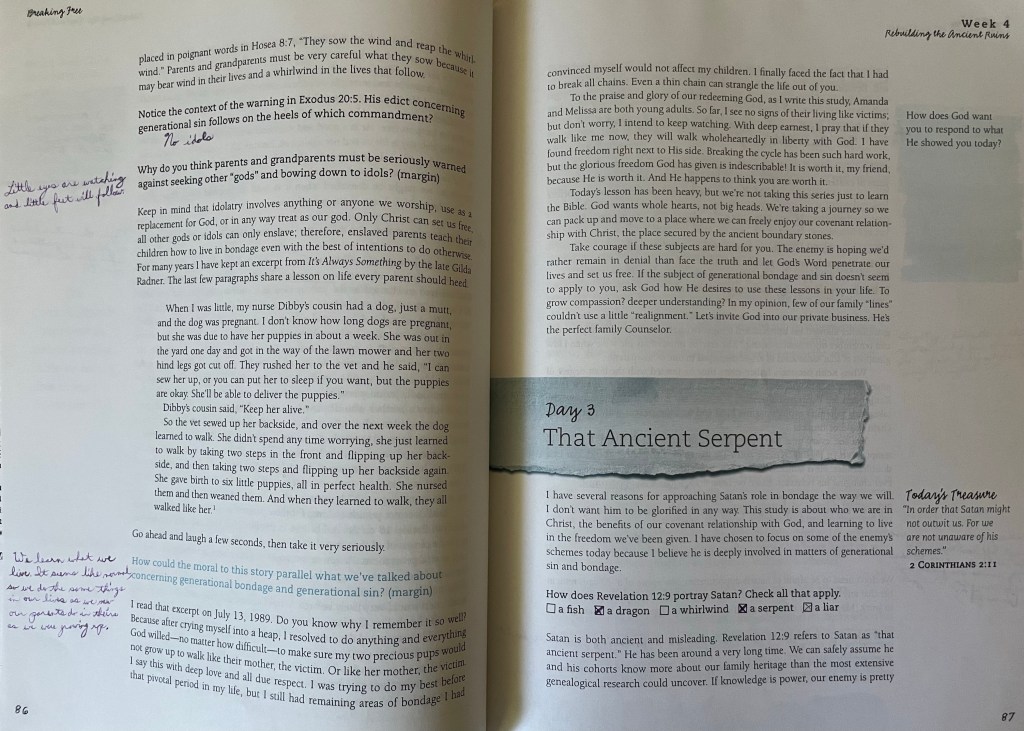
How did God identify Himself? Complete the verse: I am the Lord your God, who brought you out of Egypt, out of the… “land of slavery.”
Describe in your own words how Exodus 20:5 reflects the cycle [of bondage]
“God will punish the original sinner in the family, his children and grandchildren, etc., will follow his behavior, so God will punish them, too.”
Explain the difference between ungodly and godly jealousy.
“Maybe the motive behind the jealousy being selfish and impure, rather than selfless and pure(?)”
Having a godly jealousy means being jealous for someone, not of someone.
Notice the context of the warning in Exodus 20:5. His edict concerning generational sin follows on the heels of which commandment?
“No idols”
Why do you think parents and grandparents must be seriously warned against seeking other “gods” and bowing down to idols?
“Little eyes are watching and little feet will follow”
How could the moral to [Dibby’s] story parallel what we’ve talked about concerning generational bondage and generational sin?
“We learn what we live. It seems like normal, so we do the same things in our lives as we saw our parents do in theirs as we were growing up.”
Dearest Rachel –
I suppose it stands to reason that, after a day’s homework where you had to go through the entire memory of your family tree (and some, like your dad’s father, that you wouldn’t have memory of – at least, not personally), you’d have the following day of homework be considerably lighter. Still, there’s still a little bit to unpack here, all the same.
If it’s not visible to the reader, the reference to Dibby is about a dog who was crippled through the course of a difficult childbirth (I’m sure you cried a few tears about the owners being faced with the question of whether to save her or not, and putting in the effort to do so), but managed to bear and raise her pups. The thing is, those pups learned to walk crookedly, like their mother did out of necessity, despite none of them having to deal with the deformity she was left with by the operations that accompanied her giving birth. We as kids find ourselves modeling our parents (whether they happen to be good or bad), thinking that their behavior is normal and good, without regard to whether it truly is, because it’s all that we know.
It may seem unfair for God to say that He punishes the children to the third and fourth generation, but it also stands to reason to consider that we learn our parents’ sins and repeat (and often magnify) them, thus making ourselves worthy of our own punishment. It’s like the concept of original sin, only turned on its head; the derivative sins are just as wrong, and just as subject to penalty.
Of course, this logic requires us as parents to watch our step, and make sure our walk is clean and smooth enough that the things our children emulate are the truly good things, rather than the sins. It’s difficult, but it’s the only way to break the cycle. Not that we’re able to do that on our own, to be sure, any more than we can save ourselves by our alleged ‘good deeds,’ but with God’s help, we can escape His wrath for future generations.
Assuming they learn the good stuff; the narrow path is hardly the one of least resistance. But it’s what we need to model, if we expect those behind us to even come close to doing so.
To that end, honey, keep an eye on us, and wish us luck; we’re going to need it.

 Letters to Rachel