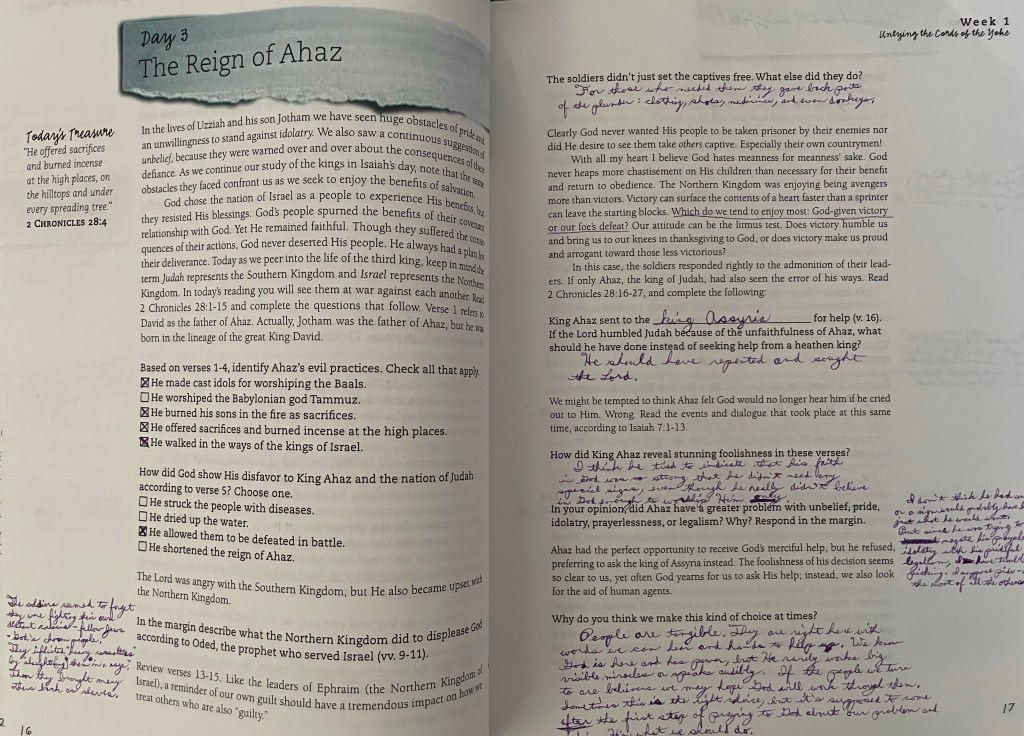

Based on verses 1-4, identify Ahaz’s evil practices. Check all that apply.
“– He made cast idols for worshiping the Baals.
“– He burned his sons in the fire as sacrifices.
“– He offered sacrifices and burned incense at the high places.
“– He walked in the ways of the kings of Israel.”
How did God show His disfavor to king Ahaz in the nation of Judah according to verse 5?
“He allowed them to be defeated in battle.”
Describe what the Northern Kingdom did to displease God, according to Oded, the prophet who served Israel (vv. 9-11)
“The soldiers seemed to forget they were fighting their own distant cousins – fellow Jews – God’s chosen people. They inflicted ‘heavy casualties’ by ‘slaughtering them in a rage.’ Then they brought many others back as slaves.”
The soldiers didn’t just set the captives free. What else did they do?
“For those who needed them, they gave back parts of the plunder: clothing, shoes, medicines, and even donkeys.”
Which do we tend to enjoy most: God-given victory or our foes’ defeat?
King Ahaz sent to the “king [of] Assyria” for help (v. 16). If the Lord humbled Judah because of the unfaithfulness of Ahaz, what should he have done instead of seeking help from a heathen king?
“He should have repented and sought the Lord.”
How did king Ahaz reveal stunning foolishness in [Isaiah 7:1-13]?
“I think he tried to indicate that his faith in God was so strong that he didn’t need any special signs, even though he really didn’t believe in God enough to worship Him only.”
In your opinion, did Ahaz have a greater problem with unbelief, pride, idolatry, prayerlessness, or legalism? Why?
“I don’t think he had unbelief, or a sign would probably been have been just what he would want. But since he was trying to negate his prayerless idolatry with his prideful legalism, I have trouble picking. I suppose pride – as the root of all the others.”
Why do you think we make this kind of choice at times?
“People are tangible. They are right here with words we can hear and hands to help us. We know God is here and has power, but He rarely works big physical miracles, or speaks audibly. If the people we turn to are believers, we may hope God will work through them. Sometimes this is the right choice, but it’s supposed to come after the first step of praying to God about our problem and asking Him what we should do.”
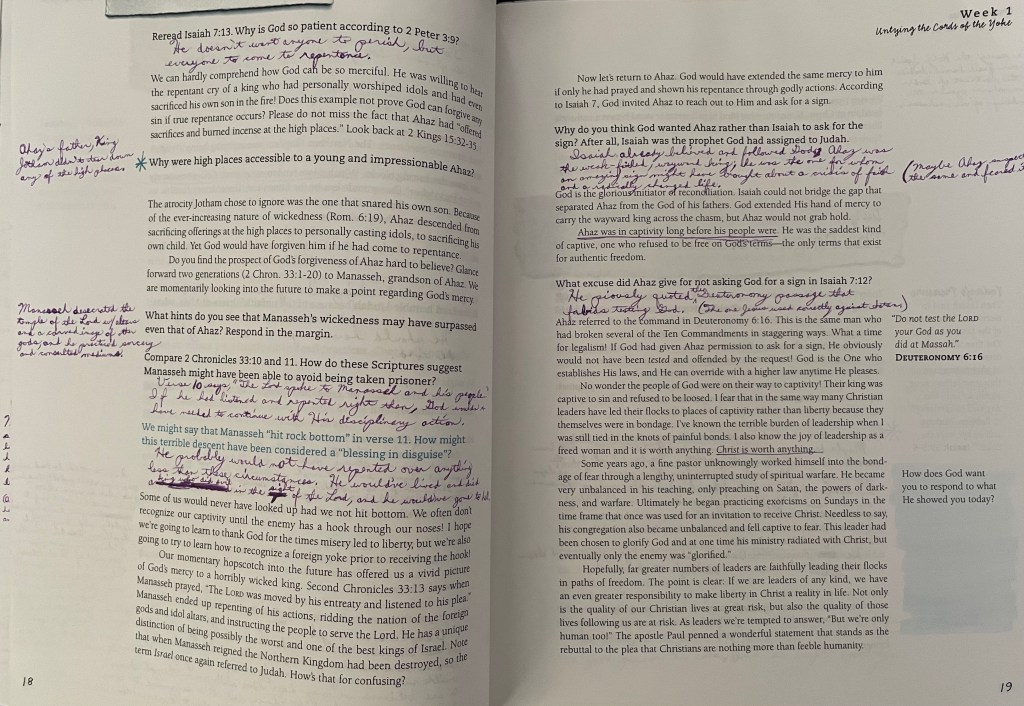
Reread Isaiah 7:13. Why is God so patient according to 2 Peter 3:9?
“He doesn’t want anyone to perish, but everyone to come to repentance.”
Why were high places accessible to a young and impressionable Ahaz?
“Ahaz’ father, King Jotham, didn’t tear down any of the high places.”
What hints do you see that Manasseh’s wickedness may have surpassed even that of Ahaz?
“Manasseh desecrated the temple of the Lord with altars, and a carved image of other gods, and he practiced sorcery and consulted mediums.”
Compare 2 Chronicles 33:10 and 11. How do these scriptures suggest Manasseh might have been able to avoid being taken prisoner?
“Verse 10 says, ‘the Lord spoke to Manasseh and his people…’ If he had listened and repented right then, God wouldn’t have needed to continue with his disciplinary action.”
We might say that Manasseh “hit rock bottom” in verse 11. How might this terrible descent have been considered a “blessing in disguise”?
“He probably would not have repented over anything less than these circumstances. He would’ve lived and died a king who did evil in the sight of the Lord, and he would’ve gone to hell.”
Why do you think God wanted Ahaz rather than Isaiah to ask for the sign? After all, Isaiah was the prophet God had assigned to Judah.
“Isaiah already believed and followed God. Ahaz was the weak-faithed, wayward king; he was the one for whom an amazing sign might’ve brought about a crisis of faith and a radically changed life. (Maybe Ahaz suspected the same and feared it.)”
Ahaz was in captivity long before his people were.
What excuse did Ahaz give for not asking God for a sign in Isaiah 7:12?
“He piously quoted the Deuteronomy passage that forbid testing God. (The one Jesus used correctly against Satan.)”
Christ is worth anything
As you conclude today… paraphrase 2 Corinthians 4:7
“We carry the Holy Spirit in our frail human bodies so the contrast of God’s power shows against the backdrop of our weakness.”
Dearest Rachel –
It’s weird how, just yesterday, I was discussing the seeming randomness of life with Luke over breakfast at the men’s Bible study (this being the first month this year that we’ve gone back to this first-weekend-of-the-month tradition), only to be going over your notes on a decidedly cause-and-effect situation during the reign of one of Judah’s many (though thankfully not all, as with their brothers to the north) evil kings.
Very little of the big things in life today seems to be traceable to our own past decision, whether good or bad. Sure, there are choices we make in life – financial, relational, lifestyle, relational and spiritual – that have a bearing on our overall well-being, but there are so many things, like disease and yes, even your accident, that to plaintively ask “why?” no matter how understandable, is pointless. We’re not being punished, we’re not being rewarded; these things sometimes just happen.
Not so with Ahaz. The defeats he suffered were very much due to his choices not to seek or follow the Lord. Even his false piety in saying “oh, I won’t test the Lord” when asked to request a sign served to seemingly aggravate God. Interestingly enough, the Lord still sent a sign – one that would be fulfilled both in the short term (in which a child born at the time of its telling wouldn’t be old enough to tell his right hand from his left before Ahaz’ enemies would no longer be a threat) and the long (in the form of the Messiah Himself) – regardless of Ahaz’ irritating response; because the nation needed the relief that both fulfillments would provide.
Besides, as you point out, sometimes we need tangible evidence of God’s presence; and what better way than through fulfilled prophecy?

 Letters to Rachel