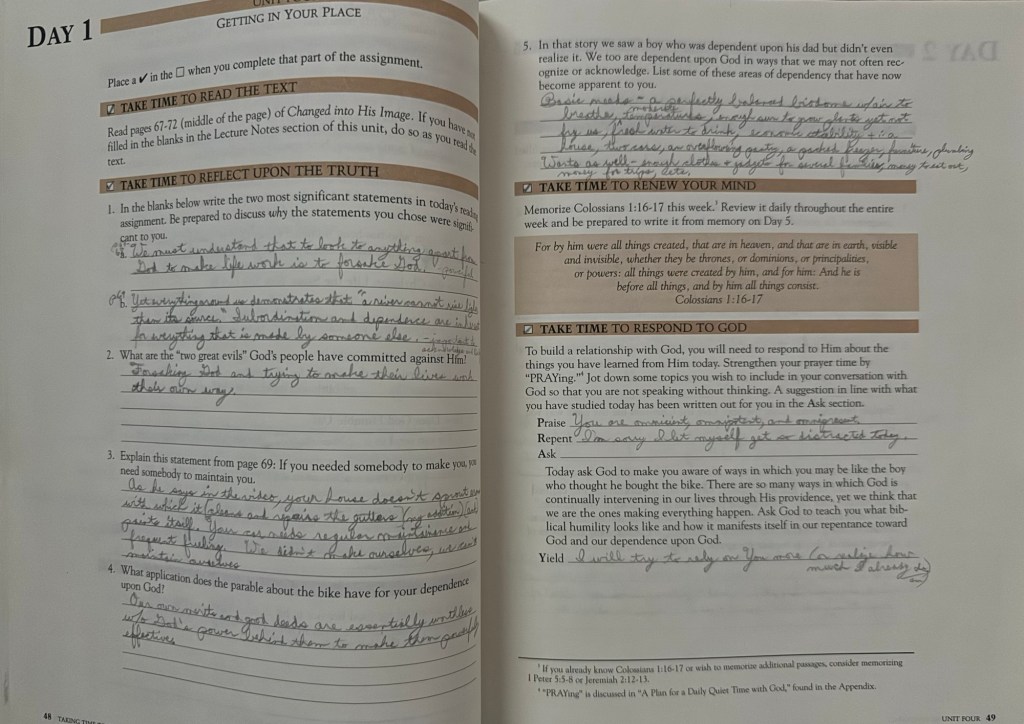
In the blanks below write the two most significant statements in today’s reading assignment. Be prepared to discuss why the statements you chose were significant to you.
“We must understand that to look to anything apart from God to make life work is to forsake God. – powerful
“Yet everything around us demonstrates that ‘a river cannot rise higher than its source.’ Subordination and dependence are inherent for everything that is made by someone else – important to acknowledge and live by”
What are the ‘two great evils’ God‘s people have committed against Him?
“Forsaking God and trying to make their lives work their own way.”
Explain this statement… If you needed somebody to make you, you need somebody to maintain you. 
“As he says in the video, your house doesn’t sprout arms with which it [cleans and repairs the gutter] (my addition) [and] paints itself. Your car needs regular maintenance and frequent fueling. We didn’t make ourselves, we can’t maintain ourselves.”
What application does the parable about the bike have for your dependence upon God? 
“Our own merits and good deeds are essentially worthless without God‘s power behind them to make them powerfully effective.”
In that story, we saw a boy who was dependent upon his dad, but didn’t even realize it. We too are dependent upon God in ways that we may not often recognize or acknowledge. List some of those areas of dependency that have now become apparent to you.
“Basic needs – a perfectly balanced biodome with air to breathe, moderate temperatures, enough sun to grow plants yet not fry us, fresh water to drink, economic stability, and therefore a house, two cars, an overflowing pantry, a packed freezer, furniture, plumbing
“Wants as well – enough clothes and gadgets for several families, money to eat out, money for trips, etc.”
Praise – “You are omniscient, omnipotent and omnipresent.”
Repent – “I’m sorry I let myself get so distracted today.”
Yield – “I will try to rely on You more (or realize how much I already do).”
Dearest Rachel –
There’s a part of me that wants to point out that the house analogy breaks down instantly in comparison to our lives as animate humans. Just the fact that it includes a line that said house doesn’t “sprout arms” with which to handle its own maintenance goes to show that, since we have such appendages, we are, in fact capable of handling our own maintenance, at least on a physical level.
But of course, that’s just it; the physical level maintenance quite literally only scratches the surface of what we truly need in terms of maintenance, even though it is the most daily and basic part of the process. There is also the matter of mental health to consider – which the secular world admits is still outside of its reach to fully understand – as well as one’s spiritual condition, which it hardly even acknowledges. And yet, they are equally as important – if not more so, from an eternal standpoint – as anything having to do with our physical health. In essence, while we can (and should) control some of our own maintenance, most of it is still truly beyond our ken.
Which brings us back to our need to turn to God for that. For all that you mention the needs and wants that He had provided us up to the point of when you were doing this homework – and that the items you categorize are, at least at first, properly sorted (once it gets to an “overflowing” pantry, that’s gone beyond any sort of real ‘need’ – we as humans can’t even determine what it is that we need in life. Most of what we think we need are just ‘wants’ that we’ve fixated on; they may seem good for us, and they might even be good for us if we were to have them, but they aren’t truly necessary, and they aren’t worth pursuing to the exclusion of more important things. And meanwhile, we ignore or overlook things that are truly necessary to grow spiritually, because we don’t have a clue that they will, or how they will. We have to rely on God to give them to us, although we can’t always expect Him to explain what they are or why we need them.
It’s even as simple as His guidance, as we cannot be ‘good’ without it. Under our own power, as you observe, we simply are not ‘good,’ no matter what some people may think about the supposed innate goodness of mankind. One is either perfect or not, and we are not – and without perfection, we cannot stand in His presence – but with His Son’s taking our place in punishment, we are clean in His eyes, and thus can approach Him. From there, we should want to become that much more ‘good’ in gratitude for this, but we still need His power to do so, as we still can’t get there on our own – or at all, but we can always get a little bit closer all the time.
Although to be fair, to the analogy of a river being unable to rise higher than its source, how could one get better than His perfection, anyway?

 Letters to Rachel