Dearest Rachel –
The one time I was in Shinjuku before, I had but an hour to wander around before I felt compelled to retrace my steps back to the train station, lest I get stuck there without a way to get back to Yokohama, where the ship was docked for the night. As a result, I had ample reason to ignore the touts and any other blandishments offered in Kabuki-cho – indeed, I was so concerned about the time, I didn’t even bother to get myself dinner there, or even so much as a snack. It actually felt like a missed opportunity; while I could at least say that I’d been there, I didn’t feel like I could say I’d been there, if you know what I mean.
So I was looking forward to showing Daniel around the place, as well as getting a little better acquainted with it myself.
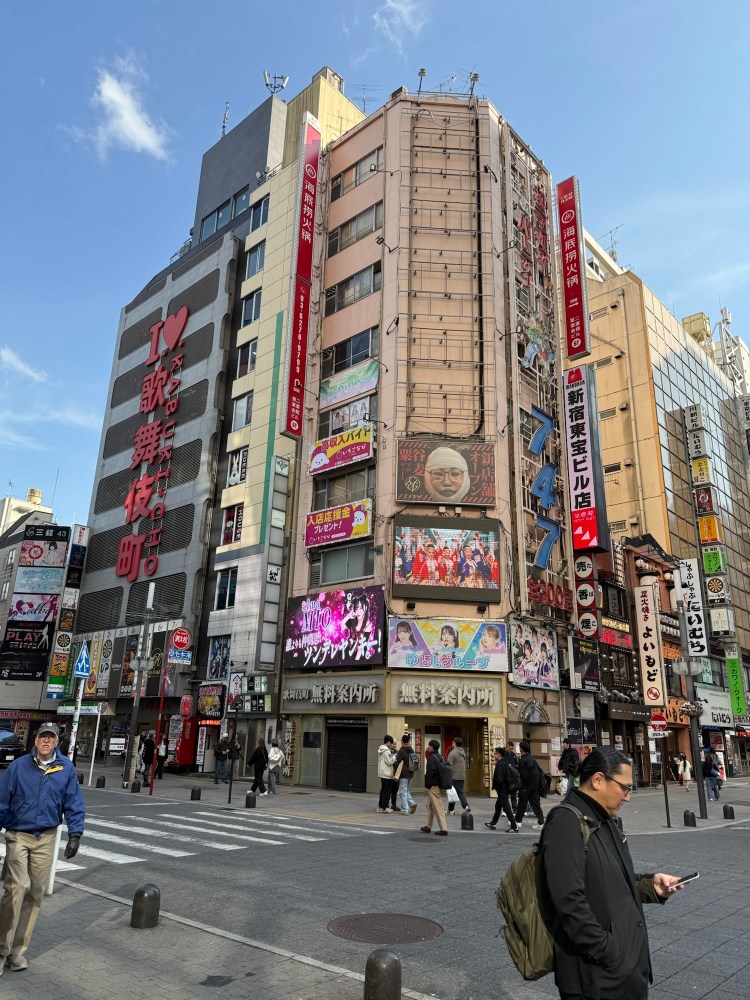
The thing is, the place looks very different in daylight than at night. At night, the lights and colors (to say nothing of the crowds) are disorienting and intimidating. You find yourself surrounded by hundreds of establishments, all wanting to part you from your money by what seems like any means necessary. From some perspectives, it’s exciting, like walking into a funhouse that spans multiple city blocks and stories. From others, it’s actually a bit on the scary side, for many of the same reasons. It is, after all, a supreme case of sensory overload, and deliberately so.
However, in the bright light of day, the man-made lights aren’t quite as intimidating as all that; the touts aren’t out trying to grab your attention – and you – into their storefront establishments, and you can take things with a little more caution. It doesn’t hurt that, wherever you go in public in Japan, you’re never far away from a wireless internet connection these days, so you can look up what’s really being said, rather than just gawking and wondering what everything is saying.
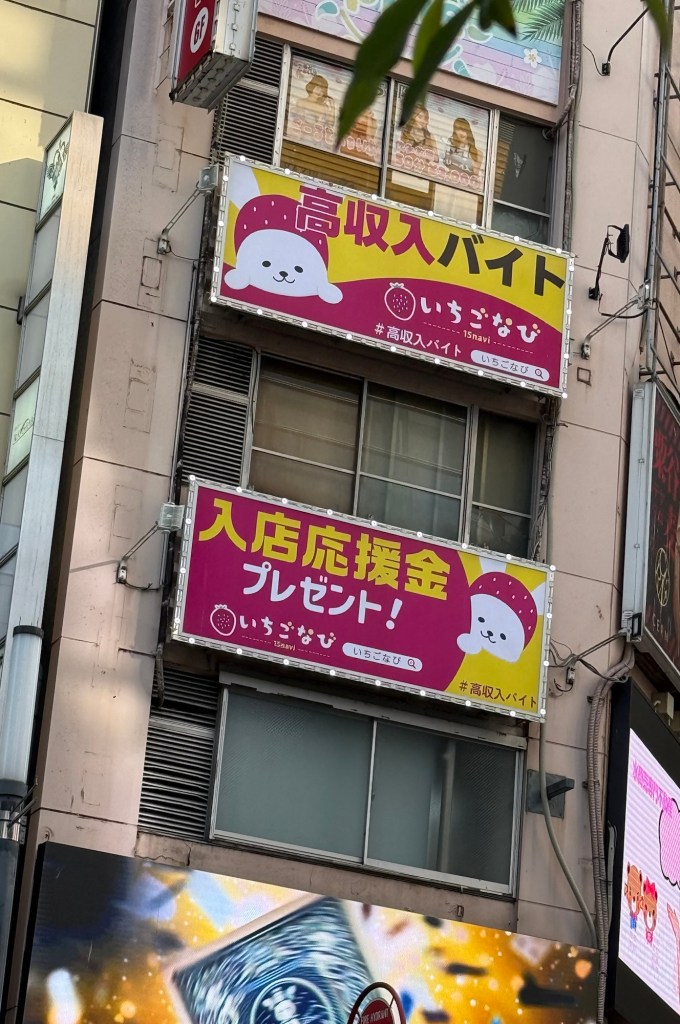
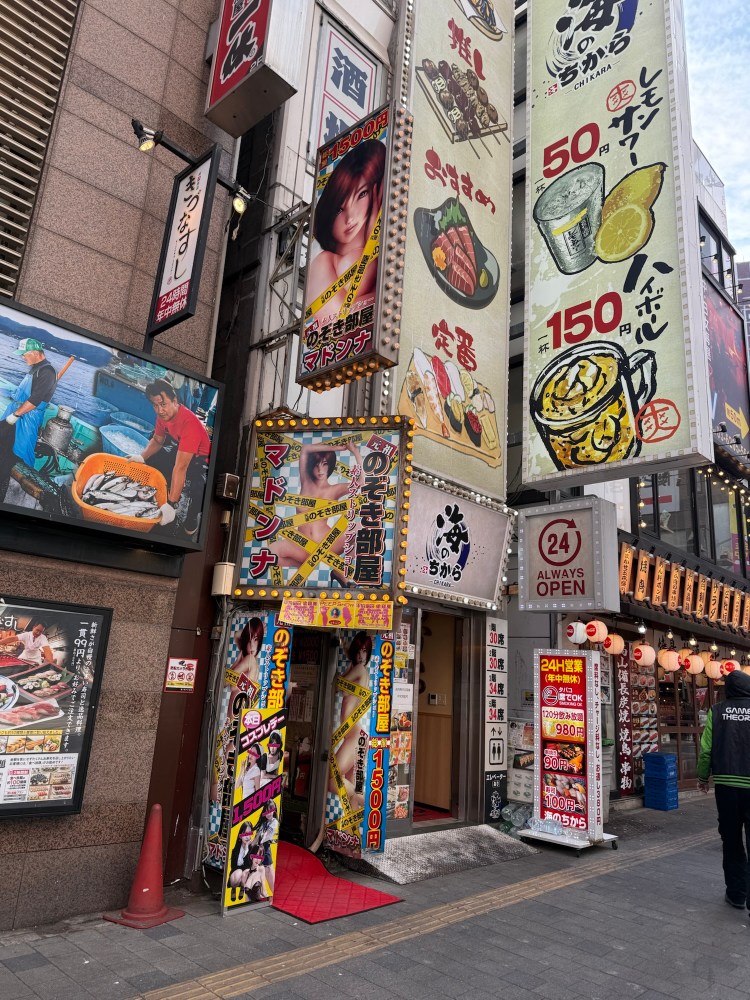
Interestingly enough, while the girls are clearly being exploited here in the advertising, the real marks are the guys being lured in. The cheap drinks, I’m informed, are loss leaders, but the signs by the door offer a little more of what the place actually costs; ¥1,500 to get in, ¥980 to spend 120 minutes with one of the house’s girls (although who’s to say if one would wind up with a girl as displayed on the entryway? I’d wager that the lights inside are dim for a reason), that sort of thing. The customer would also be expected to pay for drinks for his ‘companion’ provided by the house for that ¥980 fee – and you might notice that, while the price of the drinks are advertised loudly, the pictures of food don’t include prices, which is another red flag. The out-of-towner may well see this as a typical izakaya with pretty, scantily-clad girls, only to be hit with a particularly nasty bill at the end of the night.
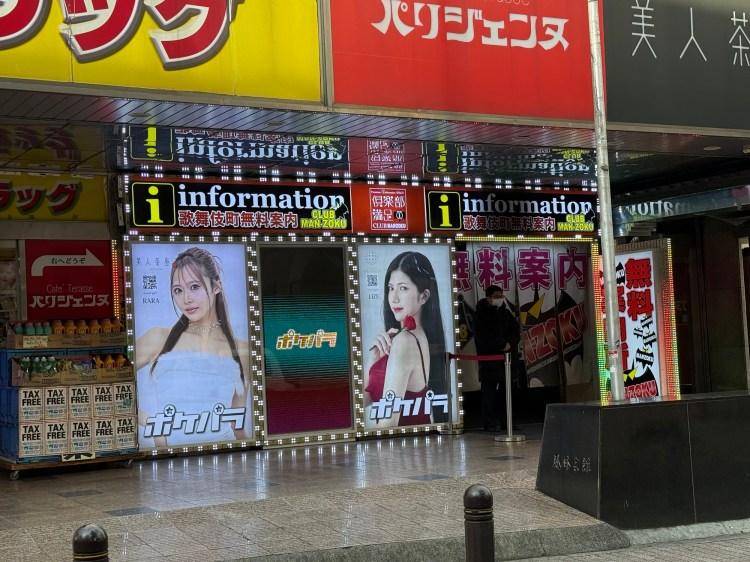
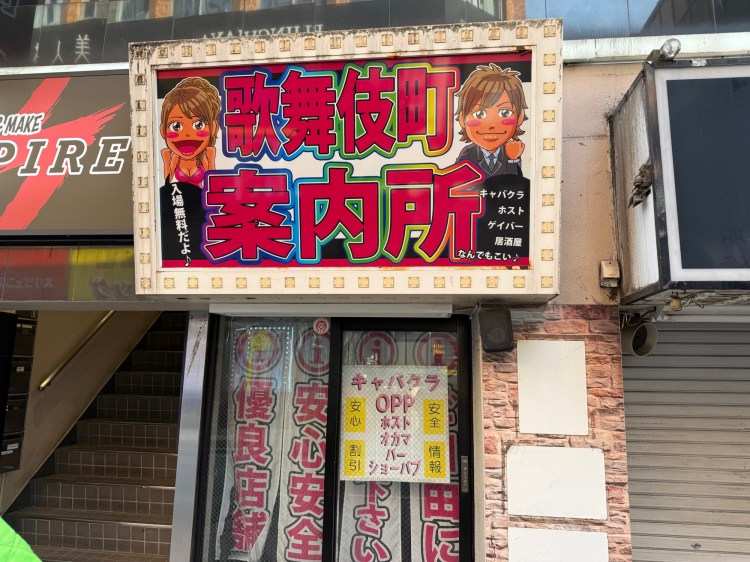
This is all part of a specific industry generally referred to as ‘fūzoku’ (風俗, which translates to ‘public morals’). It’s actually regulated and taxed by the authorities as part of a “harm-reduction” model going back centuries, if not millennia, not just in Japan, but throughout history. The idea is to keep vice confined to a specific area in a city or neighborhood, and the rest of said area will be that much safer for it. Even the sketchier practices here are condoned, within limits; those regulations include the fact that no actual prostitution may take place in these establishments. Which is not to say that such doesn’t happen in Kabuki-cho, but these particular places are too high-profile and garish to actually offer anything strictly illegal. Even the bait-and-switch business model, while illegal in Westerners’ experience, hews to the letter of local law, since the prices are in fact posted, just not in a place where they might be noticeable to the average tourist until it’s too late for them to contest them.
It’s said that sunlight is the best disinfectant; and certainly, in the bright light of day (and with a sufficiently robust internet connection), you can discover what’s what around here, and avoid the worst of it. Then again, using the term ‘disinfectant’ suggests some effort to clean it up; I suspect that, as long as this makes money (both for the proprietors and the taxing officials), this isn’t going to be ‘cleaned up’ as such.
And look, I actually understand the idea behind permitting but quarantining such activity – let those who will buy and sell these services have their own place, and leave the general population alone. However, once you see the cutesy stuff being applied for such nefarious ends, it leaves you suspicious of any such advertisements, when in fact, often they’re promoting something that’s every bit as innocuous as they seem to be.
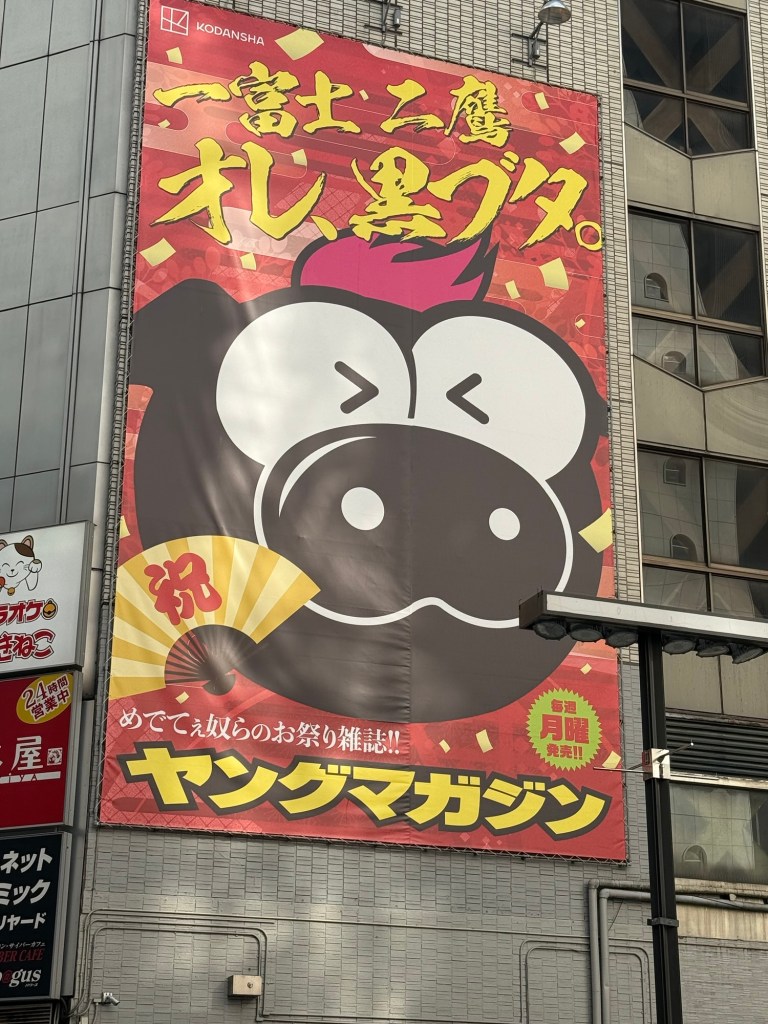
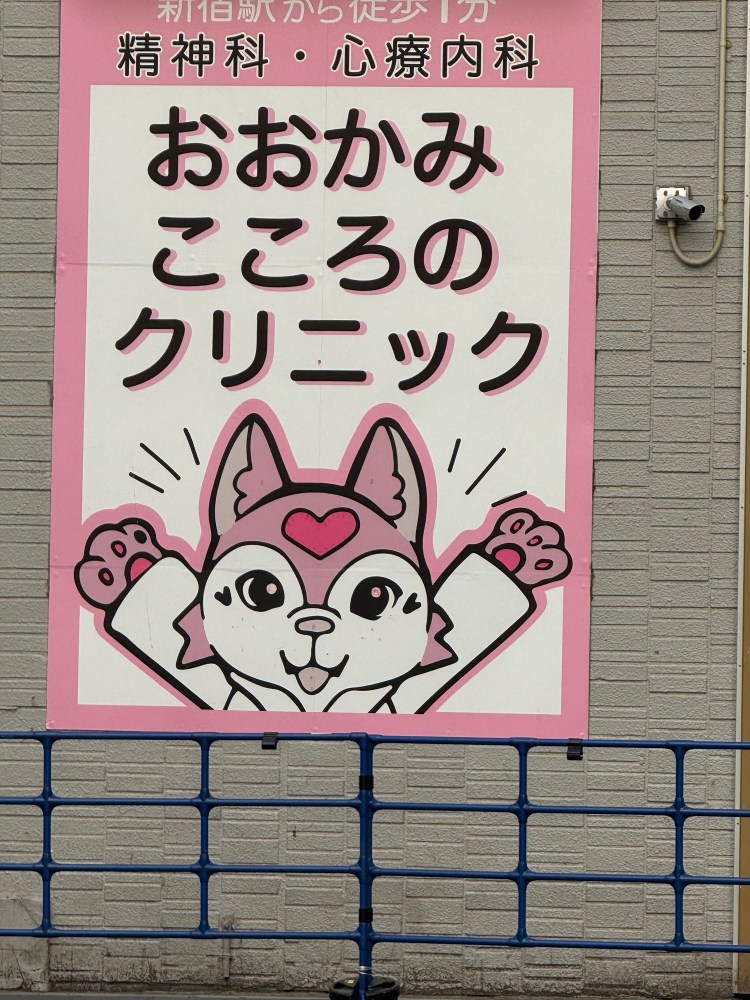
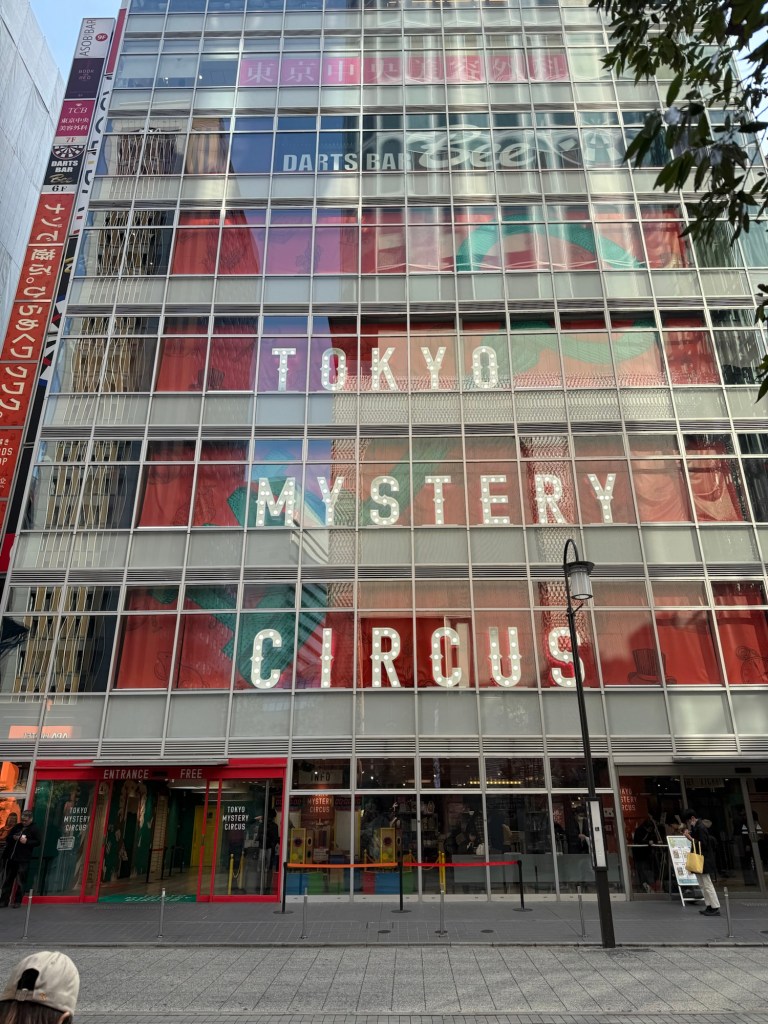
You see, for all of its seedy reputation, Kabuki-cho was intended as an entertainment venue when the city was being rebuilt after WWII. There was a kabuki theater that was planned as part of making it a center of the arts and high culture. However, funding dried up for the theater, and something else, with the focus on a slightly different type of entertainment sprang up. At the same time, it still aspires to the idea of entertaining the masses – hence the cinemas game rooms and the like – which means that it can’t all be seedy. So the area is pulled in two different directions; partly toward the spicy stuff that makes its reputation, and toward a more general-audience-friendly, mass-market version of itself. It’s actually quite the balancing act to keep its edge while keeping suspicious eyes like mine from being jaded.
Indeed, I was getting concerned that even the local food vendors might be ripping customers off. Copilot assured me that such was not the case, and recommended a reputable and well-regarded place for gyoza. Unfortunately, as per usual, its walking directions were such that we couldn’t follow them so that we could find the place it spoke of. Meanwhile, there was another place that it suggested – which had even higher ratings – that was outside of the Kabuki-cho neighborhood. Since we’d had enough of the area for the day (and possibly a lifetime), we called the other place up on Daniel’s map app, and followed that to this other place.
Granted, what it offered was more Chinese dim sum than Japanese gyoza as such (although we did get an order of cute little gyoza as part of our meal), but it was a pretty good meal. The cost was about the same as we’d paid the night before at the sushi place, but we’d ordered several courses and desserts – and again, we’re in the big city – so that’s not unexpected. All in all, a decent way to finish out our trip to the area, and the country in general.
Tomorrow, we head out, and we’d appreciate your eye on us, along with a bit of luck. We’re going to need it.

 Letters to Rachel
One thought on “Shedding Light on Kabuki-cho”