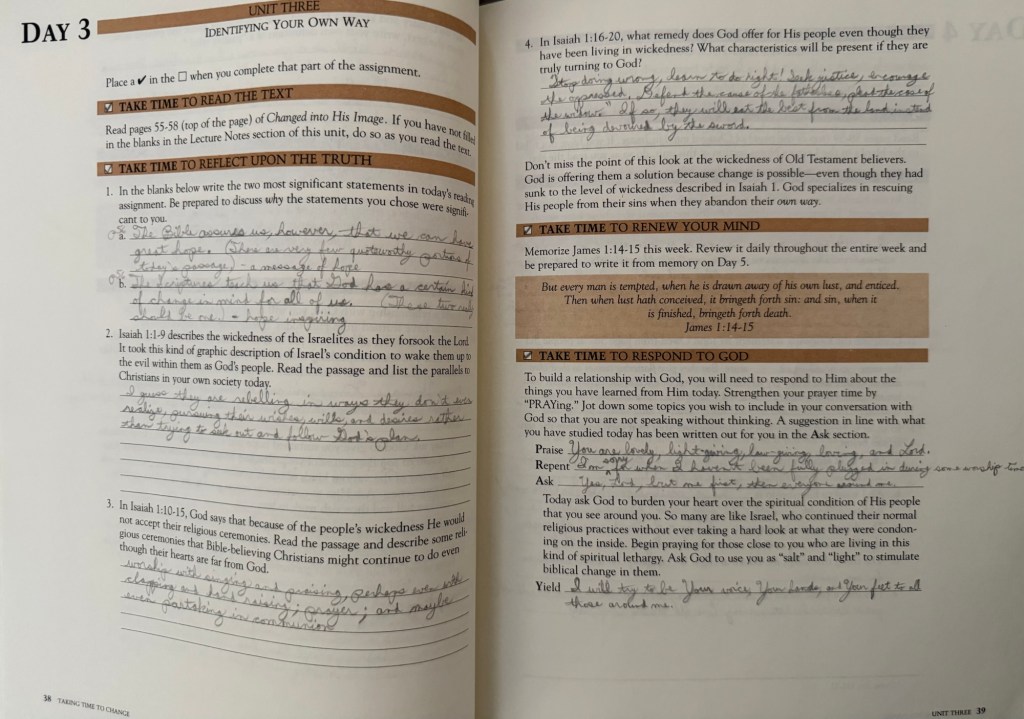
In the blanks below write the two most significant statements in today’s reading assignment. Be prepared to discuss why the statements you chose were significant to you.
“The Bible assures us, however, that we can have great hope. (There are very few quoteworthy portions of today’s passage) – a message of hope.
“The Scriptures teach us that God has a certain kind of change in mind for all of us. (These two really should be one) – hope inspiring.”
Isaiah 1:1-9 describes the wickedness of the Israelites as they forsook the Lord. It took this kind of graphic description of Israel’s condition to wake them up to the evil within them as God’s people. Read the passage and list the parallels to Christians in your own society today.
“I guess they are rebelling in ways they don’t even realize, pursuing their wishes, wills, and desires, rather than trying to seek out and follow God’s plan.”
In Isaiah 1:10-15, God says that because of the people’s wickedness He would not accept their religious ceremonies. Read the passage and describe some religious ceremonies that Bible-believing Christians might continue to do, even though their hearts are far from God.
“worship with singing and praising, perhaps, even with clapping and hand raising; prayer; and maybe even partaking in communion.”
In Isaiah 1:16-20, what remedy does God offer for his people even though they have been living in wickedness? What characteristics will be present if they are truly turning to God?
“Stop doing wrong, learn to do right! Seek justice, encourage the oppressed. Defend the cause of the fatherless, plead the case of the widow. If so, they will eat the best from the land instead of being devoured by the sword.”
Praise – “You are lovely, light giving, law, giving, loving, and Lord.”
Repent – “I’m sorry for when I haven’t been fully plugged in during some worship times.”
Ask – “Yes, Lord, but me first, then everyone around me.”
Yield – “I will try to be your voice, your hands, and your feet to all those around me.”
Dearest Rachel –
Your line of repentance on this particular day’s homework echoes what you had already said about how God was tired of the Israelites’ empty ceremonies regarding Him, and how we, too, can just go through the motions without being truly ‘plugged in’ to what He has for us. I sometimes wonder if I’ve not always been like that, given what anyone might see when Daniel and I stand side-by-side in a worship service. On the other hand, if I were to do many of the things that Daniel does – and occasionally feel like the congregation is being asked, if not outright ordered to do – it would feel like I was putting on an act and going through the motions, which is exactly what we’re not supposed to be doing. If it ever happens, it should be an authentic act of worship, not done under compulsion.
Then again, when I ask others about this, I’m often told that my concern as to whether I’m doing the right thing is a good thing, a mark of sincerity. Which is all well and good, but people can be sincerely wrong, too. Worse yet, as you point out, we can do so without really even noticing, as we spend more time on our own earthly concerns than on those of God. Even when we do think about Him and what He wants for us, do we really ask about how we fit into His plans, or how His plans can be shoehorned into ours?
Even Isaiah’s admonition as to what his contemporaries could do to remedy their standing with God might look very different to modern eyes, depending on one’s perspective. Concepts such as ‘justice,’ ‘the oppressed,’ ‘defending the fatherless,’ ‘pleading for the widows’ and the like mean very different things to different people these days – sometimes going so far as to come into direct conflict with each other, and leading the various factions to consider the other to be wrongheaded at best, and outright evil at worst, even as both sides apparently believe they are following what God wants them to do.
Of course, those conflicting activities take place on a larger scale than one-on-one, and perhaps that’s where we need to focus, rather than those great big pictures. We are but individuals, meant to lift up other individuals, rather than trying to roll the entire world in the direction we think God wants it to go (when we might be mistaken). By helping others individually, quietly, and showing them how to help others in turn, we might do so much more good than by making absurd amounts of noise about this cause or that; in any event, we’d be doing less harm if we’re wrong. We’re still only learning how to do right, as Isaiah points out.
Which leads to one of the few times I’ve seen you include a separate ‘ask’ beyond the recommendation already printed in the daily lesson. The author recommends asking for the ability to be ‘salt’ and ‘light’ to others around you suffering from spiritual lethargy. But rather than leaving it at that, you actually ask for His help for yourself first of all, not unlike those safety demonstrations on airplanes where, when the oxygen masks come down, you need to have yours on before helping others. You’re asking for His help in getting your spiritual air flowing so that you could assist those around you; something I need to ask for in turn.
And toward that end, honey, I’d ask you to keep an eye on me, and continue to wish me luck, as I’m going to need it.

 Letters to Rachel