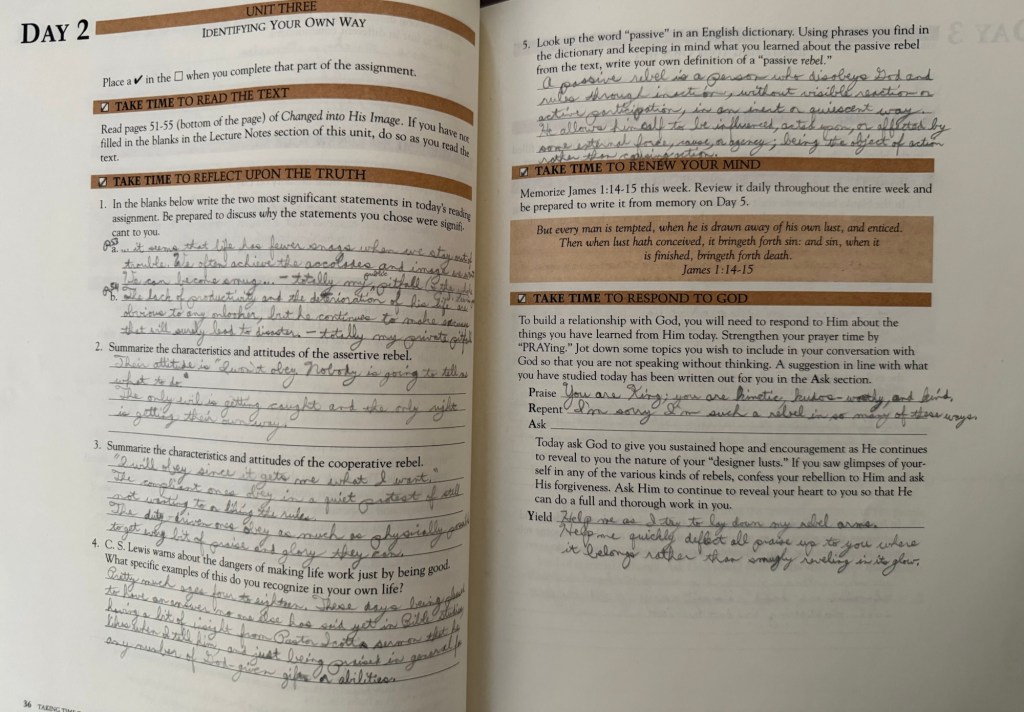
In the blanks below write the two most significant statements in today’s reading assignment. Be prepared to discuss why the statements you chose were significant to you.
“‘…it seems that life has fewer snags when we stay out of trouble. We often achieve the accolades and image we want. We can become smug…’ (and the whole C. S. Lewis passage) – totally my public pitfall
“ the lack of productivity, and the deterioration of his life are obvious to any onlooker, but he continues to make excuses that will surely lead to disaster – totally my private pitfall.”
Summarize the characteristics and attitudes of the assertive rebel.
“Their attitude is ‘I won’t obey. Nobody is going to tell me what to do.’
“The only evil is getting caught and the only right is getting their own way.”
Summarize the characteristics and attitudes of the cooperative rebel.
“‘I will obey since it gets me what I want.’
“The compliant ones obey in a quiet protest of still not wanting to or liking the rules.
“The duty-driven ones obey as much as physically possible to get every bit of praise and glory they can.”
C. S. Lewis warns about the dangers of making life work just by being good. What specific examples of this do you recognize in your own life?
“Pretty much ages four to eighteen. These days being pleased to have an answer no one else has said yet in Bible studies, having a bit of insight from Pastor Scott’s sermon that he likes when I tell him, and just being praised in general for any number of God-given gifts or abilities.”
Look up the word ‘passive’ in an English dictionary. Using phrases you find in the dictionary and keeping in mind what you learned about the passive rebel from the text, write your own definition of a ‘passive rebel.’
“A passive rebel is a person who disobeys God and rules through inaction, without visible reaction or active participation, in an inert or quiescent way. He allows himself to be influenced, acted upon, or affected by some external force, cause, or agency; being the object of action rather than causing action.”
Praise – “You are King; You are kinetic, kudos-worthy, and kind.”
Repent – “I’m sorry I’m such a rebel in so many of these ways.”
Yield – “Help me as I try to lay down my rebel arms. Help me quickly deflect all praise up to you where it belongs rather than smugly reveling in its glow.”
Dearest Rachel –
I suppose the point of this particular day’s study is that we are all rebels (against God, and for our own way); it’s just a question of what kind we are. I’d say ‘what level,’ but it hardly matters. A rebel is a rebel, no matter what they’re doing to fight back (or not). One can be clearly fighting, or an apparently cooperative fifth columnist, or a passive striker; each do their own form of damage. It doesn’t work like in Dante, where one form of sin is considered worse than another. It’s all sin, and it all breaks fellowship with God.
You seem to have settled on describing yourself as the ‘duty-driven,’ cooperative rebel, doing your part more for the praise and attention it gets you. And I have to admit, I recognize the description, not because of how I remember you – although yes, I recall you making a point most Sundays of going over to whoever had been speaking in order to offer an insight of your own – but because I can see a fair amount of that in myself as well.
Now, I might argue that you and I sought praise (and in my case, still do) to confirm that we’re headed in the right direction, on the right path. The Proverbs speak multiple times of a person’s way seeming right to themselves, but that following it without external advice or correction can lead to disaster. For all that I’ll occasionally talk to you about working with artificial intelligence, this is its Achilles’ Heel; the fact that it can be confidently wrong. And why should that surprise anyone, when it’s built be humans who are often just as confident in their state of error? So it behooves us to get confirmation from others that what we are doing is, in fact, the right thing (or at least, right enough; for all that I complain that God does not seem to set out my path in complete detail for me to guide every decision, it’s been pointed out that in many cases, He offers multiple choices that would each be within His plan for me, even as they’re mutually exclusive).
The problem with seeking confirmation like this is —fold. First of all, we run the risk of relying on human input rather than what God has to say about our decisions. Humans, even the wisest of them, are still human, and capable of error. Even in groups, where multiple perspectives can be combined to gain that much more wisdom and focus, thereby minimizing this possibility for error, it can’t be eliminated. There is a Japanese saying that “three minds have the wisdom of the Buddha”; but of course, even the Buddha is not God. Not only that, but there is the potential for groupthink, where pressure within a group prevents objections from being raised. On our part, we also run the risk of cherry-picking the counsel that tells us what we want to do, anyway. And finally, there’s a fine line between this affirmative confirmation and outright praise; while it may be argued that was need some of the former to stay on the straight and narrow, we can get addicted to the latter, and when it dances on either side of that line, well… we get to where we are.
I’ve often complained that I don’t hear God’s voice directing me, honey; I wonder if it’s not because I’m asking too many other people for encouragement along my way, and His still, small voice gets drowned out in the midst of all that I seek out. Maybe this is my rebellion, even as I try to head in what I think is His general direction.
Still, if you could keep an eye on me as well, and wish me luck in continuing (or adjusting myself) on my way, I’d appreciate it. It’s pretty clear I need it.

 Letters to Rachel