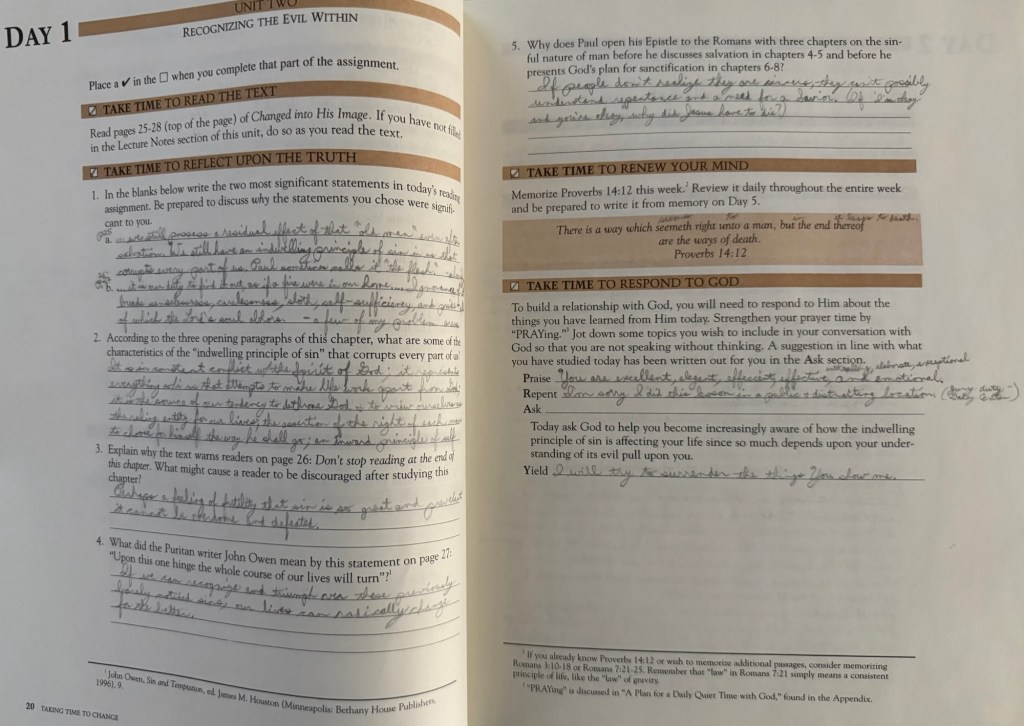
In the blanks below write the two most significant statements in today’s reading assignment. Be prepared to discuss why the statements you chose were significant to you.
“…we still possess a residual effect of that ‘old man’ even after salvation. We still have an indwelling principle of sin in us that corrupts every part of us. Paul sometimes calls it ‘the flesh’ – clarifying
“…it is our duty to find it out, as if a fire were in our home… Ignorance of it breeds senselessness, carelessness, sloth, self-sufficiency and pride – all of which the Lord’s soul abhors – a few of my problem areas.”
According to the three opening paragraphs of this chapter, what are some of the characteristics of the ‘indwelling principle of sin’ that corrupts every part of us?
“It is in constant conflict with the Spirit of God; it represents everything within us that attempts to make life work apart from God; it is the source of our tendency to dethrone God and to view ourselves as the ruling entity for our lives; the assertion of the right of each man to choose for himself the way he shall go; an inward principle of self.”
Explain why the text warns readers on page 26: Don’t stop reading at the end of this chapter. What might cause a reader to be discouraged after studying this chapter?
“Perhaps a feeling of futility that sin is so great and prevalent it cannot be overcome or defeated.”
What did the Puritan writer John Owen mean by this statement… ‘Upon this one hinge the whole course of our lives will turn’?
“If we can recognize and triumph over those previously barely noticed sins, our lives can radically change for the better.”
Why does Paul open his Epistle to the Romans with three chapters on the sinful nature of man before he discusses salvation in chapters 4-5 and before he presents God’s plan for sanctification in chapters 6-8?
“If people don’t realize they are sinners, they can’t possibly understand repentance and a need for a Savior (If ‘I’m okay and you’re okay,’ why did Jesus have to die?)”
Praise – “You are excellent, elegant, efficient, effective, enthralling, elaborate, exceptional and emotional.”
Repent – “I’m sorry I did this lesson in a public and distracting location (Jury duty – Daley Center)”
Yield – “I will try to surrender the things You show me.”
Dearest Rachel –
This is the thing about the Christian faith; we believe it will save us from what is to come – to the point where some folks disdainfully refer to it as ‘fire insurance’ – but while it may render our lives fireproof, like a home retrofit, they aren’t instantly made good as new. Indeed, this self-renovation, or sanctification, takes all of our lives, and never quite gets completed to perfection. Some may come close, while others barely even seem to bother with the work, but we all have issues as long as we’re stuck here in this fallen world.
The thing is, we live in this dilapidated frame for so long, we get used to, and even grow attached to, its quirks and foibles. It gets hard to let go of certain aspects of our lives that could otherwise be improved if we would allow God to work on us. It’s easier to live with the problem than to try to fix it; and after a while, the ‘problems’ can be embraced as things that give us ‘character,’ and we don’t want to give them up.
You made a slightly different comparison in a comment you wrote on the page prior to the one above:
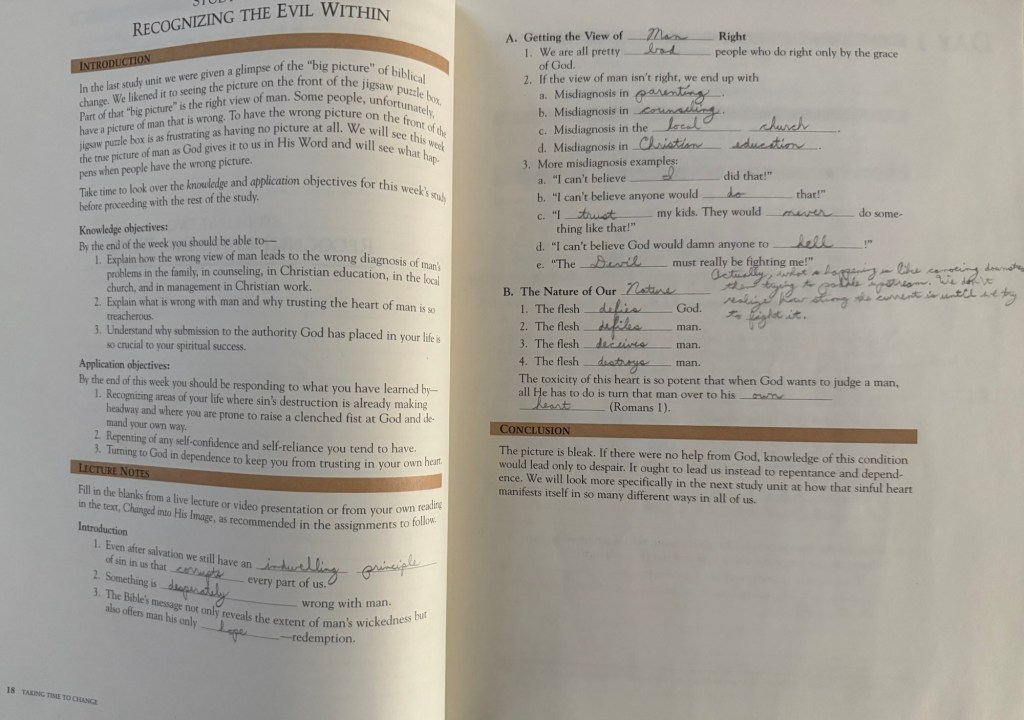
“Actually, what is happening is like canoeing downstream, then trying to paddle upstream. We don’t realize how strong the current is until we try to fight it.”
Too many of us, once we get far enough downstream, consider it too much of an effort to make our way back upstream. And in fairness, it’s not as if we can paddle our way out of this mess on our own; just like we can’t save ourselves in the first place, so too the whole process of “working out our salvation” has to be done with the help of the Spirit. And He will only help us toward that if we let Him. To extend the metaphor, He’s in the boat with us, ready to put an outboard motor on it, but only with our permission. Meanwhile, we keep paddling while He sits there patiently, waiting for us to give up and give in to His power.
You mention a few of what you considered your “problem areas,” but I think we all struggle with a lot of the things you mention. In fact, I had to parse ‘self-sufficiency’ for a moment while transcribing it; “isn’t that normally considered a good thing?” was what ran through my head at the moment. Well, yes, as one grows up and becomes a person independent of their parents and the like, this is admirable, even expected, but not when it comes to thinking one knows better than God as to what is best for one’s life. And I suspect we all have to deal with this from time to time; we just need to recognize when it’s happening, and pull ourselves back from that precipice – or more to the point, ask God to bring us back from that point.
And with that having been said, I should ask for your eye upon me, that I don’t get so full of myself that there’s no room for God and His plan. Oh, and wish me luck, as I’m going to need it.

 Letters to Rachel