Dearest Rachel –
I don’t know if my body caught wind of my concerns about waking up early enough tomorrow to meet in the lobby at two in the morning, but rather than let me have a solid night’s sleep, it decided to prove what it was capable of. As a result, when I first woke up in the darkness of a still-active city, wondering how soon it would be before my alarm would sound, I lay there for a bit before curiosity overcame me.
Upon pulling up my phone, I was struck by a pair of conflicting emotions as I read the time of half past one. On the one hand, there is nothing more satisfying to see when you have to wake up earlier than you’d like than an indication that you can sleep for a few extra hours longer. On the other hand, no matter how groggy you may be when you do so, there’s never any telling as to how long it will take and how hard it will be to fall back asleep and take advantage of those extra hours you’ve been granted. Since you were a night owl rather than a morning person yourself, honey, I’ll bet you’re that much more familiar with this sensation than I am, although let me assure you that this isn’t the first time I’ve dealt with this.
However, it’s been a while since I’ve dealt with trying to sleep in the middle of a strange and noisy city. I thought I remembered Jerusalem as practically shutting down in the wee hours; certainly, the last time we left here, the streets we all but dead. Then again, it may just have been because we were leaving on a Saturday, and the closed-down sensation had more to day with the day than the hour.
In either case, it felt like an hour went by with the occasional honk from the traffic below (why would a driver feel the need to honk, with the traffic so minimal, at this hour?) at regular intervals to keep me from fully falling asleep again. Still, I do seem to have misplaced consciousness at some point, because I found myself reaching for my phone again to find that it was after five o’clock by them. Time enough to shower and dress (and maybe rearrange the suitcase for tomorrow) before heading downstairs for an early breakfast.
We’d been recommended to start early today, not just because we would be leaving the hotel earlier than usual (we actually had an appointment to peruse the Temple Mount this time around), but because a contingent of IDF were staying at our hotel concurrently with ourselves.
You might have been amused at the madhouse that was last night’s dinner. I’m sure they were taking as much advantage of the opportunity for something better than battlefield rations as they possibly could. In any event, we were advised to show up for breakfast before they were scheduled to invade the restaurant again at seven this morning. However, the place didn’t open up until six-thirty, so we had a narrow window to work with. Still, after over a week of this sort of thing, we’re just about getting the hang of it all. Pity that we’re going to be out of here in less than twenty-four hours.
But all that is just preliminary, prosaic detail; the typical stuff that accompanies travel in general. You’re here for the meat of the story; the history this place bleeds, to remind you of its real significance. These are the places Jesus and his disciples walked and taught in; they were real people, not made-up stories. And while some of the buildings (like the Temple itself, although even its destruction was foretold by Him) are no longer there, except as ruins, there is more than enough to remind us that this was real. That’s what makes this place special.
***
The visit to the Temple Mount is… as always, hard to explain. Unlike certain other sites, even just over the wall from the complex, the area has not changed. We have to consider ourselves fortunate to be allowed in – and not just because of the security screening, as the Israeli police manning the tourist entrance, while firm, are perfectly cordial in their professionalism – and yet, it doesn’t feel that much different from previous visits. To be sure, Yael divulges information I can’t recall hearing before about how, between the Temple’s destruction and the construction of the Dome of the Rock, there was no church placed here, as with places like the Nativity or the Sepulcher. It would seem that Queen Helen decided to let the place remain with “not one stone atop one another.”
However, religion, like nature, apparently abhors a vacuum, and where a church was not built, a mosque eventually was. Still, for all that this is a holy convergence between the Abrahamic faiths, we have to remember that, once the veil was torn, there was no confining God to a single room (as if he could be on confined to such a small space in the first place -even Solomon himself acknowledged that fact). This is historically significant for us as Christians, but it is no more sacred ground than anywhere else that His children walk.
Our next stop is supposed to be the Garden Tomb, but since we’re walking there, Yael feels compelled to point out the stations of the cross that we pass on the way, since the main route to get through the city from the Dung gate to the Damascus gate is on the Via Dolorosa. We only get as far as number four, but it’s not as if I’m familiar with any of the fourteen.
Once we’re out of the Damascus Gate on the north side of the Old City, it’s a fairly short walk (just shy of two hundred yards) to the Garden Tomb. Our visit is comprised of three stops; one overlooking Skull Hill (Golgotha in Aramaic, and Calvary in Latin), another outside the tomb itself, and then we gather for worship and communion in a small pavilion off to the side of the tomb.
I don’t film the singing, in part because that keeps me from participating (and I observe far too much through the camera lens as it is; it’s an unfortunate side effect of the process), but also because, as we start singing, the call to prayer is broadcast from a minaret overlooking Skull Hill. As long as we’re singing, we can drown it out (it definitely gives a little more punch to the lyric “You have no rival”), but it does go on for some time.
Despite the fact that the only way out is through the gift shop, we don’t linger very long there; we have other places to be and go to. Junior is leading a contingent to the tattoo parlor that’s been run by the same family for some seven hundred years; nearly two-thirds of our number head over there. Meanwhile, the rest of us make our way into the Old City to eat and shop.
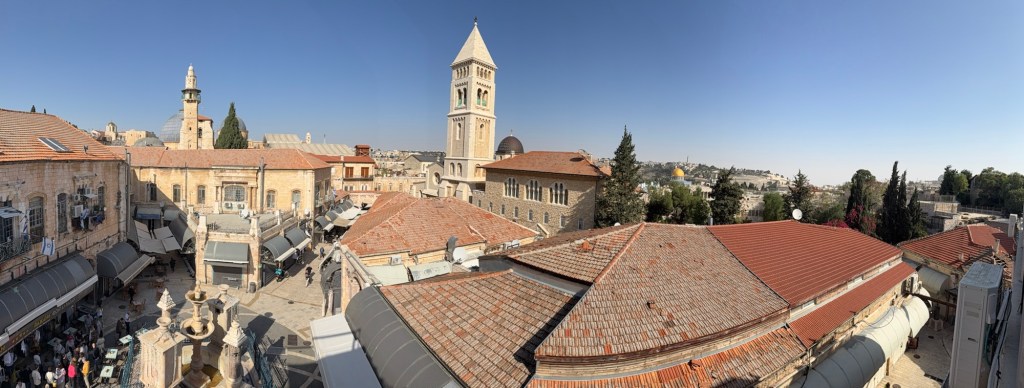
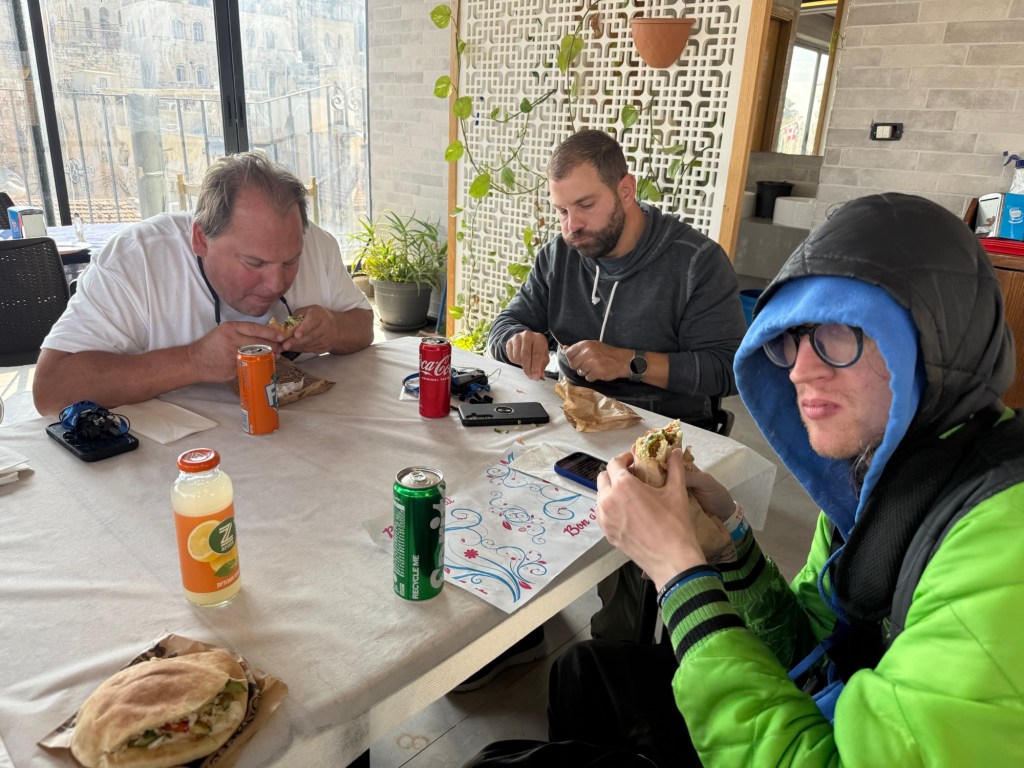
The next couple of hours are spent wandering through the streets of the Old City, mostly on the way to the Western Wall. However, almost without intending to (well, without Daniel and I intending to; I think some of the others deliberately wanted to come here), we end up at the Church of the Holy Sepulcher. While we don’t necessarily see the appeal of wandering through a cathedral designed to commemorate Jesus’ death and resurrection, but seeming more to cover it up with excessive decoration, it is a sight that we know we’ve never gotten the opportunity to see, and likely never will again, so we follow the group inward.
From there, we continue through the Christian and Jewish quarters of the city; none of us really gets much chance to do much in the way of shopping – which I don’t mind all that much, but I know I’m going to have to get my hands on some cash soon enough, as I didn’t bring enough for tips. Thus far, however, every ATM either is out of order, has no English option or declines my card (possibly from requesting more cash than it’s able to dispense). It’s getting disconcerting as time wears on, and failure builds on failure. For the moment, though, there are other things for me to focus on.
Finally, though, we arrive at the Western Wall, and for whatever reason, I’m suddenly exhausted. Maybe it’s all the walking; maybe it’s the continued concern about finding a place to get cash. Maybe it’s the celebrations and presentations going on at the wall that we don’t want to interfere with. Maybe it’s that the last requests you (and later, I) put in the wall have yet to be fulfilled; why ask for more at this point? But in any case, Daniel and I decide to hang back and just wait for everyone else to rejoin us.
Once they do, we call it a day… and now that I’ve told you about it, I can call it a (very short) night. So begins the end of this trip, and all that is left is epilogue. But until then, honey, keep an eye on us, and wish us luck. We’re going to need it.

 Letters to Rachel