Dearest Rachel –
The last dozen or so of the Psalms are referred to as “songs of ascents,” as they’re meant to be sung while en route to the city of Jerusalem, which is, as you’ll recall, built on the top of a mountain (Mount Zion, or going even further back, Mount Moria, where Abraham was tested regarding his willingness to sacrifice his son Isaac). This letter isn’t really meant as a song of praise, so don’t go looking for any soaring poetry in it; however, it can at least be considered a retelling of our ascent toward Jerusalem as best I can do.
Of course, before we ascend towards the city of Jerusalem itself, we have one more stop in the Dead Sea area to visit, which is an ascension of its own. It’s one of those places that is visited regularly by pilgrims to Israel, despite having no direct connection to any of the biblical texts; the fortress of Masada. Like the city of Gamla on the north side of Galilee, this was ultimately destroyed by the Romans as part of the Jewish rebellion in the late 60s A.D., culminating in the destruction of Jerusalem. Also like in Gamla, its defenders committed suicide en masse, rather than allowing themselves to be captured by the Romans.
I was tempted to take the path leading up to the fortress, but when I heard that we didn’t have the time for that sort of thing, I decided against it. I do intend to take it at some point on a future trip; but thus warned about time constraints, I thought better of it today. However, once we arrived at the top, I discovered that there were some people who decided to climb the path anyway.
Meanwhile, the tour went on for longer than we had budgeted; I think even some of our leaders were getting antsy, especially considering that Masada doesn’t have much in the way of biblical significance. I did get time to take a fair amount of footage; I hope I’ve edited it properly.
I have to admit to being grateful for the USB plugs throughout the bus; while I might not be able to access the Internet, any better than at the hotel we just left a few hours ago, at least I can charge both my phone in my camera. The ladder, in a particular; after the time spent at Masada, it was down to only half its charge. It would never have survived an entire day.
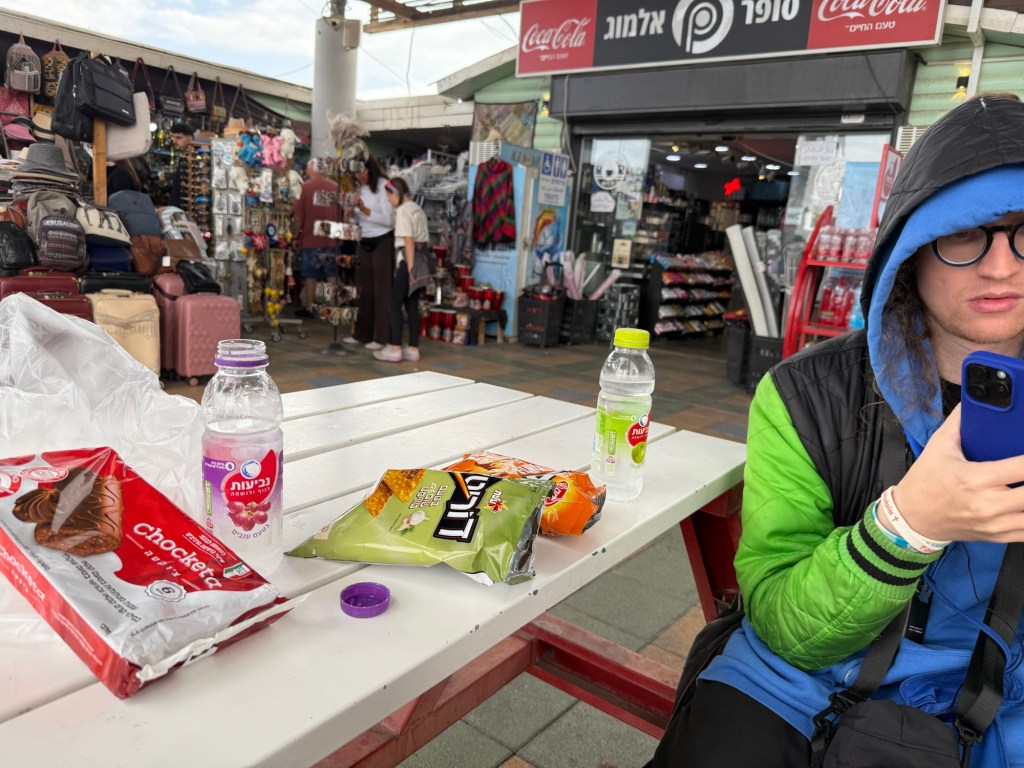
Then again, our next stop – if you can call it one, since it doesn’t seem like a place to be visited by a Bible study tour – actually has wi-fi for the time we spend there. It’s one of those ‘shopportunities’ that, when they come around, you have to take advantage of them. Besides, I wasn’t able to do anything at the mall near where our hotel was located, so this more than makes up for it.
Junior acknowledges that this stop seems a bit out of character from the rest of the tour, but given that we are about to hit Jerusalem, with all the weight of both history and symbolism around every corner, we could use this ‘breather’ moment before everything ramps up. To be fair, I’d claim that the whole time at the Dead Sea could be considered a ‘breather’ episode (apart from the fact that we don’t even have time to unpack before we have to leave our hotel again), but I’m not going to complain about any amount of relative downtime.
A half-hour’s worth of driving brings us back up to Qumran, and while the views of the sea are spectacular from the height of our road, it’s surprising how quickly the beige of the rocks and sand grows monotonous. It should be fascinating, as nothing like this exists at home, but when your entire field is filled with nothing but beige, well…
To be fair, eventually the beige gives way to orchards of palm trees and the more than occasional shrub here and there, but this stretch of land is utterly empty.


From here, we turn west, and begin winding between west and north as we ascend the four thousand feet toward Jerusalem. It takes less than a half hour from our rest stop before we enter the tunnel that opens up to a view of the Old City, now below us as we continue to climb the Mount of Olives.
Once we arrive, we gather in one of the niches overlooking the old city, specially built for groups such as our to gather and contemplate the view, Yael describes the history of the city, and Junior explains about the prophecies pertaining to both the place we’re standing and the city below.

As we disperse to take pictures and footage, the afternoon call to prayer rings out, haunting and eerie. Needless to say, I don’t film anything more once that starts.
We don’t walk down the Mount of Olives this time around, although given the traffic, it might have been faster to do so. Somewhere along the road, our bus runs over something, maybe a soccer ball; the popping sound is like a gunshot, alarming more than a few of us. Had we made our way on foot, the poor thing might have been spared. Then again, the bus would have had to come down to retrieve us, so it may have been a matter of timing.
Either way, it’s a ten-minute ride to the Garden of Gethsemane, and a few minutes’ negotiation to allow us into the private grotto.
Pastor Scott recommended to all of us that we not film in this place (although not until after I recorded his remarks). Given that I’m all too prone to snark on camera, I understand that such wouldn’t be appropriate, and hold off thereafter.
But I could think of more than a few things I might say here. The name of the garden – Gethsemane – refers to the press where the olives were squeezed for their oil. I wonder, Lord, what it was like to be pressed under the weight of the sins of billions of people – everyone who had lived, who was living, who would live, and who have yet to live – and did You sense the weight of mine in the midst of all that? Did it just strike You at that moment, or had You been able to ignore it up until that time? How did You know that Your prayer to the Father was not going to be answered; or rather, that it would be answered with a “no”? And while I know that if I were to be the only one You could save by Your actions, You would still go through with it all, did it help to know how many You would save, or was the knowledge of those who wouldn’t be saved more than enough to crush that glimmer of hope?
***
On an unrelated note (or maybe it’s related too, in which case it’s more the pity), we had been warned by Yael to leave our wallets and any non-essential items on the bus (you came with in the pocket of my jacket), as this area of Jerusalem is known for its pickpockets. I can’t say that I’d recognize one on sight, but the hawkers are another matter entirely. However, with no money on hand, I couldn’t have bought anything from any of them, even if I had wanted to.

Likewise – and this might have ruined things – this also meant that I had nothing to put in the donation box (labeled as being for the upkeep of the garden). As our group was leaving, several of the attendants there were quite adamant about us putting in donations, but that was beyond my control at the moment. However, one of our number offered his belief that those donations weren’t entirely going to the church for the garden’s upkeep; “If it was going to the church, they wouldn’t be so insistent about it.”
It’s a shame that we feel the need to be so cautious and cynical about people, especially in a place known as ‘the Holy City,’ and yet here we are.
***
From the base of the Mount of Olives, our bus has to ascend again, honking its horn every so often (hey, it’s a city, with all the things you could expect from one), as we make our way to our hotel, at which point, the sun is disappearing below the cloud line in the west. It seems that it takes longer to travel this distance than to go from the oasis to the city limits in the first place. Eh, that’s how things go, I suppose.
Some of the group are talking about going to the market area after dinner, but since the markets themselves are closed, and I’m not much for the nightlife (and Daniel that much less so), I’m torn about it. I’d like to be social, but it doesn’t seem like my thing. Besides, we’ve been down there before, and have no need for a restaurant at this point, anyway. I think we may as well call it yet another early night, despite the fact that tomorrow is starting a little later than the days have been. We’ll have to see what the day brings.
And with that being said, honey, I hope you’ll be willing to keep an eye on me in the days to come. Oh, and wish me luck; I’m going to need it.

 Letters to Rachel