

One of our chief goals in this study of Daniel is to become familiar with the basic themes of each chapter. Recall as many of our chapter rhymes as you can…
Daniel One: Carried “off to Babylon”
Daniel Two: “Neb’s Dream” Statue
Daniel Three: From a “Fiery” Furnace “Freed”
Daniel Four: I’ll “Humble Neb” Some More
Daniel Five: Says the Handwriting, ‘“You Die”’
Daniel Six: The “Lion’s Jaws” Fixed.
Daniel Seven: There’s a “Judge” in Heaven
Daniel Eight: “Antiochus” Spreads Hate
Daniel Nine: “Seventy ‘Sevens’” in Time
Daniel Ten: Where’s the “Angel” Been?
Daniel Eleven: A “Vile King’s” Succession
Daniel Twelve: Shine Bright “Till All Is Well”
Let’s read our text for today: Daniel 11:20-32. Look back at your chart of Seleucid kings on day 1 and identify each of the rulers depicted in the following segments:
Daniel 11:20 – “Seleucid IV” Daniel 11:21-32 – “Antiochus IV”
Swindoll continues, ‘After the battle, the two kings feasted together, toasting, and making bargains.’ How is this meeting described in verse 27?
“sit… and lie to each other, but to no avail.”
What does verse 28 forecast regarding the heart of the king of the north Antiochus IV?
“His heart will be set against the holy covenant.”
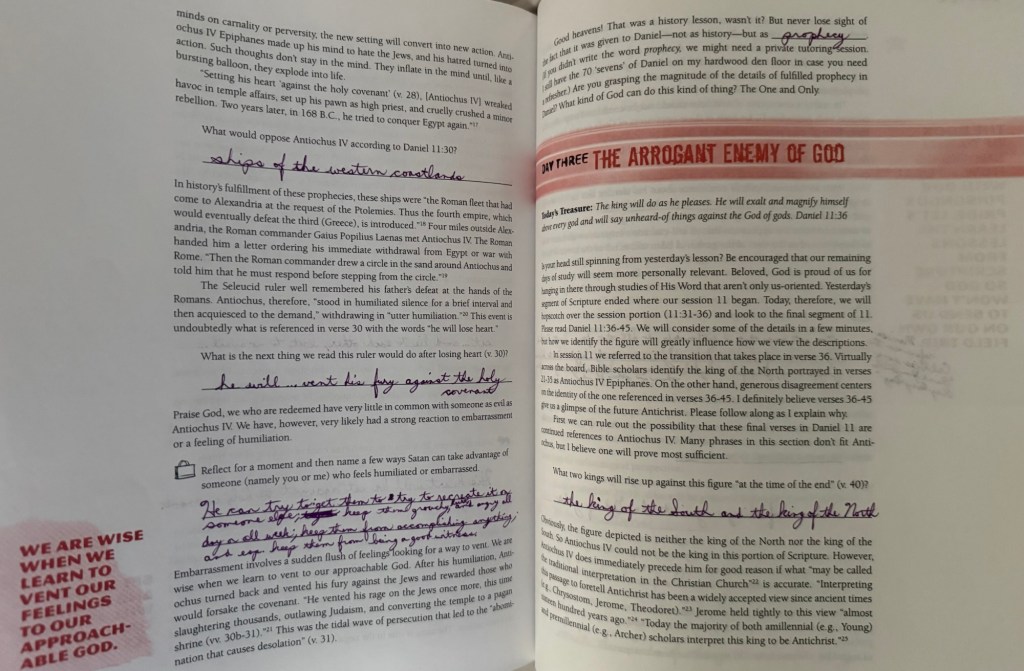
What would oppose Antiochus IV according to Daniel 11:30?
“ships of the western coastlands”
What is the next thing we read this ruler would do after losing heart (v. 30)?
“he will… vent his fury against the holy covenant.”
Reflect for a moment and then name a few ways Satan can take advantage of someone (namely you or me) who feels humiliated or embarrassed.
“He can try to get them to try to re-create it on someone else; keep them grouchy, hurt, and angry all day or all week; keep them from accomplishing anything; and especially keep them from being a good witness.”
But never lose sight of the fact that it was given to Daniel – not as history – but as “prophecy”
Dearest Rachel –
For all the prompts there are on today’s study, the only thing that really sticks out here is your answer about how an embarrassed or humiliated Christian is a vulnerable Christian. And it’s not even a response that seems to be coming from personal experience, but a fairly generic list of possible ways that vulnerability could be exploited by our longstanding enemy. Not that this is an issue; it could have been just that you weren’t going through much at the time, and saw little in your personal life to tie to the question at hand.
The one thing that comes to mind about the answer (or maybe it’s how the question is worded) is that we as Christians are instructed to be humble. After all, in comparison to our Lord and Savior, what have we to be proud about, in and of ourselves? If we don’t practice humility in our Christian walk, it may well be that God will need to allow circumstances in our lives to beat humility into us.
Of course, this runs the risk that we’ll blame God for the troubles He allows to befall us. I’m sure there were plenty of Daniel’s countrymen who did just that, as they were carried off to places like Assyria and Babylon – places that, as the prophet Habakkuk pointed out a generation or two before, were considerably more evil than the Israelites were, even on their worst days. The bitterness toward what God had permitted to happen even crept into other parts of scripture; consider the coda to Psalm 137, where a blessing is pronounced on those who would “dash the little ones [of Babylon] against the rocks.” I would ask where the grace was in this statement, but this was in the age before grace, I suppose.
Still, even as those mighty nations were doing what mighty nations have always done – conquering other nations, annexing their land and either destroying or assimilating their people – the Lord had appointed a day when they, too, would be overwhelmed and overthrown by the next great kingdom to rise up after them. This book essentially lists them all in various forms, perhaps without naming names (as future names would mean nothing to Daniel and his contemporaries, but the real meaning – that no human kingdom can last forever without God’s support and its relying on that support – can be understood and accepted at any point in time), but its readers could understand and accept that whatever they was dealing with, it would eventually “come to pass,” as the saying goes.
Just as humiliation is imposed on one nation after another when they lose their humility, so too can it be with us as individuals. God will not directly embarrass or humiliate us Himself (unless, like with Nebuchadnezzar, we demonstrate our desperate need for it), but He will allow it to happen as He sees fit. It’s at that point we need to recognize we need to learn from the moment, and not allow Satan to get a foothold through whatever we’re dealing with. Whatever sufferings we have ought to be borne in such a way as to not jeopardize our witness, but rather enhance it; our reactions should reflect well on the Father (and the Son, whose name we bear).
To that end, honey, I’d appreciate your eye on me today, and that you would wish me luck, as I’ll be needing it, as always.

 Letters to Rachel