Dearest Rachel –
Well, we’re finally landing somewhere I’ve – we’ve – never been before, and to be honest, it’s a place that never would have crossed my mind. Not just that it wouldn’t have occurred to me to visit Greenland, but this town is one I didn’t know existed, and still find myself wondering how it’s pronounced (for the record, one is supposed to pronounce the Qs as if they were Ks – kah-KOR-tock – as opposed to our English interpretation of them as KWs. It begs the question as to why they don’t just use the letter K in the first place, though). Apparently, it’s the Kalaalit word for ‘white,’ which makes a certain sense for the entirety of the country; although, being on the southernmost tip of the island, it might be considerably less so than anywhere else in Greenland.

Indeed, we’ve actually descended six degrees in latitude (about four hundred miles south, never mind west) from where we just were in Reykjavik; there’s a business within sight of the harbor that calls itself 60º North, as opposed to the Icelandic clothing store that goes by the name of 66 North. Not that we’re actually docking here in Qaqortoq; the ship is too big for that, so those of us going ashore are going to be doing so via tender boats.

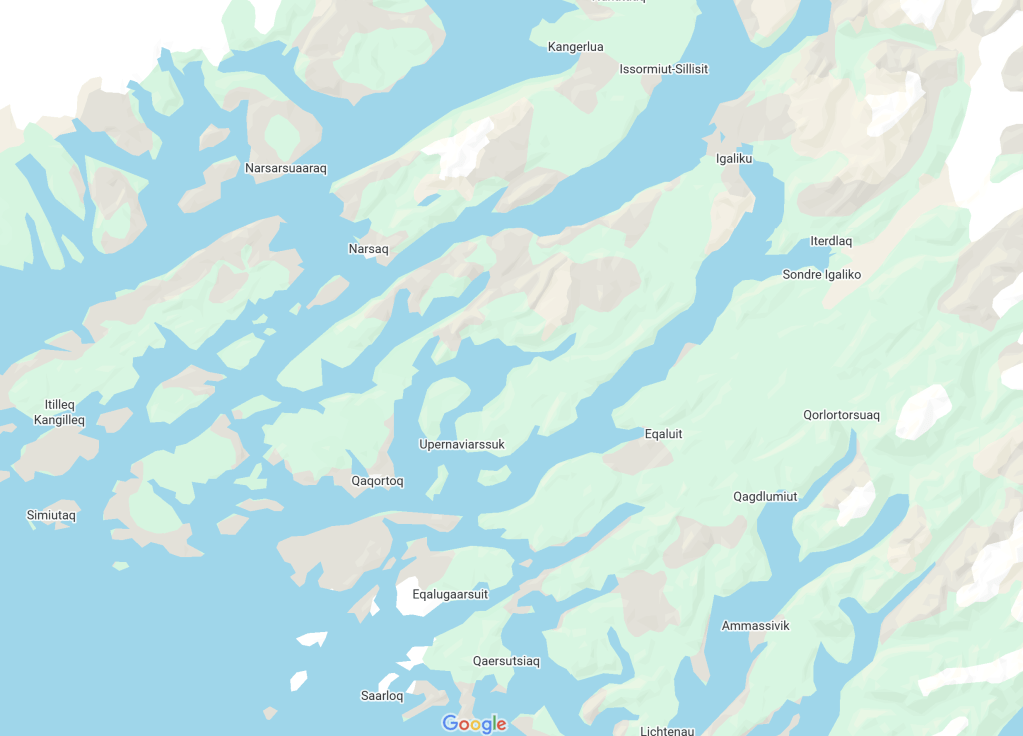

Interestingly, it’s not even the smallest town we’ve ever visited on a cruise; with a permanent population of just over three thousand, it’s still larger than some of the towns in Alaska we went to back in 1999. I think Hanes, in particular, was (and still is) only about two-thirds this size. Then again, it is the capital – and largest town (containing nearly half the population) – of the Kujalleq municipality, covering the entirety of the southern tip of Greenland, so you might expect more of such a place.

In any event, this spot has apparently been inhabited continuously for over 4,300 years, from the Saqqaq to the Dorset to the Vikings to the Thule people to the Danes. Sometimes it’s been concurrent, other times one tribe drove another out – such is the nature of cultural rise and fall – but throughout all that time, the area has been occupied, as has Greenland as a whole. But for all that time, it’s never been able to grow into something larger than it is today.
Now, you could argue that “well of course not; it’s Greenland, for crying out loud. Who would want to live in that frozen wasteland?” A valid question, but consider that geographically, it is – or rather, could be – to the Atlantic what Alaska is to the Pacific; a northern connecting hub between the continents on either side. Anchorage, for instance, is at least half again larger than Reykjavik (and don’t forget, that latter is some three to four hundred miles further north that Qaqortoq, while Anchorage is about a hundred miles further north). This place, for all its disadvantages, could have been somewhere.
Granted, the Little Ice Age of the late medieval period chased the Vikings out (and if you’ve deterred the Vikings from their settlement, that’s an accomplishment. Then again, they had already abandoned their settlements in Vinland over a breach of their laws by Leif Erickson’s own sister generations before, so there wasn’t anything to be made of a connection to the Americas), so maybe that was the last best hope lost. And perhaps the Kalaallit Inuit simply saw no need or desire to grow further; as long as they were scraping out a sufficient existence on their own, and they were otherwise left alone by Denmark and the rest of the world, everything was fine.
Then again, they’re letting us in these days, so maybe they’re not as keen on isolation as all that. In any event, we’ll learn more over the next couple of stops; there’s book (and wiki) learning, after all, and then there’s what you can learn from actually being somewhere and hearing from the inhabitants. Let’s see what they have to say.
For now, though, if you can keep an eye on us, honey, and wish us luck, we’d appreciate it. We’re still going to need it.

 Letters to Rachel