Dearest Rachel –
I don’t think of myself as a “car guy”; the idea of popping open the hood and messing around with a car’s engine does not appeal to me. I’m not one for getting my fingers dirty over a vehicle’s mechanical parts, nor do I relish the smell of any oil other than that in deep-fat fryers (and even then, I keep a healthy – pardon the pun – distance from one when in operation, as hot spattering grease is a danger to one’s extremities, and the stuff pulled out of the fry basket is a danger to one’s innards, no matter how good the stuff tastes). In fact, I’m hard-pressed to find the hook that holds the hood to the car even when I need to pop it open. Beyond that, there’s the concern that even if I were to try to do anything, I’d probably make matters worse, whatever it was. In short, if anything needs to be done with a car, I’ll leave it to experts, of which I am not, nor do I wish to be.
That being said, I seem to be developing a fascination for vehicles that can’t be easily obtained here in the States. It no doubt follows with my travels, as I see things that catch my eye, but I’ve no opportunity to bargain for at the time (and no logistical way to get it home, in turn). Fortunately, we live in the day and age of the internet where, with a little bit of starting information, one can research such things and decide at one’s leisure whether it’s really worth obtaining. You’ve read at length about the Twike, for instance, and my quest to be the first American (and at this point, the first in the world, according to the waiting list queue) to get my hands on their sixth generation model (compared to the second or third-generation model I’d seen in Basel). But now there’s another thing that’s caught my attention.
Like with the Twike, it’s something I’ve only seen, and not actually ridden in – which, for all I know, would make a difference as to whether I might want to own one. I did have the opportunity, if I wanted it badly enough, to ride one into Hambantota town; but given what I’d already learned about the size of the place (only a few thousand people), I didn’t think that the $50 I was being asked for was worth it. It wasn’t until my fellow travelers gathered at the dinner table that evening that I heard what an experience riding in a tuk-tuk could be. Granted, it could be an alarming one, if you weren’t prepared for how folks drove there, but it was apparently equal parts exhilarating at well. I kind of thought I’d missed a chance.
Lo and behold, while down in Honduras, we saw more than a few of them making their way about the hill country outside of Siguatepeque, including this pristine model that could be found most of the week sitting outside of the conference room entrance of our hotel:
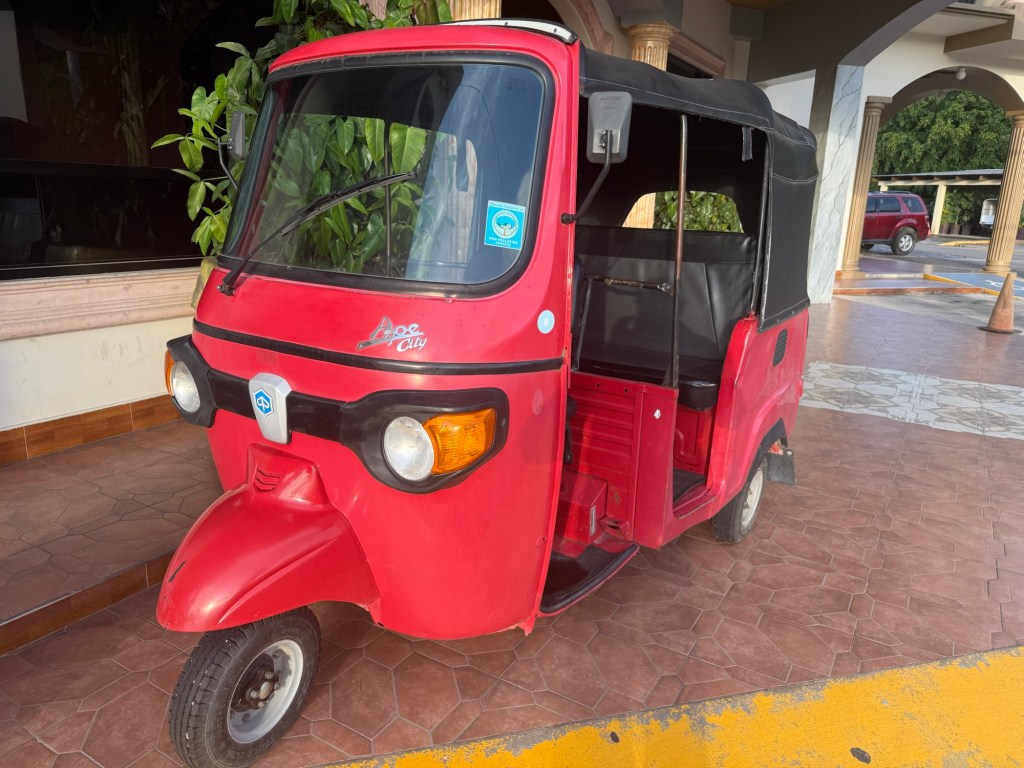
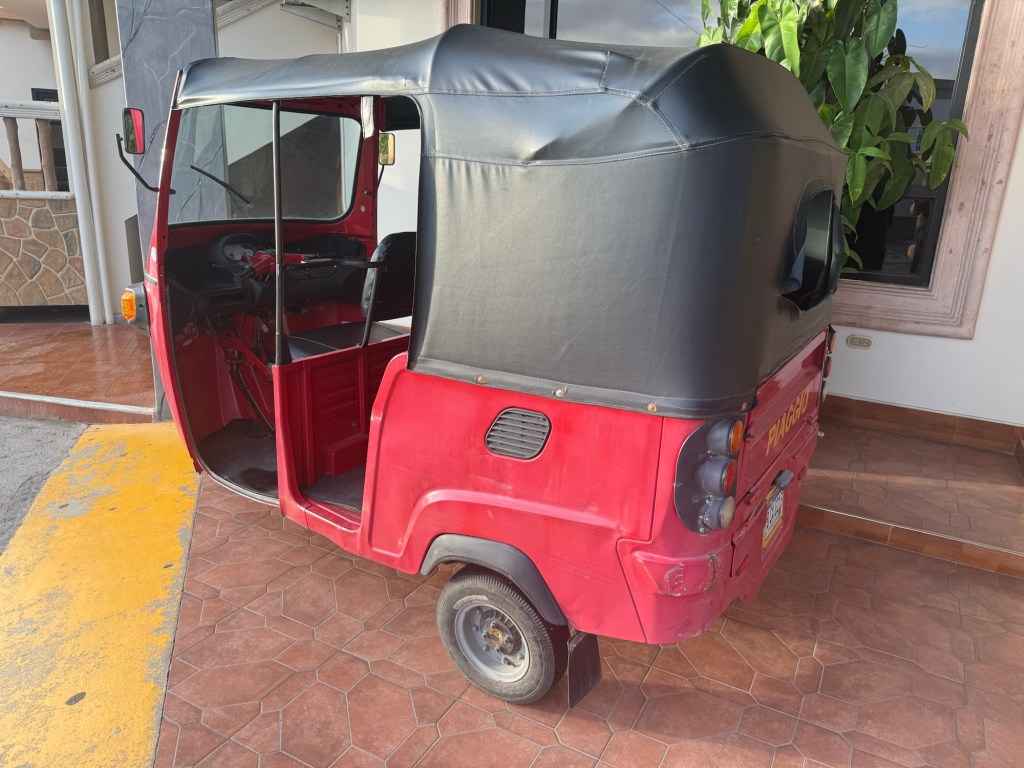
Now, to be fair, there was no opportunity for us to get a ride on one of these things while we were down there. As I told you while down there, there was more to do than hop a ride on some jerry-rigged taxi. Besides, the received wisdom was that we should never travel outside the confines of either the hotel or the Just One campus in a group smaller than three or four, which clearly precluded this mode of transport.
Additionally, while I lamented in the moment that even if I were to buy one and take it home, it wouldn’t be street legal, it was pointed out that they aren’t exactly street legal down there, either. They aren’t really supposed to be on the paved roads; only on the dirt paths of the mountain villages (which means that the machine at the hotel had committed a violation just to get where I could see it). However, to get between villages, it’s inevitable that they have to deal with the arterial roads of Siguatapeque – and for whatever reason, the authorities have decided to look the other way. In fairness, they do have bigger fish to fry (but it’s not as if they go after the cartels or anything, either – or have the strength to do so).
In any event, while I wasn’t going to have a chance to ride in one of these things down there – and resigned myself to that fact – I decided to investigate as to whether one could be obtained for use back home. Even if it was limited in terms of use – especially with regard to speed and range – how much driving do I do in a typical day? It’s three miles from home to the ‘office,’ and only another additional mile to church; if two such trips (to get myself there and back) are my total mileage for the day, this, like the Twike I’m still invested in, would be more than sufficient, and like the Twike, would be the sort of vehicle to turn heads along the way. In short, I was still curious about owning one.
And as I said before, we live in the internet age, where anyone can sell their wares to the world…

Interestingly, these British offerings seem to be touted as the bases of mobile businesses; often geared for small deliveries, mostly of hot food. Indeed, he offers customized models that serve as mini food trucks – although there’s no way to have a mobile kitchen in the back of one of these, like with the food trucks we generally think of and see on this side of the pond. And of course, they can serve as taxicabs, albeit a far cry from the iconic black hansom cabs of London. Hey, not everyone can afford that means of getting around – they aren’t quite limousines, but they have a similar cachet and price tag.
Speaking of affordability, though, one of the other places I was directed in my search was to Alibaba, China’s answer to Amazon. While normally I don’t trust China and Chinese manufacture any further than I can pick up and throw them – there’s a reason why Wish.com and Temu are memetically considered to be synonymous with “poor quality” – the fact remains that Asia is the hub of where these vehicles are being produced and used (despite originating in Italy and being seen in Central America). And while there are industrial-scale manufactories in India (which would explain their presence in Sri Lanka, as well as where many of the U.K. custom models were being sourced from), what bigger hub of commerce is there in Asia but China, who’s always trying to make the next knock-off of someone else’s invention, whether a vehicle or a website? So this is just a sampling of what I found there…
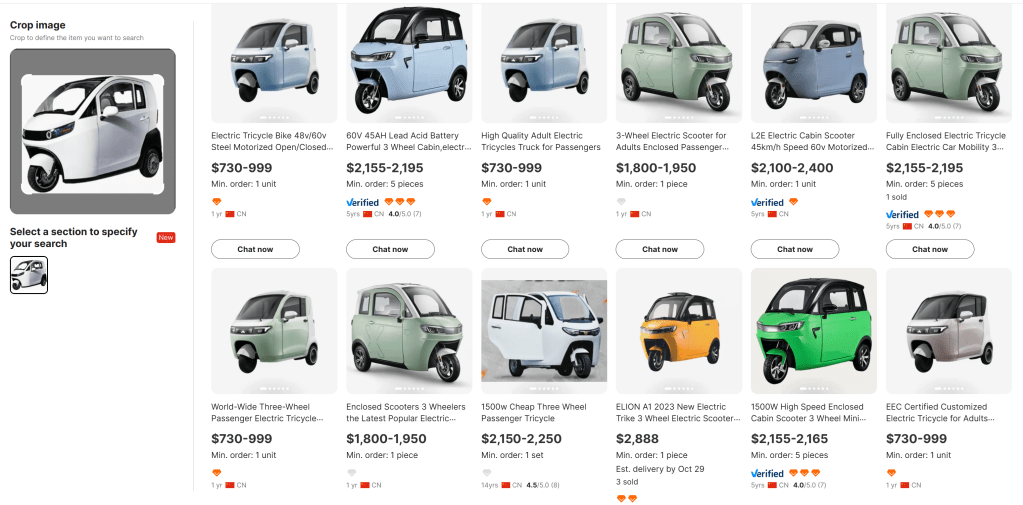
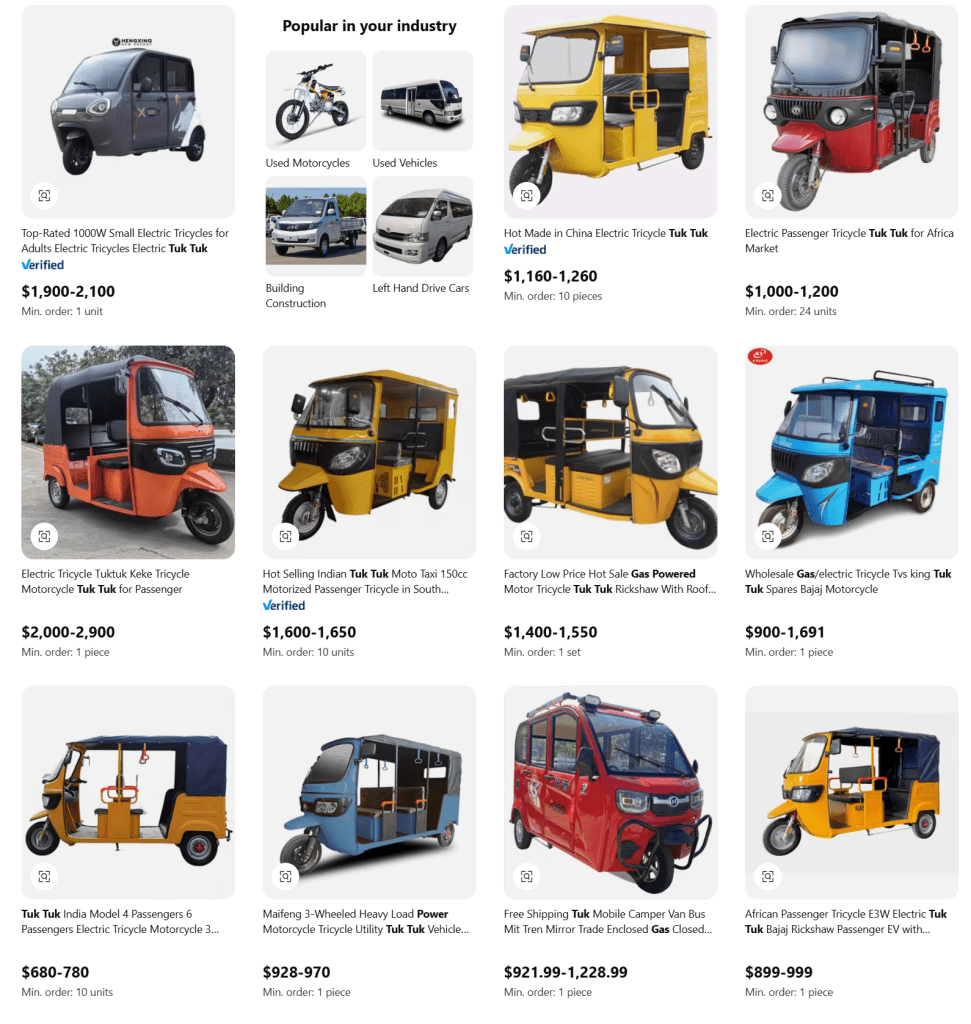
And you might notice the prices on these Chinese models. Whereas the Twike is going to run me some thirty to forty thousand euro – roughly comparable to a typical new car – and the British custom tuk-tuks start at nine thousand pounds (don’t worry, they weigh considerably less than that, ha-ha), these Chinese knockoffs appear to top out at under three grand. Cheap doesn’t begin to describe them – most of them cost less than my trip to Honduras, by way of comparison – and they’re more affordable than a high-end bike at this point.
Of course, the devil is in the details; there’s likely the question of the tariffs on them, which I don’t know what they would come to, and the shipping (which, for all I know, might actually incorporate the tariff, given its size), which effectively doubles the listed price. But still, it’s ridiculously tempting in its cheapness (which probably explains their appeal and popularity in the low-income Asian nations I passed through last year). I could get a fleet of these for the price of the single Twike.
Which may very well be what some of them are meant to be; fleets. Many of their models are offered at a discount when purchased in quantity, and they offer customization options for large bulk orders (occasionally starting as low as five to twenty units, although the example I picked here doesn’t kick in its customization offerings until you buy 200 of them, which is a bit much for any but a reseller or a large distribution business).
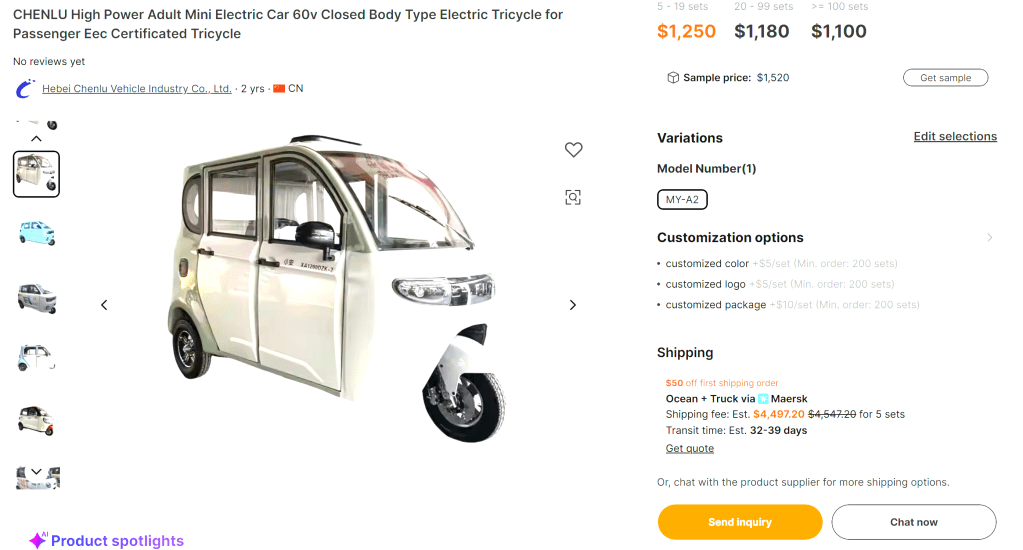
It gets me thinking that, considering how the camp rents a fleet of golf carts for people to get around the grounds (which they, in turn, rent from the camp for that purpose). Maybe it would be kind of cool to supply the camp with a number of these vehicles – possibly even emblazoned with the camp logo on them – in place of having to rent transport from an outside vendor. I could get one for myself to test it as a proof of concept, and if it works around here, this might be feasible on that larger scale. It would certainly be less selfish than the purchase I already have in the works.
But this all begs the question; I started off this letter with a statement that you already knew, that I’m not a car person. Vehicles are, to borrow from Detective Columbo, “just transportation,” as far as I’m concerned. Why am I getting into these odd, head-turning methods all of a sudden?
I’m not entirely sure myself, honey. It probably has something to do with their exotic nature and appearance, sure, and there may be more than a touch of retail therapy at work as well. Even the level of difficulty in finding and acquiring them adds something to the whole process – it’s one thing to get a car from a dealership, but these are something special, and hard to come by, which is why you don’t see them every day – while at the same time, they’re still easier to get my hands on than ‘Megumi’ is, assuming she even exists. At least these are out there, and at some point, I could bring one – or a whole bunch of them (and let’s not think about how that analogizes, thanks) – over to this side of the pond. Any one of these explanations could be considered plausible, but there’s probably no one single one that answers the question; I think they’re all a part of it, and there might even be more beyond them as well.
For now, let’s just see what I can do with these, and if it might turn into something larger than just something to fit in the driveway. Until then, honey, keep an eye on me, and wish me luck; I think I’m going to need it.

 Letters to Rachel
3 thoughts on “Tuk-Tuk Temptation”