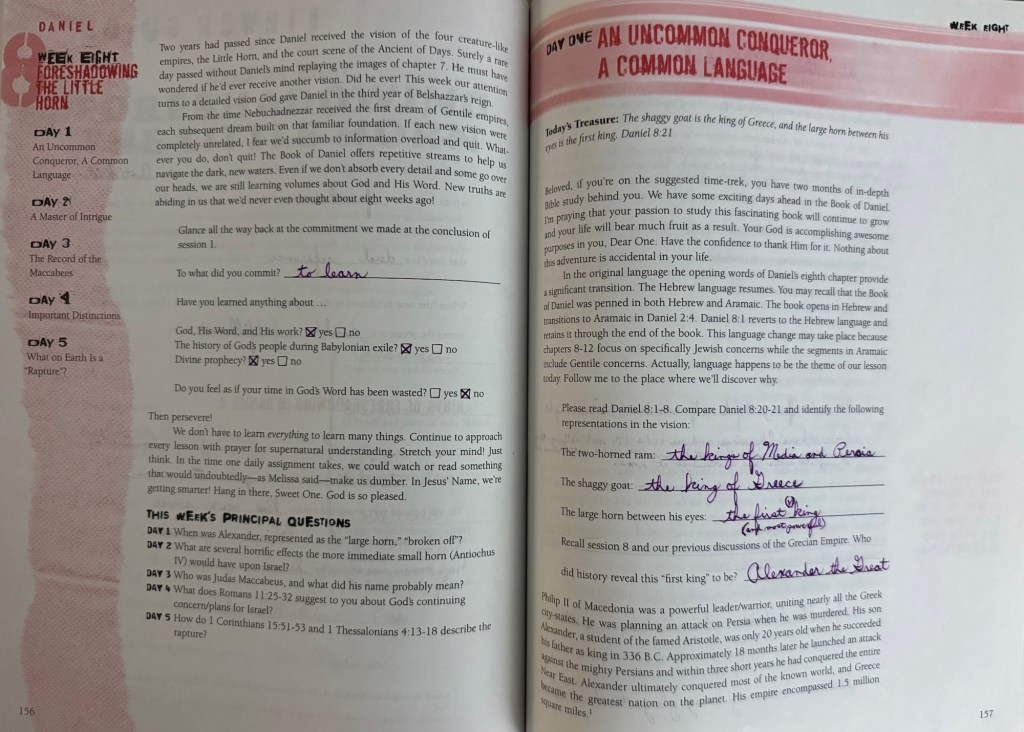
Please read Daniel 8:1-8. Compare Daniel 8:20-21 and identify the following representations in the vision:
The two-horned ram: “the kings of Media and Persia”
The shaggy goat: “the king of Greece”
The large horn between his eyes: “the first (and most powerful) king”
Recall session 8 and our previous discussions of the Grecian Empire. Who did history reveal this ‘first king’ to be? “Alexander the Great”
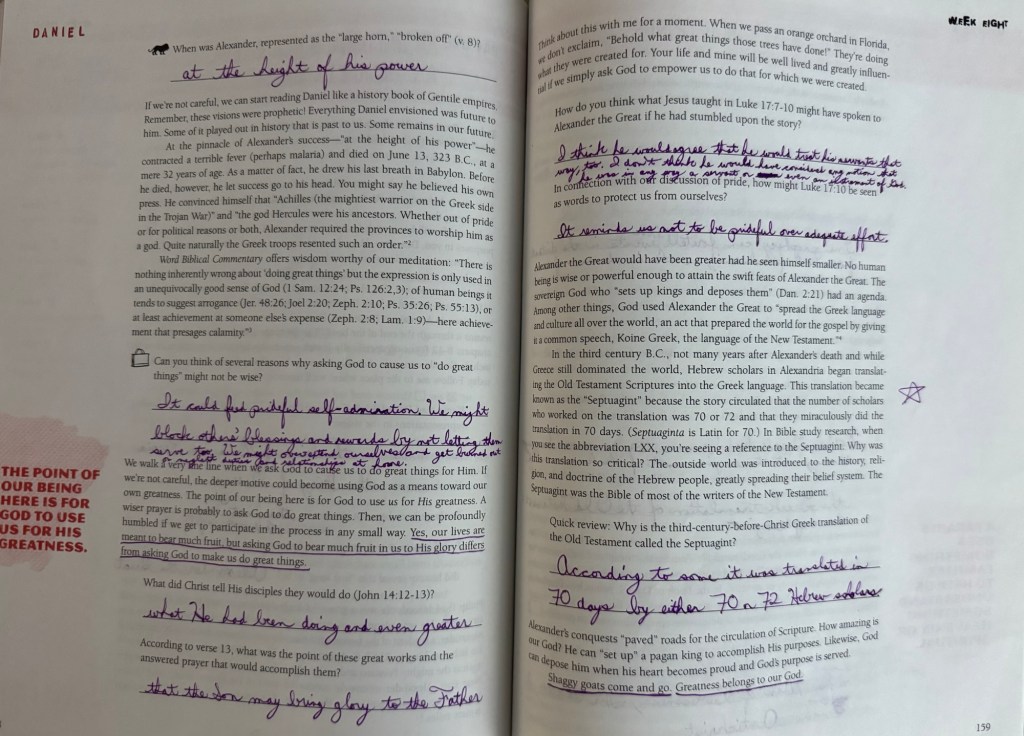
When was Alexander, represented as the ‘large horn,’ ‘broken off’ (v. 8)?
“at the height of his power”
Can you think of several reasons why asking God to cause us to ‘do great things’ might not be wise?
“It could feed prideful self-admiration. We might block others’ blessings and rewards by not letting them serve too. We might overextend ourselves and get burned out or neglect duties and relationships at home.”
Yes, our lives are meant to bear much fruit, but asking God to bear much fruit in us to His glory differs from asking God to make us do great things.
What did Christ tell His disciples they would do (John 14:12-13)?
“what He had been doing and even greater”
According to verse 13, what was the point of these great works and the answered prayer that would accomplish them?
“that the Son may bring glory to the Father”
How do you think what Jesus taught in Luke 17:7-10 might have spoken to Alexander the Great if he had stumbled upon the story?
“I think he would agree that he would trust his servants that way, too. I don’t think he would have considered any notion that he was in any way a servant or an instrument of God.”
In connection with our discussion of pride, how might Luke 17:10 be seen as words to protect us from ourselves?
“It reminds us not to be prideful of adequate effort.”
Quick review [as starred above]: Why is the third-century-before-Christ Greek translation of the Old Testament called the Septuagint?
“According to some it was translated in 70 days be either 70 or 72 Hebrew scholars.”
Shaggy goats come and go.
Greatness belongs to our God.
Dearest Rachel –
Given that the acronym GOAT has come into parlance (mostly since your departure, but it may have been occasionally used in the sporting world previously; I honestly can’t remember) to denote the ‘Greatest Of All Time,’ it seems both funny and appropriate to see the term applied to Alexander the Great by his being represented in Daniel’s prophecy by an actual goat. Obviously, neither the acronym nor the pun would have existed in the original Hebrew or Greek, but given our own cultural and linguistic shifts, it’s wild to see that we’ve added a little extra spin to his depiction here.
Of course, it’s also humbling to note that the Greatest Of All Time, given sufficient time, can still be buried and forgotten by the sands of history, much like Ozymandius in Shelley’s famous poem (although at this point, we believe the name referred to Ramses II, who we have a surprising amount of knowledge about, but in Shelley’s day, with Egyptian hieroglyphics being only so much gibberish at that point, he too was an obscure figure in history. Although, to the vast majority of average students – and, by extension, average men-in-the-streets – he and Alex are just names on a page that means nothing in daily life, unless they have a history test coming up).Whatever “great things” we might accomplish in this life (however we might choose to define that) are going to amount to very little, given enough time. You’d think that would be so much more obvious these days, in the ephemeral come-and-go of the internet era, in which our attention spans have been compressed to only a couple of minutes before we get bored with any given topic, but still we pursue “greatness.”
That being said, I’m not sure that there’s anything wrong with doing so, or even asking God to accomplish “great things” through us. It all depends on who’s defining the term “great” here. If it’s us, then absolutely, the issue that Ms. Moore (and by extension through your response to her question, you) has with seeking out “greatness” stands. Just as we mistake what we want for what we need, so too does our idea of great deeds and accomplishments conflict with what God would have us do (which, if done in His service, are great by definition, as they serve His plans).
To be fair, I’ve had my own issues with this, as you both used to hear personally and would have seen written on this site, so I don’t say any of this out of a sense of superiority over those pursuing “greatness”; I’m as guilty of treating my own path with disdain as anyone else. I just think it’s important to remind ourselves of how little our “greatness,” should we by some improbable happenstance achieve it, will matter in the long run – especially considering that, in the long run, we all wind up on your side of the veil, where very little of what we’ve done on this side will amount to anything, apart from rescuing those who might otherwise miss the chance of an afterlifetime.
To that end, honey, I’d ask you to keep an eye on me today, and however long it takes for me to get this right, and wish me luck. I’m definitely going to need it.

 Letters to Rachel