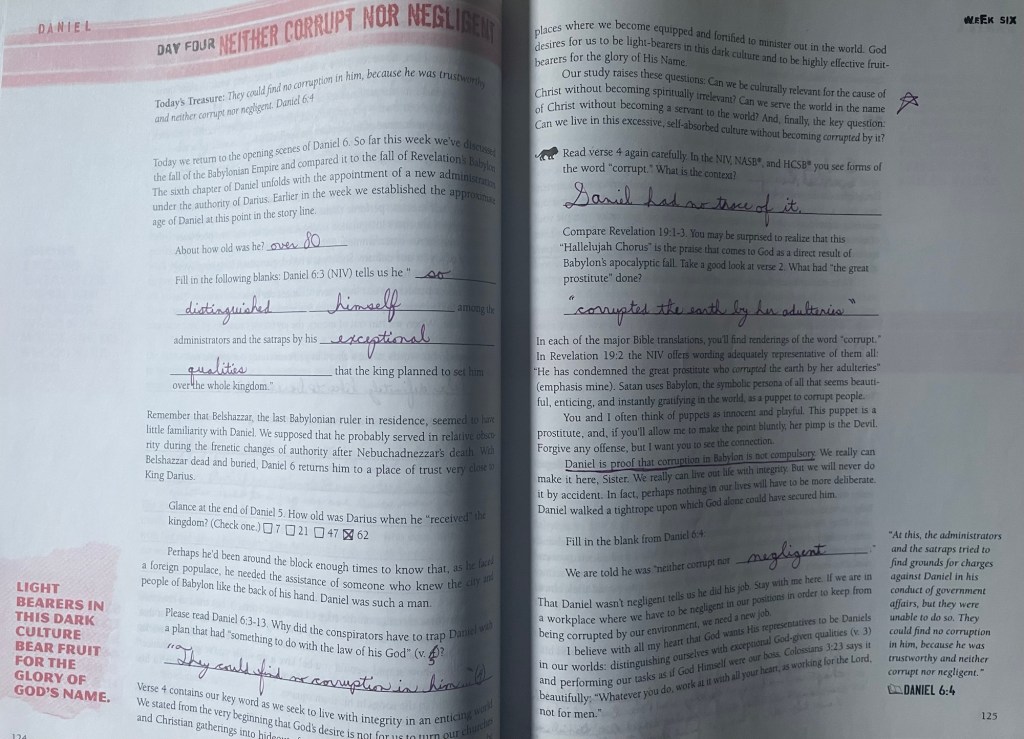

Earlier in the week, we established the approximate age of Daniel at this point in the storyline.
About how old was he? “over 80”
Fill in the following blanks: Daniel 6:3 (NIV) tells us he ‘“so distinguished himself” among the administrators and the satraps by his “exceptional qualities” that the king planned to set him over the whole kingdom.’
Glance at the end of Daniel 5. How old was Darius when he ‘received’ the kingdom? “62”
Please read Daniel 6:3-13. Why did the conspirators have to trap Daniel with a plan that had ‘something to do with the law of his God’ (v. 4 “5”)? “‘They could find no corruption in him.’ (4)”
✫ Our study raises these questions: can we be culturally relevant for the cause of Christ without becoming spiritually irrelevant? Can we serve the world in the name of Christ without becoming a servant to the world? And finally the key question: can we live in this excessive, self-absorbed culture without becoming corrupted by it?
Read verse 4 again carefully. In the NIV, NASB, and the HCSB you see forms of the word ‘corrupt.’ What is the context? “Daniel had no trace of it.”
Compare Revelation 19:1-3. You may be surprised to realize that this ‘Hallelujah Chorus’ is the praise that comes to God as a direct result of Babylon’s apocalyptic fall. Take a good look at verse 2. What had ‘the great prostitute’ done? “‘corrupted the Earth by her adulteries…’”
Daniel is proof that corruption in Babylon is not compulsory. 
…from Daniel 6:4: We are told that he was neither corrupt nor “negligent”
Have you ever found yourself in a work environment, where you could not do your job well without being corrupted by it? If so, explain.
“Only if you count a house full of entertainment options more fun than housework.”
Dearest Rachel –
When I was transcribing this week’s daily homework, I was mildly surprised by the last question on it, which contains your longest hand-written response. The author appears to be assuming that virtually all of her readers exist in a work environment, as opposed to being what is presently acquiring the fad name of “trad wife.” Ever since the feminist revolutions in the sixties and seventies, it was expected that women ought to be as much a part of the work farce as men. Although let’s face it, even your folks would occasionally express a wish that you would get more out of your college education than an “Mrs. degree.”
And in a way, it should actually be easier to adhere to honest (i.e., not corrupt) dealings if one is in business. If a business person develops a reputation for crooked behavior, they are likely to be shunned by their potential clientele as a result. Just as a customer can always find someone else who can do a job better or cheaper (though rarely can one find someone who can do both simultaneously, but that’s beside the point), they can also find someone who is an honest broker; they don’t have to put up with a sketchy dealer unless they really think they, too, can get away with cutting corners. This applies to businesses themselves with regard to employees, as well; they have a vested interest in their staff delivering value for the money they pay them, and many is not all have a code of conduct for them to adhere to while they represent the company. The employees might take issue among themselves about it, but as a rule, if they want to stay employed, they need to abide by certain rules – including, one might expect, dealing fairly and honestly with the company’s external customers. Wholesale (pardon the pun) corruption is bad for business.
But in the home, you don’t answer to anyone; you are, effectively, your own boss. The house itself isn’t going to complain about ill-treatment or neglect; you just have to live with the results of that, and weigh whether those results are worth the enjoyment that prompt such treatment. Likewise, your child cannot seek out different parents – and likely wouldn’t recognize that anything about their home life was ‘off’; whatever life they life in is the benchmark of ‘normal’ to them. Even one’s husband is rarely going to call a wife to account for how she keeps the place, as most of them (including myself) don’t consider it their area of expertise; how can we gainsay what you’re doing as wrong? You’re left to your own devices, to do as you see fit.
And so, you get the results you get; and you recognized that. And while you recognized that as a ‘corrupting’ influence, you also implicitly pointed out that the author might not, since it had nothing to do with the outside work farce you were expected to participate in. In a way, I might point out that the author has been affected by the cultural norms in making such an assumption, when the temptation to slack off is that much greater when one answers to neither employer nor customer.
Not that I consider her to have been corrupted by them, mind you; she’s literally reflecting what the culture we live in is like. While the concept of the “working woman” is a relatively new one compared to most of human history, it has been the norm for most of living memory, and even you knew that you were something of an outlier for your generational cohort (after all, you grew up in a two-profession household yourself). You were grateful that I didn’t require you to go out and get a job, and the permission you gave me to retire reflected that; “You’ve supported me for all these years, now it’s my turn.”
Granted, that gratitude wasn’t always reflected by a neat and tidy house that could receive guests, and it was this that prompted your answer. Is that a reflection of corruption? I don’t know; I suppose it could be taken as such; “to him that knoweth what to do, and doeth it not,” and all that. These days, I will admit to doing no better, bringing in hired experts to take care of one thing or another I’d rather not (I haven’t mowed the lawn in years, one of my relatively few household tasks back in the day – what does that say about me?) So I’ve no place to criticize you, honey, as I’ve no right to pick up, let alone throw, any stones at you for it; as if I’d ever want to. Granted, that may just mean I’m every bit as corrupted as you were… or more so…

 Letters to Rachel