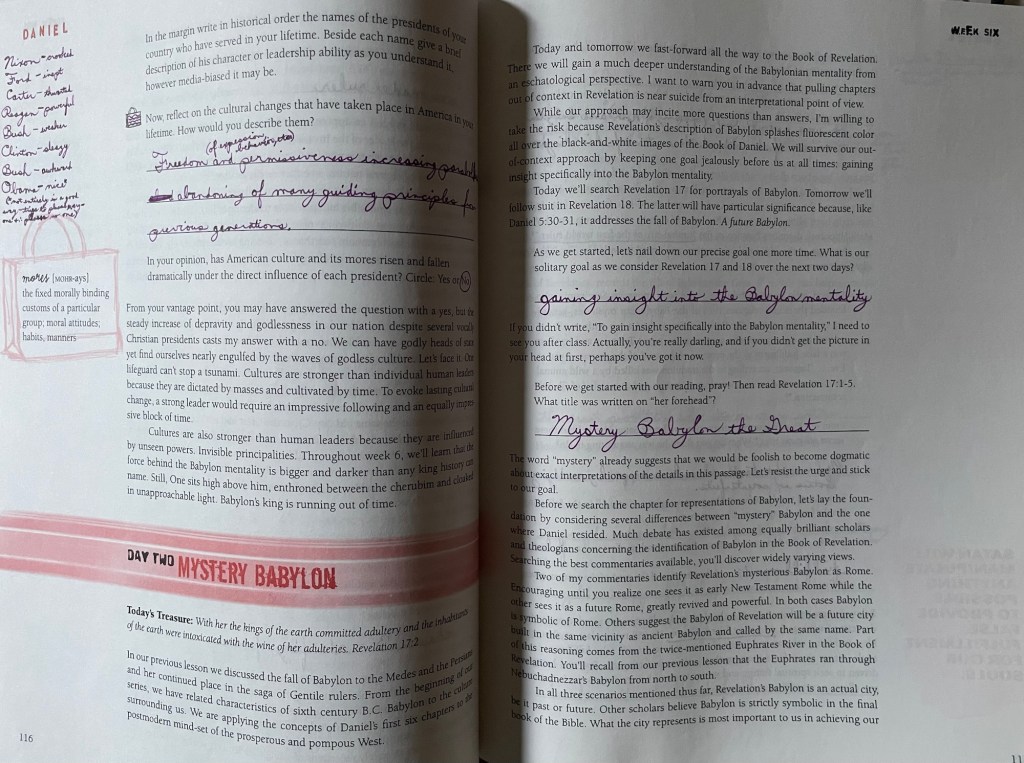


As we get started, let’s nail down our precise goal one more time. What is our solitary goal as we consider Revelation 17 and 18 over the next two days?
“Gaining insight into the Babylon mentality.”
Before we get started with our reading, pray! Then read revelation 17:1-5. What title was written on ‘her forehead’?
“Mystery Babylon the Great”
Who was Nimrod and what was his relationship to Babylon according to Genesis 10:8-12?
“He was a son of Kush (of Ham, of Noah), and Babylon was one of the cities at the center of his kingdom.”
Author Mark Hitchcock describes Babylon as the ‘capital city of the first world ruler’
From our New Testament perspective, we know Satan was behind these ‘secret religious rites’. What do you think he was attempting to do?
“Maybe make truth seem less unique by muddying the waters with counterfeits.”
Two critical words surface in the previous quote. Please fill in the following blanks from the quote to discover them: ‘a son… who was given the name Tammuz, and in effect was a “false fulfillment” of the promise of the seed of the woman given to Eve.’
You’d be hard pressed to discover two words more perfectly depicting Satan’s goal: providing false fulfillment.
Does this make sense to you in light of your own experience? “yes” If so, how?
“It is very easy to let my mind wander and slip into ‘going through the motions mode’ – be it in worship, message, or even sometimes AWANA. It takes a conscious effort to bring my thoughts back into focus. (Also, like the Screwtape Letters, ‘get him to fixate on the cross on the wall’)”
What is Babylon called in verse 1?
“the great prostitute who sits on many waters”
How does verse 2 depict her influence over the earth’s inhabitants?
“intoxicating and adulterous”
How is she dressed according to verse 4?
“in purple and scarlet, glittering with gold, precious stones, and pearls”
What is she holding in verse 4?
“a golden cup filled with abominable things”
How is Babylon described in Revelation 17:6?
“drunk with the blood of the saints”
Who is this woman according to verse 18?
“the great city that rules over the kings of the earth”
One last question: based on all we’ve considered today, can you think of possible reasons why Babylon is symbolically described as a prostitute?
“I guess maybe because she is seductive in all the passions with which she tries to tempt people. ”
Dearest Rachel –
You know, for a study based on the sixth chapter of Daniel, these segments spend an awful lot of time on the man’s previous employer, don’t they? You’d think they would move on to the things leading up to the “lion’s den” incident, and how to apply that to your life. Maybe Beth thinks that story has been done to death, and wants to set that aside for now.
Or maybe she’s looking ahead to the rest of the book (both Daniel’s own and the rest of the Bible itself), and focusing on what prophetic messages there are to come. And despite at this point having been conquered and supplanted, Babylon was and still is the biblical byword for sin and rebellion against God, only matched by Sodom and Gomorrah (and the latter probably only because we’ve made a word out of their specific sin, which puts them further ahead in the Anglophone mind, since “Babylon” is only used as a descriptive term, such as “Hollywood Babylon” or the like, without dropping its capitalization).
To be sure, some of the questions she has you address refer more to the distant past, and how even then, they were seeking a solution to their situation that was outside God’s will. Tammuz, like the very first child conceived and born (i.e., Cain), was thought to be the fulfillment of God’s promise of a messiah that would crush the serpent’s head and restore humanity’s relationship with God. Meanwhile, Nimrod and his fellow citizens of the newly-founded Babylon were seeking to reach God by building a tower that would take them to Him, which bothered Him so much that He sought to confuse their languages, in order to cease the construction of the building, and scatter them across the world aas He intended for them to do.
As a sidebar, I often wonder about that tower; I suspect that it was as nothing in comparison to the edifices we put up on the regular across the world these days. Why He would claim to feel threatened by it seems strange to modern readers, since our towers clearly don’t bring us any closer to God – or prove that we’re somehow His equals. I suppose it was that intent that caused Him to interfere; that, or the refusal to spread out across the globe, to “fill the earth and subdue it” that got under His skin rather than the building of the tower itself, per se.
What’s interesting is that the ancient Babylonians (both from Nimrod’s time and Nebuchadnezzar’s) were looking toward God – even if only to try to supplant Him. These days, it seems that society has moved so far past that to not even think of God, and His existence in our lives. Even those of us who follow Him have a tendency to ‘phone it in’ or confine our spiritual duties to a certain compartment – relegating Jesus to ‘the cross on the wall’ as some kind of totem. We don’t even think of it as watching over us as we go about our lives. May that not be.
And to that end, honey, keep an eye on us, and wish us luck. We’re going to need it.

 Letters to Rachel