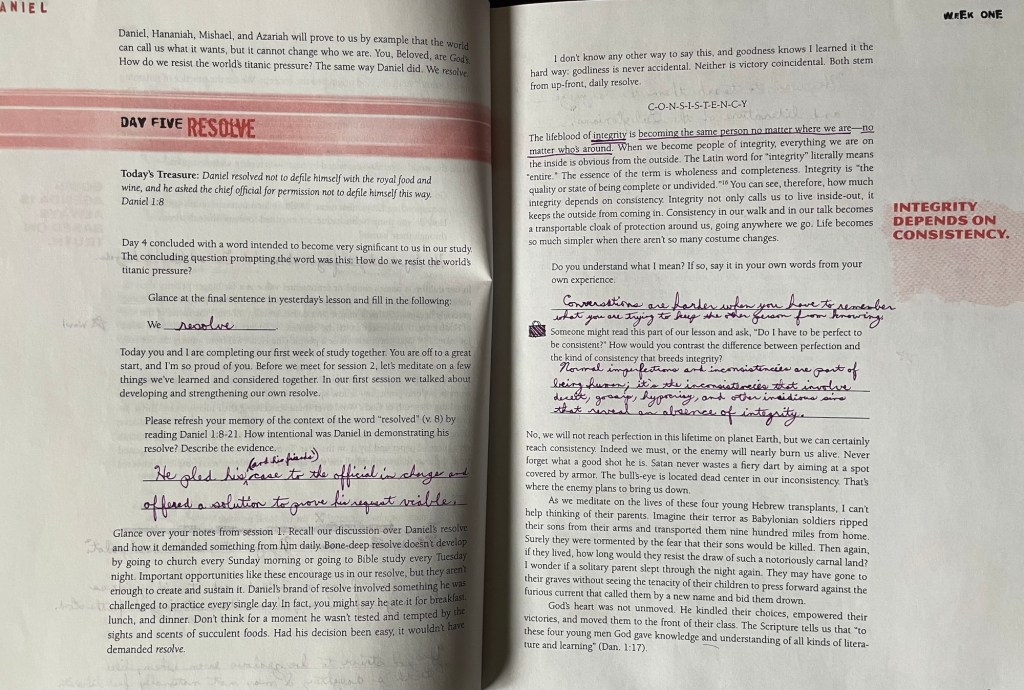

Glance at the final sentence in yesterday’s lesson, and fill in the following: We “resolve”
Please refresh your memory of the context of the word ‘resolved’ (v. 8) by reading Daniel 1:8-21. How intentional was Daniel in demonstrating his resolve? Describe the evidence.
“He pled his (and his friends’) case to the official in charge and offered a solution to prove his request viable.”
The lifeblood of integrity is becoming the same person no matter where we are – no matter who’s around. 
Do you understand what I mean? If so, say it in your own words from your own experience.
“Conversations are harder when you have to remember what you are trying to keep the other person from knowing.”
Someone might read this part of our lesson and ask ‘Do I have to be perfect to be consistent?’ How would you contrast the difference between perfection and the kind of consistency that breeds integrity?
“Normal imperfections and inconsistencies are part of being human; it’s the inconsistencies that involve deceit, gossip, hypocrisy, and other insidious sins that reveal an absence of integrity.”
Look back at Daniel 1:4. What was the chief of Nebuchadnezzar’s court instructed to teach the Hebrew youths?
“‘He was to teach them the language and literature of the Babylonians.’”
They read the language of their culture with the lens of God. Thereby, they became culturally relevant without becoming spiritually irrelevant. 
Dearest Rachel –
As much as I wish there was more to work with in terms of this study, some days just aren’t all that involved, in terms of questions or responses. I suspect that, as you would occasionally rush through those last few days’ worth on the night before in order to be able to contribute to the weekly discussion, you were just as happy for these breaks.
It’s not as if there’s all that much to tell, in any event. As you put it, as long as you’re telling the truth, you don’t need to worry about keeping your story straight. This results in the story itself being more straightforward… but also a bit shorter. For what it’s worth, though, it also means that people know what to expect from you. It was just the other day I was telling about our one argument – and more to the point, how Pastor Scott acknowledged that had it been any other couple who said it was their only argument, he wouldn’t have believed it. The guys I was relating this story also agreed that my assertion was believable, knowing the both of us (also the number that do is dwindling… or perhaps being diluted by those who don’t these days). It is, as you say, a mark of integrity.
At the same time, I don’t know if it’s something that has to be resolved to do. Quite honestly, it just seems easier to be honest about these sorts of things. I can’t control what people think of me and what I do, say and think – heck, most of the time, I don’t even know what they think. So why concern myself with trying to please them, when I don’t know what that would be or how I would do that? Best to do what comes naturally, and hope that, at the very least, it aligns with what God would have me do.
I would say that the best policy is to “be yourself,” but considering what I am now compared to what I was when you were still here, I’m not entirely sure what that is, or if I ever knew that. Still, to follow one’s instinctive reaction to a situation, as long as it’s tempered by one’s faith and understanding of God’s desires for oneself, should get close enough to pass. Whatever comes as second nature might as well be first nature, for all intents and purposes; don’t you agree?

 Letters to Rachel