

Please glance back at your previous lesson and re-read Psalm 133. What two metaphors did the psalmist employ as expressions of kindred living together in unity?
First metaphor (v. 2): “fine oil on the head”
Second metaphor (v. 3): “the dew from Mount Hermon”
Read Exodus 29:1-9 and describe it briefly here:
“God told Moses how to consecrate Aaron and his sons as priests of Israel.”
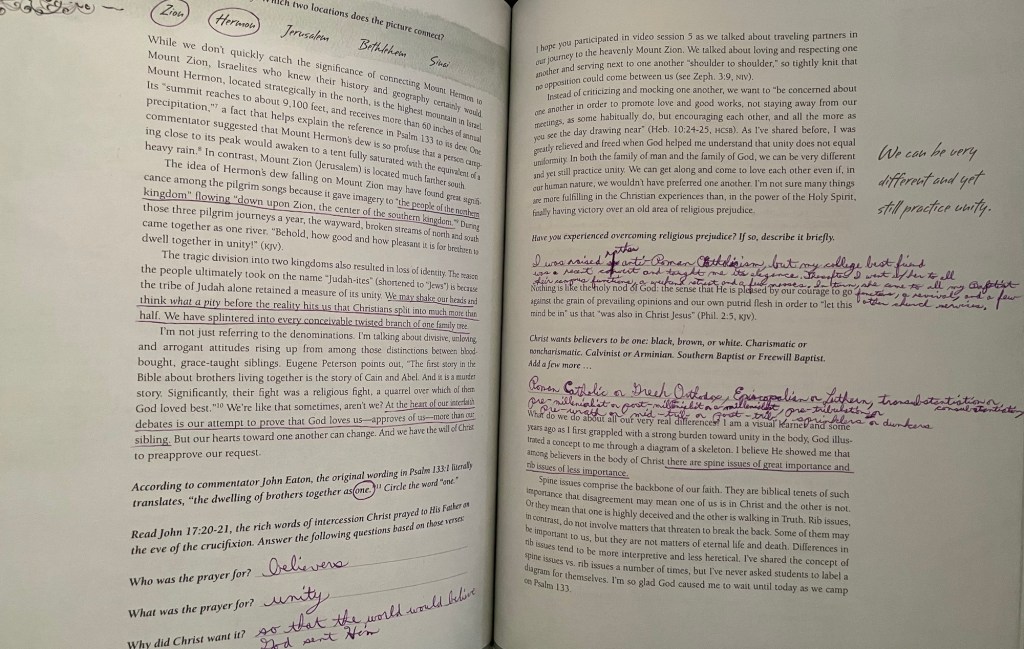
Read verse 3 carefully. Which two locations does the picture connect? “Zion”; “Hermon”
The idea of Hermon’s dew falling on Mount Zion may have found great significance among the pilgrim songs because it gave imagery to ‘the people of the northern kingdom’ flowing ‘down upon Zion, the center of the southern kingdom.’
We may shake our heads and think what a pity before the reality hits us that Christians split into much more than half. We have splintered into every conceivable twisted branch of one family tree.
At the heart of our interfaith debates is our attempt to prove that God loves us – approves of us – more than our sibling.
Read John 17:20-21
Who was the prayer for? “believers”
What was the prayer for? “unity”
Why did Christ want it? “so that the world would believe God sent Him”
Have you experienced overcoming religious prejudice? If so, describe it briefly.
“I was raised rather anti-Roman Catholicism, but my college best friend was a recent convert and taught me its elegance. Thereafter, I went with her to all their campus functions, a weekend retreat, and a few masses. In turn, she came to all my Baptist functions, a revival, and a few other church services.”
Christ wants believers to be one: black, brown or white. Charismatic or non-charismatic. Calvinism or Arminian. Southern Baptist or Freewill Baptist. Add a few more…
“Roman Catholic or Greek orthodox, Episcopalian or Lutheran, transubstantiation or consubstantiation, pre-millennialist or post-millennialist or a-millennialist, pre-tribulation or pre-wrath or mid-trib or post-trib, sprinklers, or dunkers.”
…in the body of Christ, there are spine issues of great importance and rib issues of less importance.
Based on the descriptions I gave you just a moment ago, meditate on several possible spine issues and rib issues; then label them on this diagram.
Rib issues
“Eschatology
“details of sacraments
“legalism to liberalism
“Bible translations
“leadership structure of church”
Spine issues
“Salvation: by faith, not by works, not by sacraments
“Jesus lived perfect life, our sins, died, rose again”
Dearest Rachel –
Unlike you, I didn’t have the same exposure to other denominations as you did. To be sure, you spent most of your formative years going to the same church every Sunday, just like I did, but you started out having the option to attend either your dad’s Episcopalian church or your Mom’s Baptist church, choosing the latter for the fact that it had better facilities for children, as I recall. Considering that it was there that you received the salvation message you ultimately heeded (as opposed, say, to getting it at home, like me and, eventually, Daniel), it makes me wonder how things might have been different had you made the other choice way back then.
Most of what I saw of other variants on faith was secondhand, as I studied what I believed in an effort to avoid the fate of those who perished at Jonestown. Granted, I spent my middle school years at Lutheran school, so I guess that counts as exposure to a different form of faith, but it’s been so long ago that it doesn’t always register in my memories – although now that I think about it, my back-and-forth conversations in catechism classes might have tracked well with that line about God’s approval you highlighted in this study. Although, considering what my folks say about several of their old friends that attend such a church, and the fact that theirs seems to be on the verge of dying out (for reasons unrelated to doctrine), I wonder if any of that chauvinism might be justified, since one tends to associate whether a ministry thrives or languishes with God’s favor.
In any case, while you and Elizabeth sought common ground between each of your versions of Christianity, most of my roommates were essentially irreligious (aside from Dave, but then, he was the only roommate I had that I didn’t leave up to chance); there was no common ground to be sought on this particular front, and none of us really made any effort to change that. I suppose this would count as a strike against me for not attempting to reach out to any of them, but then again, I wasn’t led astray by any of them, either. How that gets marked against my name in the book of life, I don’t know, but there’s nothing to be done about it now.
Personally, I don’t think too much about other churches, and how they differ from us, doctrinally speaking, these days. It’s enough to keep up with what we’re doing ourselves, to be honest. Not that we, as a church, don’t consider and pray for other like-minded organizations; after all, we can’t be everywhere for everyone, and other such places must fill the needs in other places.\, both near and far. They may differ from us on a number of what Ms. Moore refers to as “rib” issues, but as long as the spine is “intact,” they should be able to stand and hopefully reach those who we can’t.
And with that being said, if you can keep an eye on these other places, and wish them luck just as much as ourselves, that would be appreciated. There’s a whole world out there that could use it, after all.

 Letters to Rachel