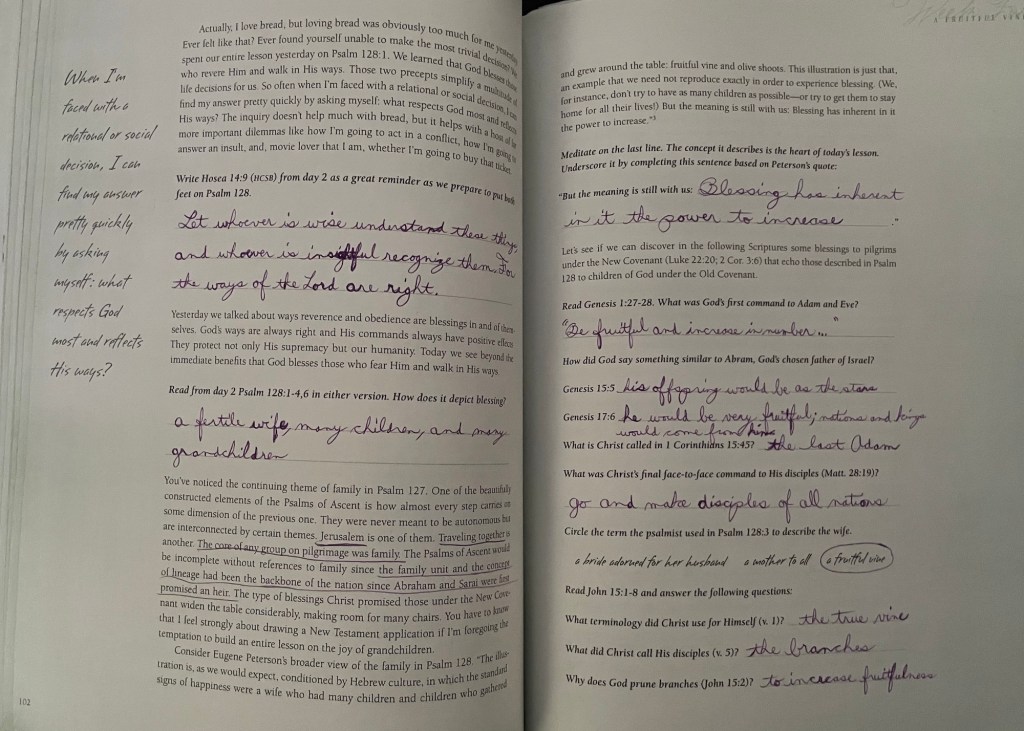

Write Hosea 14:9 from day 2 as a great reminder as we prepare to put both feet on Psalm 128.
“Let whoever is wise understand these things, and whoever is insightful recognize them. For the ways of the Lord are right.”
Read from day 2 Psalm 128: 1-4,6 in either version. How does it depict blessing?
“A fertile wife, many children, and many grandchildren”
One of the beautifully constructed elements of the Psalms of Ascent is how every step carries on some dimension of the previous one. They were never meant to be autonomous, but our interconnected by certain themes. Jerusalem is one of them. Traveling together is another. The core of any group on pilgrimage was family. The Psalms of Ascent would be incomplete without references to family since the family unit and the concept of lineage had been the backbone of the nation since Abraham and Sarai were first promised an heir.
Meditate on the last line. The concept it describes is the heart of today’s lesson. Underscore by completing the sentence based on Peterson’s quote: ‘But the meaning is still with us: “Blessing has inherent in it, the power to increase.”’
Read Genesis 1:27-28. What was God’s first command to Adam and Eve? “Be fruitful and increase in number…”
How did God say something similar to Abram, God’s chosen father of Israel?
Genesis 15:5 – “his offspring would be as the stars”
Genesis 17:6 – “he would be very fruitful; nations and kings would come from him”
What is Christ called in 1 Corinthians 15:45? “the last Adam”
What was Christ’s final face-to-face command to His disciples (Matthew 28:19)? “go and make disciples of all nations”
Circle the term the psalmist used in Psalm 128:3 to describe the wife. “a fruitful vine”
Read John 15:1-8 and answer the following questions:
What terminology did Christ use for Himself (v. 1)? “the true vine”
What did Christ call His disciples (v. 5)? “the branches”
Why does God prune branches (John 15:2)? “to increase fruitfulness”
What must the branch do to bear fruit (v. 4)? “remain in the vine”
How is our Father glorified (v. 8)? “by Jesus’ disciples bearing much fruit”
John 15:16 is comprised of two sentences. Write the first sentence. “‘You did not choose Me, but I chose you and appointed you to go and bear fruit – fruit that will last.’”
Keeping everything we’ve talked about in mind, please read Christ’s parable in Luke 19: 21-27. What is the point of this parable? “Lack of fruit indicates lack of loyalty.”
When Christ called His Bride (His church) to be fruitful, and through its fruitfulness, to multiply, He wasn’t just issuing a great idea or even an invitation. He was issuing a command. God not only enables increase, but He also expects it. 
Christ did not issue you permission to bear much fruit. He issued you a commission. What do you sense him saying personally to you right now? “Don’t be afraid to speak my name – proclaim it boldly.”
Dearest Rachel –
I’ve often joked about how God‘s command in Genesis to “be fruitful and multiply” has been the only command He has ever given humanity that we have followed throughout time. In fact, there are many that argue that we have followed it all too well, and the planet can’t hold any more than it already has. Although, now that I think about it, that argument has been made since at least our childhood, and we have more than doubled in population since then, so it’s possible that those claims that were made back then, were simply alarmist. Then again, you can wander about any city and see where a tightly packed population leads to poverty and squalor, so there yet may be a point to what they say.
Still, in biblical times, it was considered a blessing to have many children, both to keep the household running, and to sustain the family name for generations to come. These days, those aren’t the same concerns we have, and as a result, so many nations (including our own) are running below the replacement rate – which is a concern in and of itself.
Be that as it may, we, as the church have been given a similar command, one that does not necessarily involve physical reproduction, but more of a multiplication of spirit in those that already walk the earth. Our mission is to spread the good news to others, and boldly. I don’t mind telling you, the first part of that order is difficult enough without the addition of the adverb.
That line about pruning the vine gives me pause, too. Out of the three of us in our family, you were always the boldest when it came to this order; why should He prune you, and leave us? Did He think that we would be able to do the job you did even as well as you did, never mind better? Or did He think we could grow into the roles He had assigned us to better in your absence; rather than sitting back and leaving you to do all the work, He was forcing us into the position that He had planned for us that we wouldn’t have taken otherwise? Meanwhile, you get to enjoy an early retirement of your own, one that, as the saying goes, is literally out of this world.
Then again, I may be overthinking things. Some things that happen are because God intends them to; others may simply be because He allows them, and we aren’t going to be able to divine which is which. That’s not for us to do. Our job is to stay close to Him, and through Him bear the fruit we were meant to for the world to see and benefit from (and become, depending on the interpretation of “fruit” in this case).
With that being said, honey, keep an eye on us, and wish us luck. We’re going to need it.

 Letters to Rachel
One thought on “from Rachel: Olive Shoots Around Your Table”