
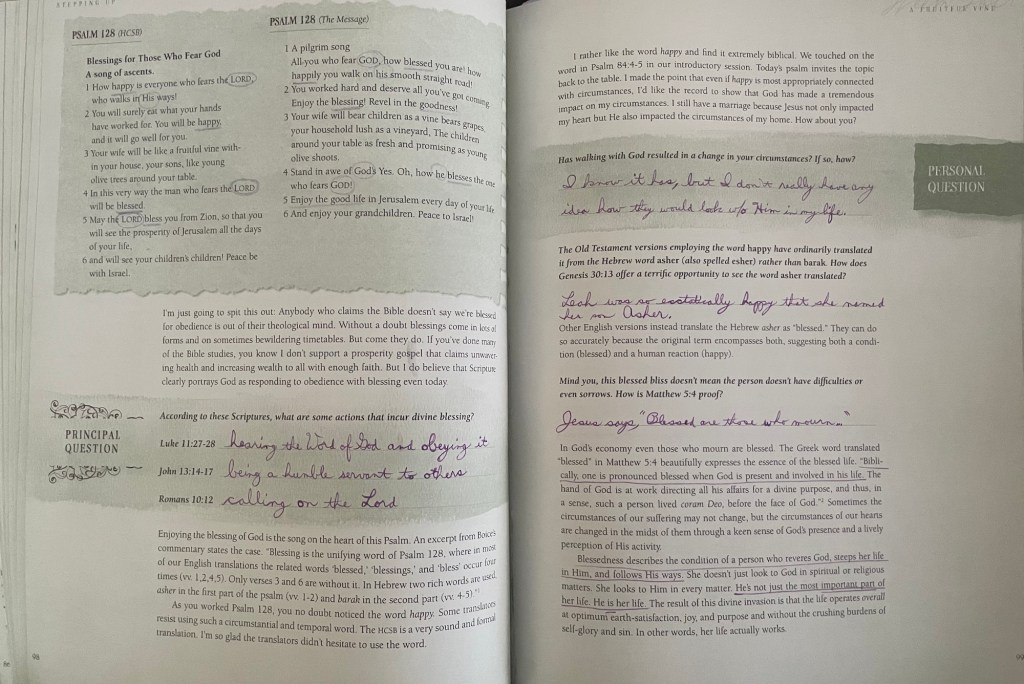
According to these Scriptures, what are some actions that incur divine blessing?
Luke 11:27-28 – “hearing the Word of God and obeying it”
John 13:14-17 – “being a humble servant to others”
Romans 10:12 – “calling on the Lord”
Has walking with God resulted in a change in your circumstances? If so, how?
“I know it has, but I don’t really have any idea how they would look without Him in my life.”
The Old Testament versions employing the word happy have ordinarily translated it from the Hebrew word asher (also spelled esher) rather than barak. How does Genesis 30:13 offer a terrific opportunity to see the word asher translated?
“Leah was so ecstatically happy that she named her son Asher.”
Mind you, this blessed bliss doesn’t mean the person doesn’t have difficulties or even sorrows. How is Matthew 5:4 proof?
“Jesus says, ‘Blessed are those who mourn…’”
Biblically, one is pronounced blessed when God is present and involved in [one’s] life.
Blessedness describes the condition of a person who reveres God, steeps her life in Him, and follows His ways… He’s not just the most important part of her life. He is her life.
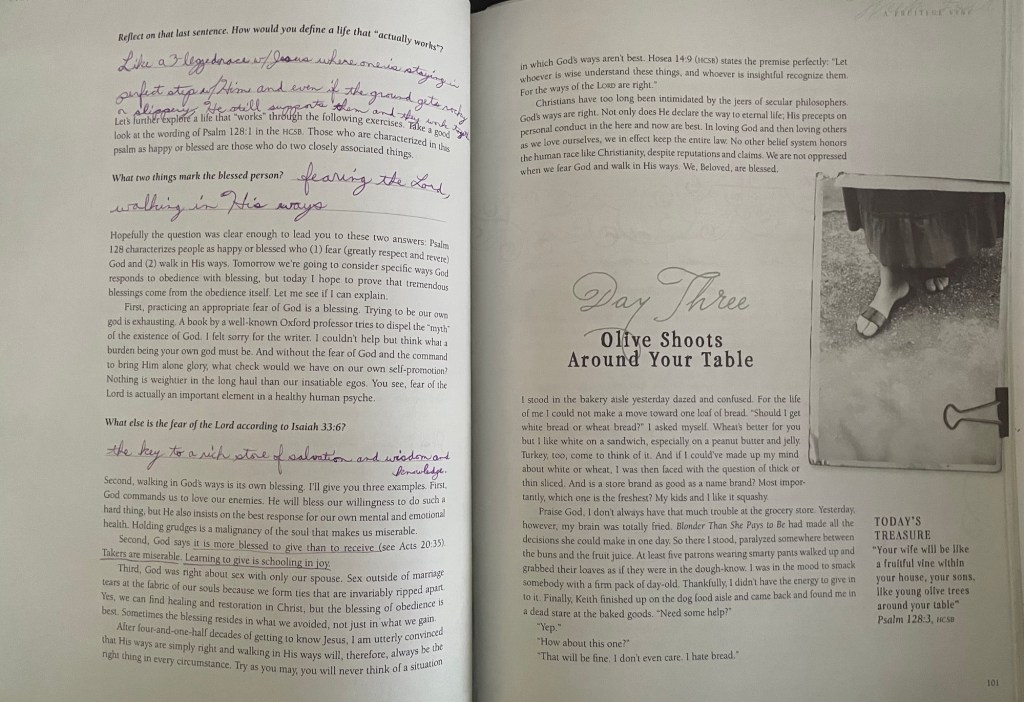
How would you define a life that ‘actually works’?
“Like a three-legged race with Jesus where one is staying in perfect step with Him and even if the ground gets rocky or slippery, He still supports them and they work together.”
What two things mark the blessed person? “fearing the Lord, walking in His ways.”
What else is the fear of the Lord according to Isaiah 33:6? “the key to a rich store of its salvation and wisdom and knowledge.”
God says it is more blessed to give them to receive (see Acts 20:35). Takers are miserable. Learning to give is schooling in joy.
Dearest Rachel –
In one sentence, you’ve summed up the Christian life for so many of us, especially those that came to Him at a young age. We know we’ve been blessed by our walk with God, but in the absence of a ‘control’ (or would it be an ‘experimental’ group? I think it’s more the former, as the default state of humanity is a fallen one, without Him), we can’t grasp what, specifically, those blessings would be. Apart from an alternate history of our lives, and being able to see the trajectory of our godless selves, we don’t know what we have that we wouldn’t otherwise.
It’s all the more challenging when it seems like we’ve had blessings taken away. I’ve reference Proverbs 18:22 to you, and its implications, a number of times in the past thirteen hundred days. But as your study points out, we are given blessings when we mourn – indeed, because we mourn – even if we don’t know what they might be.
Besides, how much worse off would I be without Him at my side (even if I don’t necessarily sense His presence)? Indeed, without Him, where would I be? I probably wouldn’t have found you in the first place, among the more obvious changes. Just as a single pebble throw into a lake creates ripples that carry to the shore, so a single choice can change the course of one’s life forever; how much of an effect would a boulder like the absence of God and His guidance be? The list of differences would be a long one, but without living that life (thankfully), we can hardly begin to guess.
To be sure, I’ve often complained that it also means that I don’t have the sort of compelling story of change from ‘what was’ to ‘what is’ that some people have when they give their testimony. There’s nothing particularly spectacular about my life that would cause someone to say “wow, I want what he has in his life!” And I would guess that you would have said something similar about yours, honey. Then again, I’ve been told by people who have undergone such a change that their ‘before life’ is often one they wouldn’t wish on someone else; for all I know, you’ve known people who said something similar to you. And perhaps, that’s as much of a blessing as anything we could ask for, even as it, too, is something we can’t perceive on the single track that we experience our lives as.

 Letters to Rachel