Dearest Rachel –
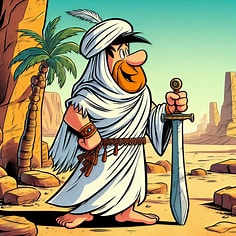
I don’t know why it is, but I can’t seem to bring myself to take this place seriously. Every time I hear the name pronounced (even silently in my head), I always hear the additional syllable “Doo!” at the end, as if cried out exultantly by an Arabian version of Fred Flintstone:
Of course, it could just be from the effects of trying to absorb and regurgitate information about too many places when I’d just as soon not bother; it’s that old conflict between the id and the superego, with the rest of me caught in the middle. I mean, I know it would be a good idea to know where it is I’m going, and what I might expect there, and the easiest way to drill it into my head is to write it all down as I find out one thing or another, but it does sort of feel like more work than I really want to bother with, especially given that we’re only going to be here for a few hours – and what I’m planning to do won’t have a lot to do with the history or culture of the area.
Still, I suppose it’s not a good idea to be completely ignorant of my destination – I got away with it in Malaysia, but I probably shouldn’t have – so let’s see what I can dig up about this place and the country it’s the capital of.
Yes, Abu Dhabi is the capital of the United Arab Emirates; I always thought of the nation as a mere collection of petrodollar-rich city-states, held together in some form of loose confederation. Turns out, their existence goes back a lot further than those petrodollars, though.
Once upon a time (and given what this story involves, I might as well use this sort of language to start it off with), there were a collection of tribes; basically large family groups, ruled by a leader who was referred to as an “emir,” a title at least a rank or two below that of “caliph” within the Islamic world, although there seems to be a certain informality (or perhaps it’s just a case of being lost or at least garbled in translation) as to where in the hierarchy these leaders stand. Several of these emirs – the ruling families of Sharjah and Ras Al Khaimah – were known collectively as the Al Qasimi who, in their battles with the empire of neighboring Oman, harassed British-flagged shipping. Indeed, the area became known as “the Pirate Coast,” hence the storybook beginning – because what good story doesn’t have pirates in it?
Bear in mind, this was in the early part of the nineteenth century. Britain wasn’t quite yet the empire on which the sun never set, but it was already the greatest navy in the world, as well as the home of the East India Company, which was big enough to have a military of its own to play with. Picking a fight with these two, even if it was in the name of maintaining ones own trade routes with India (which has been argued), is a Very Bad Idea.
Late in 1819, the British sent a force to bombard Ras Al Khaimah, which they proceeded to raze to the ground. The populace fled to a supposedly ‘impregnable’ hill-top fort called Dhayah, with the British landing their cannons and hauling them inland to blockade them into surrender. The entire process took about a month, from arrival to the surrender of Dhayah to the destruction of various fortifications and ships along the Pirate Coast, and cost the British five men, compared to between four hundred and a thousand casualties suffered by the Al Qasimi. At this point, terms of surrender were finally agreed up in a document referred to by the rather grandiose name of “General Treaty for the Cessation of Plunder and Piracy by Land and Sea, Dated February 5, 1820.” Among other terms and conditions, the various emirs signing the treaty were required to fly a flag on their ships including a red rectangle and a white border, signifying their ‘friendly’ status. And so it is that, to this date, the various emirates within the then-known-as Trucial States (which was a British protectorate until 1971, thanks to this treaty) each have their own red-and-white flag representing themselves:
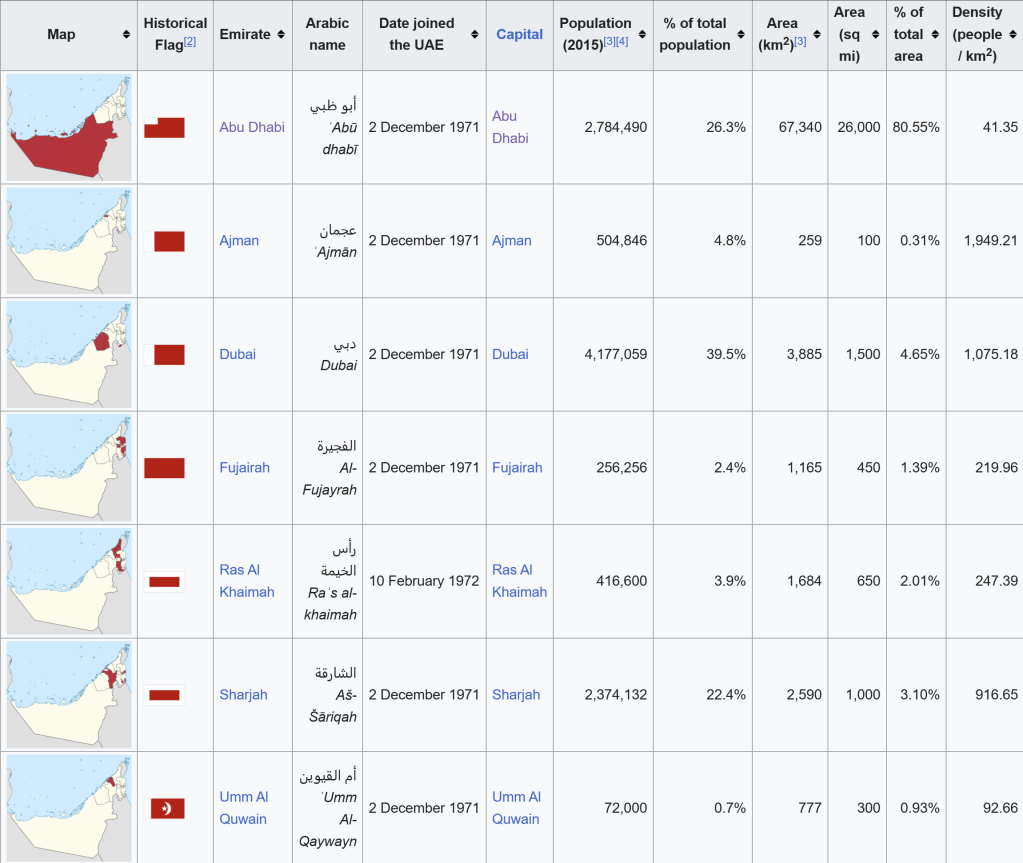
You’ll notice that Abu Dhabi is the largest of these emirates, as well as the ones furthest from the area of conflict (that of the Strait of Hormuz). While there were signatories from Abu Dhabi on the treaty, they had nothing to do with the original pirate attacks, nor were reprisals visited upon the area; however, they decided it was in their best interests to be on Britain’s good side rather than otherwise.
Now, what does any of this have to do with tomorrow’s trip? Not much, I’ll admit; I may find it interesting to look into, but it doesn’t really have a lot of bearing on the places we’ll be going to, or the things we’ll be seeing. These include the five-mile long Corniche, the waterfront road along which the city’s numerous ultra-modern glass skyscrapers and elegant residential complexes can be found; followed by a stop at the Wahat al Karama, a monument to the Emiratis who have fallen in the line of duty – which, since it was inaugurated in 2016, represents wars participated in since being released from protectorate status, including the Gulf and Afghan wars, as well as the Yemeni and Syrian civil wars.
But most of tomorrow’s trip will be spent around the Louvre – and yes, Abu Dhabi has a Louvre, in partnership with the original in France. Designed by a French architect, it has a unique dome structure that… well, perhaps that should wait until I’m there to see and film it. A picture’s worth a thousand words, after all. But the really interesting thing about it is that we’ll be kayaking around it, rather than walking. I don’t know if this allows us to see any of the works within, but it’s a particularly unusual approach to an art museum, to say the least. Obviously, I’ll have more details once I’m there.
Until then, honey, keep an eye on me, and wish me luck. I’m going to need it.

 Letters to Rachel