Dearest Rachel –
So this is an interesting case; one last city in which we’re staying overnight. Presumably, this is so the folks who left from Goa for the overland trip to the Taj Mahal can rejoin us. Honestly, given the complexity of this whole trip – punctuated by the fact that they had to adjust an entire leg of it on the fly…
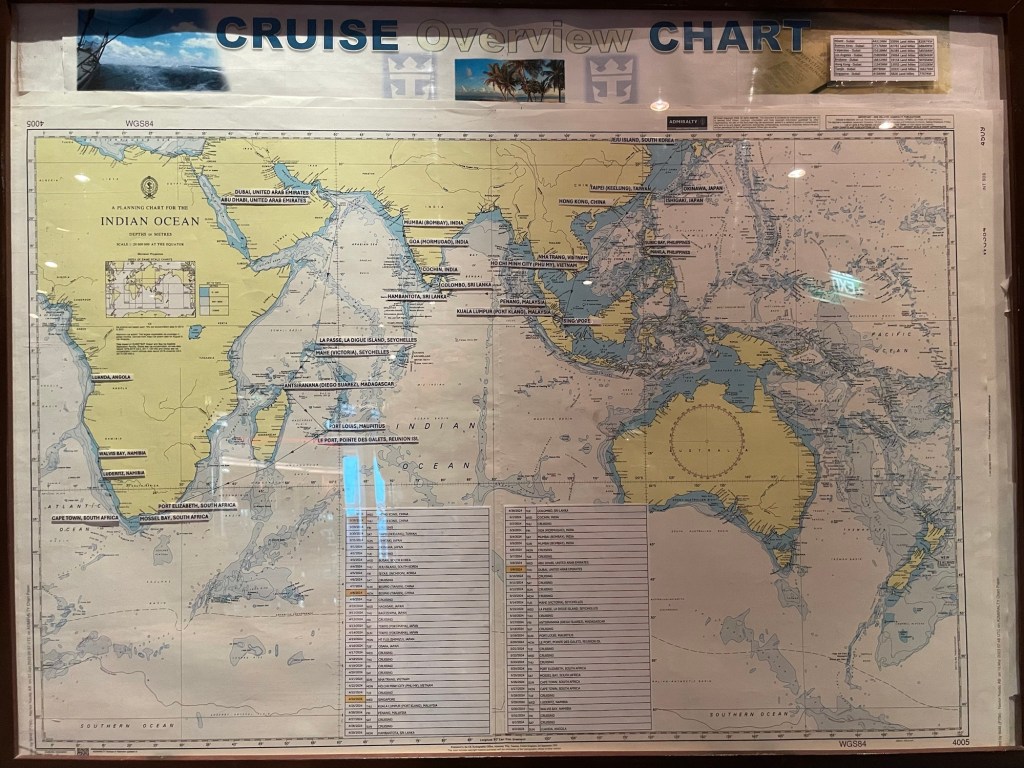
…I somehow suspect that this is going to be the one and only time that Royal Caribbean tries to pull off this whole “world cruise” thing. They can’t be making a profit on this, at this point. Sure, they may be getting all kinds of attention and publicity from it all, but I can’t imagine that this is going to have people stampeding to sign up for a next time (if there was to be a next time), especially if they have to jack up the price to make it profitable (which I’m certain they are).
But I’ve gotten way off track here. The thing is, researching each of these cities before we get there (especially as I’m doing it as I’m preparing to disembark in a previous city, and thus giving short shrift to the present) is becoming more of a chore than I’d hoped for. Even relying heavily on Wikipedia and ChatGPT doesn’t make things as much easier as I’d hoped; if nothing else, other thoughts and opinions get in the way, like right now. It’s probably not helped by the fact that my heart doesn’t belong to India like it does with Japan, and that, as the trip winds down for me, I’m already getting into the “prepare for departure” mode, despite that still being about a week away. So I’m not giving these destinations anywhere near the attention they probably deserve.
Then again, how interested would you be in this (or any of the subsequent) destination?

The capital city of the state of Maharashtra (which, by the way, borders Goa to the north, so it isn’t as if this is a particularly long distance from our previous port of call), Mumbai is the financial capital and the most populous city of India, with an estimated population of 12.5 million. When the entire metropolitan area is factored in, that number swells to 23 million; compare that to the one-and-a-half million who call the entire state of Goa home. Then again, the Mumbai metropolitan area encompasses over twenty-four hundred square miles, while Goa in its entirety only amounts to fourteen hundred.
Not only is Mumbai the financial and cultural capital of India, its influence in these spheres extends throughout the entirety of southern Asia. Nearly anyone recognizes the term “Bollywood” these days, which comes from a portmanteau of “Bombay” (Mumbai’s prior name, based in part on the Hindi name for Mumba Devi – Bomba – the patron goddess of the region; the current name is based on her name in the official state language of Marathi) and “Hollywood” – its cultural impact extends well beyond that of India, to the point where even Americans recognize the style, if not necessarily the substance, of the works produced there. Meanwhile, it’s also one of the top ten centers of finance in the world, accounting for a quarter of the nation’s entire industrial output, as well as seventy percent of its maritime trade.
And while it hasn’t always necessarily been as large and important as it is today, it’s been around for a long time. The area recorded by the Greek geographer Ptolemy as Heptanesia was known as “the city of seven islands” since antiquity, with archeological finds indicating at has been inhabited as far back as the Stone Age. The name came from the obvious fact that it was made up of seven major islands:

However – and I’m sure you can guess by now, as so many cities we’ve visited over the past three months have had similar stories – they’ve since been filled in, with massive amounts of land reclaimed from the sea. Starting with the Hornby Vellard project – an effort to build a causeway connecting all of the islands, initiated by the governor Willam Hornby in 1782(!) and completed in 1838 – and built upon further by the East India Company (who leased Bombay from the Crown for a mere £10 a year) who realized that more land meant more money, Bombay was eventually built into a single massive island, and finally, attached to the mainland directly:

Since we’re going to be here for two days – and I don’t know my way around the place personally – I’ve left it up to the professionals to show me around on each of those days. My first day will be a bit more of an overview of life in Mumbai, including one of the proto-Uber Eats, the dabbawallah culture of delivering home-cooked meals to offices throughout the city (although it’s been pointed out that, tomorrow being Saturday, things might be a bit quiet on that front). We’ll also be taking the train to the Mahalaxmi Station, one of the busiest hubs of the Mumbai train system; while the ad copy suggests that we’ll be “riding like a local,” I hope that it doesn’t include having to hang onto the outside of the train while it’s going at speed. And at some point, we’ll visit the Mani Bhavan, which served as Gandhi’s base of operations between 1917 and 1934 as he worked to free India from British rule.
Sunday’s tour will be shorter and more specific, centering on the spice trade – and will be more present-day oriented as opposed to historical. While the tour will pass landmarks such as the Gateway of India and Victoria Terminus train stations, as well as the Mumbai High Court, the primary focus will be on our stop at the Coloba Market, where spices, linens and other gifts can be browsed and purchased. Not sure how the place will compare to the market in Panjim, but there’s really only one way to find out; by going there and experiencing it for myself.
And with that having been said, honey, I guess that all I can add is a request for you to continue to keep an eye on me, and wish me luck, as I’m sure I’ll need it yet.

 Letters to Rachel