Dearest Rachel –
Back in the day, I understand that Thomas Cook & Son was considered to be the gold standard for tourism; the “Cook’s tour” was proverbial for being given a decent understanding of a place and situation, whether a new job or an actual vacation spot. So, taking into account that the job of a chef is considered to be more prestigious than that of a cook, how much more so would a Chefs Tour be considered?
Of course, bearing in mind that this is supposedly a gustatory experience, I really should’ve skipped breakfast this morning. But I can’t seem to help it; I’m a creature of habit, right down the fact that I wake up at a ridiculously early hour, so it’s no wonder I’m hungry by the time three hours pass, and seven o’clock rolls around.
Equally habitual (although this has been slowly developing over time; I used to be more pre-punctual, as you might remember) is the fact that I don’t make my way to the theater until fifteen minutes before we’re to report there. As a result, I discover only as I settle into my chair that I’ve left my wallet behind in my stateroom. Not that it has adequate tip cash in there (which I should have dealt with yesterday in the casino, I suppose), but if I want to get local cash, I’ll need my ATM card, plus a photo ID would be useful to have on hand, to put it mildly. As with the time I left my camera behind, I run up the stairs to collect it, and still return in plenty of time to wait out the call of our number.
And while quite a few numbers get called before ours, it’s not really all that long before we’re off the ship and on our bus. Certainly not as compared to Kochi.
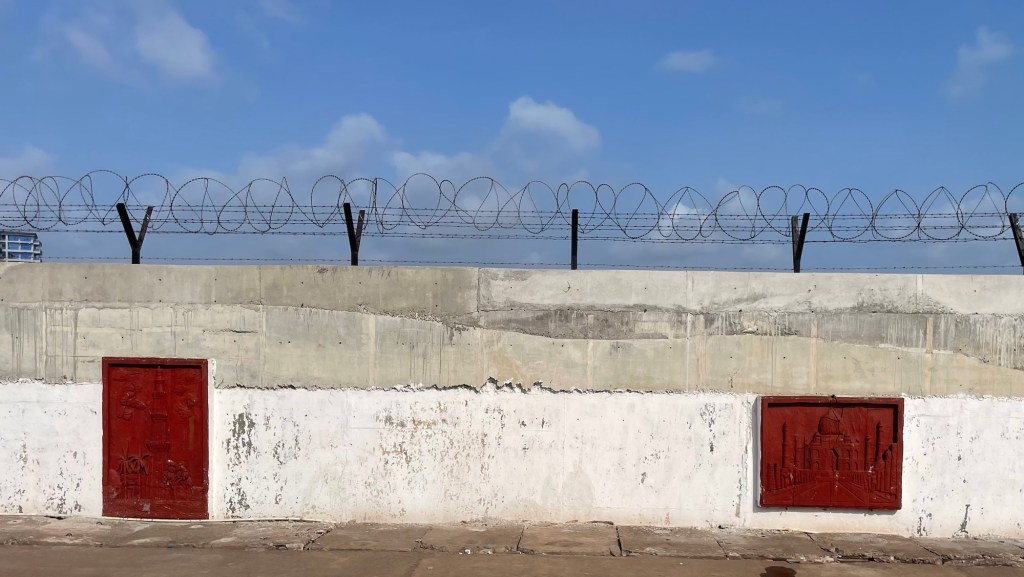
This impression isn’t helped by the fact that, before we can pull out of the pier, a fellow in camouflage, fatigues walks onto the bus and has us hold up the page with our Indian visa and the local stamps on it, just to verify one more time who we are. We just went through a face-to-face check at the terminal; why is an army dude going through and checking us a second time?
In any event, we finally make our way out, and our guide warns us that Panjim isn’t going to be like many of the big cities we’ve visited. Despite (or perhaps in part because of) being the capital city of Goa, it is a fairly small town. It’s also a World Heritage site, and as such, its buildings cannot be improved upon, lest the heritage inherent in them be damaged. Honestly, I’m starting to wonder about the designation; it seems to stand in the way of progress and improvement for certain locales. I could understand if there was a trade-off in terms of tourism revenue, but I can’t see where it benefits the locals living in these places.


Our guide speaks of Goa’s size and demographics. It’s the smallest state in the union of India, with an area approximately the same size as the city of Mumbai – but with a population not even a twelfth as large, since much of the interior is hilly and forested. Having been a Portuguese colony for over four centuries, it has a unique cultural ethos in comparison to the rest of the country. Arranged marriages are uncommon here, while interfaith ones aren’t. Drinking is permissible here in a way that is not prevalent throughout the rest of the country (although drinking to excess is still frowned upon), as are things like bikini-clad women. Essentially, Goa is thought of in the Indian psyche as a land of freedom.
Of course, Goa has its own disadvantages as well. With a higher standard of living, there comes a higher cost of living; he talks about a kilogram of rice costing ₹70 here that would cost ₹30 in any neighboring state. As he does so, I’m trying to wrap my head around how much rice we can buy at home for less than a dollar; I’d bet a lot more than that that it would be considerably less than a kilogram.

We walk up the alley leading to the fish market, and find ourselves having to pause en masse at the entrance; one of our number was apparently bumped by a car, causing a dispute between a husband and wife and the driver of the car. It felt more than a little awkward, as the group of us stood there, effectively blocking the entrance to the market for a few minutes while the situation was sorted out with the guide’s intervention. It occurs to me that we can’t buy anything from here, even if we wanted to, because of agricultural issues; we’re interfering with, rather than contributing to, the local economy.
Although after passing through the seafood (and meat) market, we turned a corner and climbed a few stairs to find ourselves amidst a multi-level shopping center with produce and clothing stalls. At this point, we’re given leave to scatter throughout the place and see what, if anything, we might want to buy. Since I’m short on cash (and really, have no local currency), I find myself unable to do much – although, given that, like in Vietnam, there are those coming up to me to offer to sell me this thing or that, and lacking cash is the perfect excuse to fend them off.
At the same time, there are a few things I wouldn’t mind getting my hands on, so I eventually take the opportunity to ask our guide about where I might find an ATM. He gives me some vape directions, after a few twists and turns, I do manage to find a bank (although I have to wait around outside the ATM stall for some time before I’m up in the queue). The problem is, by the time I’m through with that, and I wander around the market for a bit longer, I’m starting to wonder if I need to get back to our drop off point.
I find my way back just before 11 o’clock, and I find a few others from the group already there. However, it turns out that I didn’t need to be there for another half hour yet. And while I might be able to go back into the market, it’s not as if there was anything my heart was set on; I’d seen a shirt for Daniel, but it wasn’t in his size, and I wasn’t going to pursue the matter any further than that. Besides, the guy did already told us that the cost-of-living was higher in Goa than most places; maybe I’d have better luck in Mumbai?
After hanging around the park by the river for the requisite half hour, we discovered we would need to cross the road again in order to get on the bus. No big deal – although the traffic is a little daunting, we manage all right, and proceeded to a restaurant, where presumably we could see to what use the wares of the market could be put.
There really isn’t that much more to tell about this particular trip, honey, as it turns out that it’s an hour’s drive to and from the port to Panjim, and ours is a relatively short stay here in Goa; we need to be getting underway in order to make it to Mumbai by tomorrow. I realize it’s necessary, as these places are not nearby each other, but it does limit the amount of time that we can spend in any one place. I feel like this has been limited, but given the distance to and from, it’s probably the best we could do. Now, we’ve got to prepare for our next stop.
So until then, honey, keep an eye on me, and wish me luck. I’m sure I’m going to need it.

 Letters to Rachel