Dearest Rachel –

Technically, we’re in the municipality of Phu My (and please, don’t ask me to pronounce that). It’s not all that unusual; many of the cities that we are visiting are separate from the port we actually dock at. Consider Keelung and Taipei, for instance, or even Yokohama and Tokyo, for that matter – although that once again gives very short shrift to the second largest city in all of Japan.
So I’m guessing that it might be a bit of a ride into the city proper. It happens, and it’s why I prefer to be on a shore excursion in these cities that I don’t know enough about personally. Better to travel with someone that Royal Caribbean is willing to vouch for (and who, if they should run late today – which, given the reduced duration of our time in Ho Chih Minh, isn’t out of the question – they will be willing to wait for) than take my chances with someone else, or even my own two feet.
And on the subject of not trusting my own choices, I should let you know that I’d originally put on my “Introverts Unite” t-shirt, only to conclude that the defiant fist-in-the-air image might not be appreciated by the authorities. Revolutionary imagery is only acceptable until the revolution has been accomplished; now that the revolutionaries are in charge, there will be no defying the brave new order of the socialist workers’ paradise. Never mind that the tag “separately in your own homes” demonstrates that it’s all a joke (and in fact, I was approached by a fellow passenger asking where I got the shirt, so she could find one for her own daughter); I’m not counting on all of the authorities here being able to read English and having a sense of humor.
Yes, I’m a little paranoid; why do you ask?
***
Our number is called maybe about fifteen minutes after I arrive at the theater and collect it, but we wind up standing in the exit for at least the same amount of time; I’m reminded of Robin Williams’ routine as Adrian Cronauer in (appropriately enough) Good Morning Vietnam where he beats on his chest to simulate the sound of a helicopter traffic report, claiming that there’s been an accident involving an overturned water buffalo on the Ho Chih Minh Trail, causing a miles-long backup. Not that I expect that’s the case here, but I am curious as to the delay – if nothing else, it makes me wonder why our number was called so quickly, when they weren’t really ready for us. 
Our guide, “Michael,” starts of by welcoming us to Saigon; as far as he is concerned, the name Ho Chih Minh City is for the younger generation, who doesn’t know any better, and the newspapers. The natives apparently still call it Saigon, for all intents and purposes; and here I thought that would be an unpleasant reminder of pre-independence days (not to mention the war).
Tour guides are a bit of a mixed bag; some of them are a fount of information, giving you a schpiel about their city and region such that you can barely keep up with it, and will be almost guaranteed to have forgotten most of it by the time you arrive at your destination. Others keep quiet during the longer bus rides, and let you rest up for and from the day, which, to be fair, can be a little bit boring in its own, right. On the other hand, that’s kind of the point; you can’t nap when somebody’s talking at you.
For now, Michael happens to be one of the former tour guides, which stands to reason, as they’re more common than the quiet type; more often than not, they seem to see it as they’re duty to inform us of the place we’re visiting, under the (correct) assumption that we know next to nothing about it. Among other things, he shows us his ID card; every Vietnamese receives one of these upon turning fourteen years of age. Every bit of information about you is on this piece of plastic. You can use it to withdraw funds from your bank (although, post-Covid, who uses paper money anymore?) and pay for things. It works as a driver’s license (although once he turns 56, he’ll no longer be allowed to drive a bus anymore; I guess that rules out a career of bus driving in Vietnam for me).
That last bit of information is where things go slightly off the rails, at least in my mind. This government-issued ID not only identifies you, but the information on it can preclude you from doing certain things. This is a country where the government can tell you “no,” and there isn’t a thing you can do about it. Sure, who wants to start a new career driving a bus at the age of 56? But if you thought you might want to do something like that in order to make a little extra money, you can forget about it. Something about that doesn’t sit well with me, and I wonder if Michael mentioned that on purpose, or he doesn’t see the problem with it.
On the other hand, he talks about how Vietnamese people can retire at a young age; at 55 for women, and 60 for men. This is because nearly forty percent of Vietnam’s population are young people, unlike much of the rest of Asia we’ve visited. As a result, they have plenty of young workers, so they don’t need the older folks to keep working; the younger generation can support them. And those workers work for cheap; Michael boasts of how many corporations – Apple, Samsung, Lego, just to name a few – have set up, or are looking into setting up factories here, given how economical it is to do so.
He teases us Westerners about the fact that we have to work until we’re 67 or so for our retirement benefits, but I question how good his are going to be; how much can one’s kids support you when they’re only making the equivalent of $10,000 US a year? That’s not even enough to support oneself, let alone accomplish one’s filial piety by supporting one’s parents.


Michael points out that Vietnam exports nine million tons of rice per year, making them the largest rice exporter in the world. And that isn’t even their biggest export; coffee is, although they’re second in line behind Brazil on that crop. Which shouldn’t be a surprise, given Brazil’s enormous size.
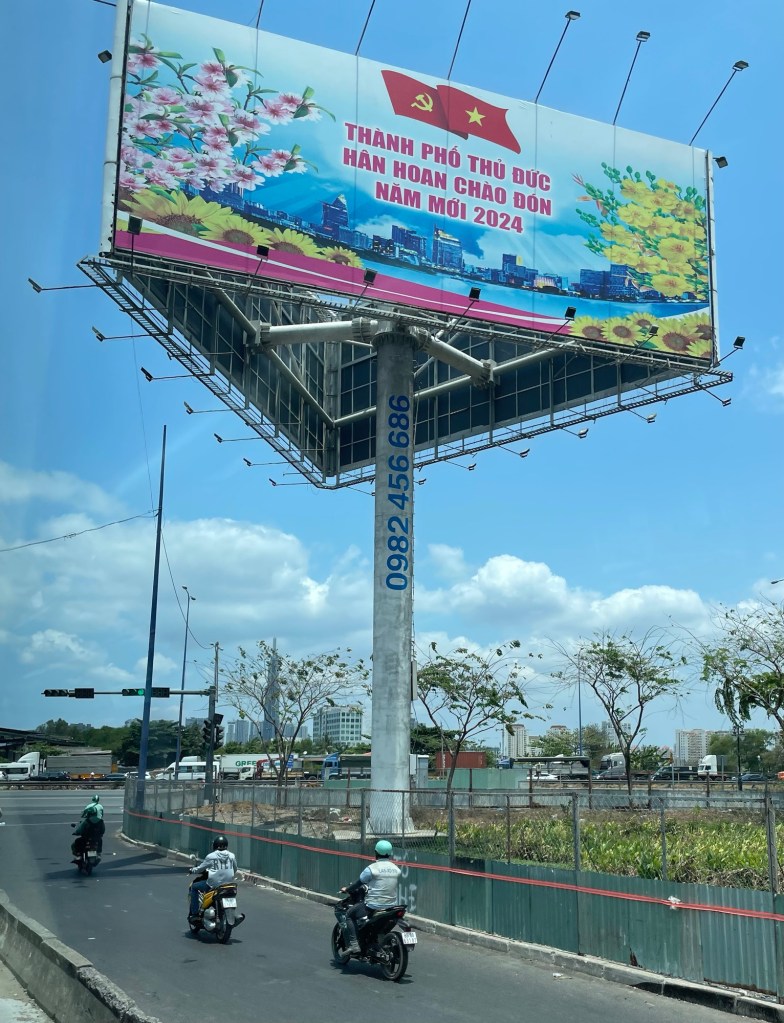
Michael talks about foreign investment in Vietnam; while Hanoi’s infrastructure is built almost entirely on Chinese money, in Saigon, most of the investors are Japanese, with some Australian, Cambodian and Laotian money thrown in for good measure. They aren’t as beholden to Chairman Xi down here, it would seem – although I don’t know if that makes a difference, on a national basis, especially if their thumb is on the scale in the seat of government.


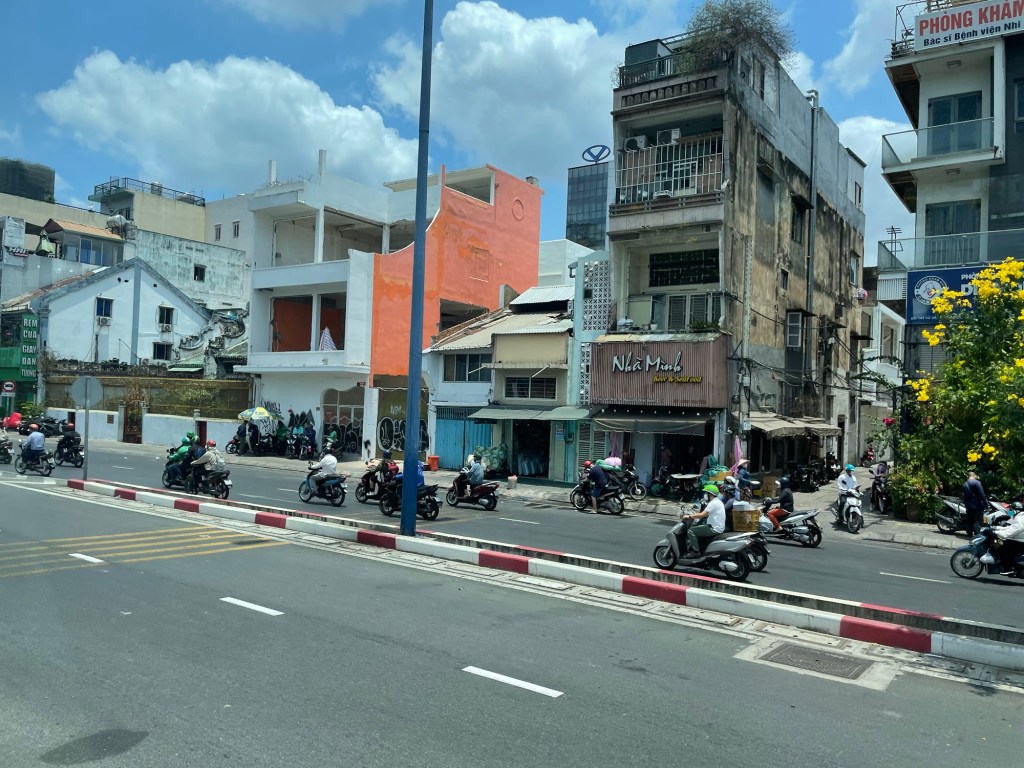

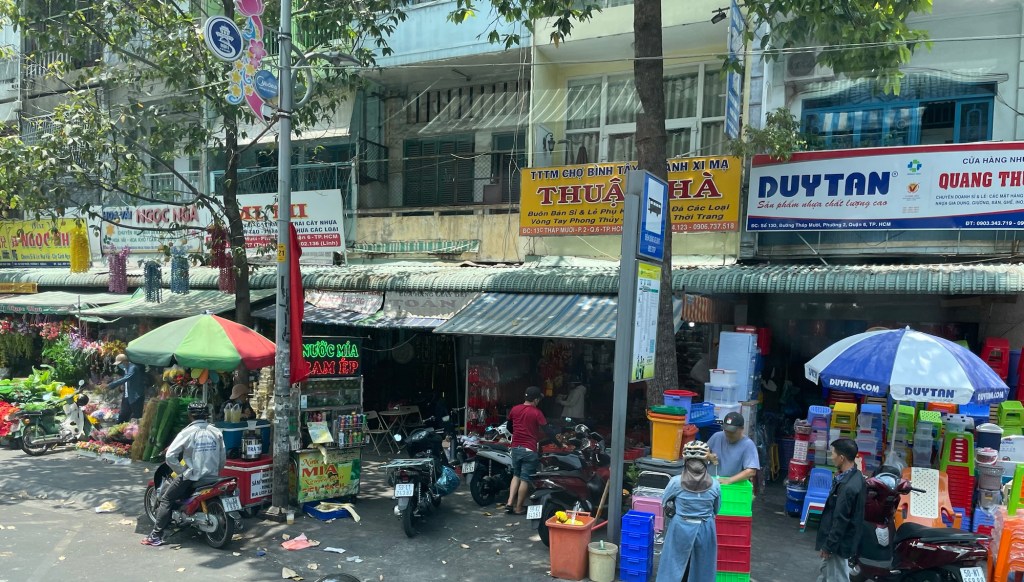
We finally make our first stop, allowing us to get off the bus, at around noon. It’s a quick buzz past the building from which the last helicopter took off on April 30, 1975, and on to the Gustav Eiffel-designed Post Office. Even the Notre Dame Cathedral across the street is something of an underwhelming disappointment, as it’s under repair for leaks – and has been for seven years thus far.
From here, we drive to the main shopping district (and here, I had hoped to shop in Chinatown, but alas) and are given the bulk of the free time to wander about the usual high-end brand name stores. At a certain point, one wonders why a traveler would be interested in getting their Hermes or Louis Vuitton from Tokyo or Saigon or wherever; the price is likely to be similar, as it’s presumably dictated by corporate. But what do I know? That’s not something I’m interested in shopping for in the first place.
At least Michael offers to take those of us who are interested to a local place for a proper Vietnamese buffet lunch. It’s not included in the cost of the excursion, but then again, neither is the shopping, so that’s perfectly fine. I get to encounter a few things I wouldn’t under any other circumstance, with surprises going in both ways (pleasant and not). Either way, I get my fill.
And we’re still left with half an hour to shop, or whatever. I won’t say that I’m a soft touch, honey; I do want to get rid of my Vietnamese money, and some of the stuff the street vendors are selling actually appeals to me, to a certain extent. But when they start getting aggressive, and approaching me directly, it raises my hackles to the point where I would be just as happy to take that money – that I will never be able to spend anywhere else – and go back to the ship with it, rather than give any of it to them for whatever it is they happen to be selling. Still, I do give in, and get myself a trio of polo shirts, and a couple of T-shirts, before being swarmed by a bunch more of these… guys (I’m trying to remain civil here)… once I’m out of all but tip money.
Between this, the smell of cigar smoke in the air (even outdoors), and the slight sense of paranoia that, justified or not, comes with the territory when it’s communist, I can’t say I’m enjoying Vietnam all that much. On the other hand, maybe it’s just the fault of a.) having just come from my favorite foreign country, where any place would suffer in comparison, and b.) having to run around in the heat and humidity after four days of utter lethargy at sea.


Our final stop is at the Presidential Palace, which makes it sound absolutely opulent. I find myself assuming that the Vietcong left it standing just to show the masses about how decadent the capitalist elites were while the proletariat all but starved.
But it doesn’t seem really all that extravagant, compared to some of the places we’ve seen. Even the theater pales in comparison to, say, the Shi family compound in Tianjin. Then again, that was built with a part of one family’s own money; this was built on government money, both that of Vietnam and the U.S. I wonder what we’re building with all the cash we’re sending to Kyiv…
Of course, modern Saigon has grown and prospered in the days since the end of the war. Michael has been name-checking a fellow by the name of what sounds like ‘Vin Rangh’ (which can’t be how it’s spelled – and sure enough, when I look it up upon returning to the ship, I find him listed as Phạm Nhật Vượng), who he makes sound like a cross between Sam Walton and Elon Musk, in terms of his corporate holdings. A truly socialist country would frown on the accomplishments of such a man, but between his grocery stores, his electric autos and buses, and the skyscrapers bearing his name or imprint, it seems that such activities are approved of, if not outright lauded. So, good for him, and good for Vietnam, I suppose.
But I can’t help but wonder; what would “Uncle Ho” think?

 Letters to Rachel