Dearest Rachel –
Another port city, another destination I know next to nothing about. In all honesty, when I realized we would be making two stops in Vietnam, I rather assumed that we would be going to the two former capitals – or at least, the port cities that led to them – Hanoi in the north, and Saigon (yes, yes… Ho Chih Minh City, whatever…) in the south. And while our next stop is in Ho Chih Minh, tomorrow’s stop in Nha Trang is not only nowhere near Hanoi (that would be Haiphong that we would be visiting in order to get there; and even then, it might be like visiting Beijing, or at least Tianjin or Taipei), it’s not even particularly close to the dividing line between North and South Vietnam – not as though that’s been a thing for a long time, now, to be sure.
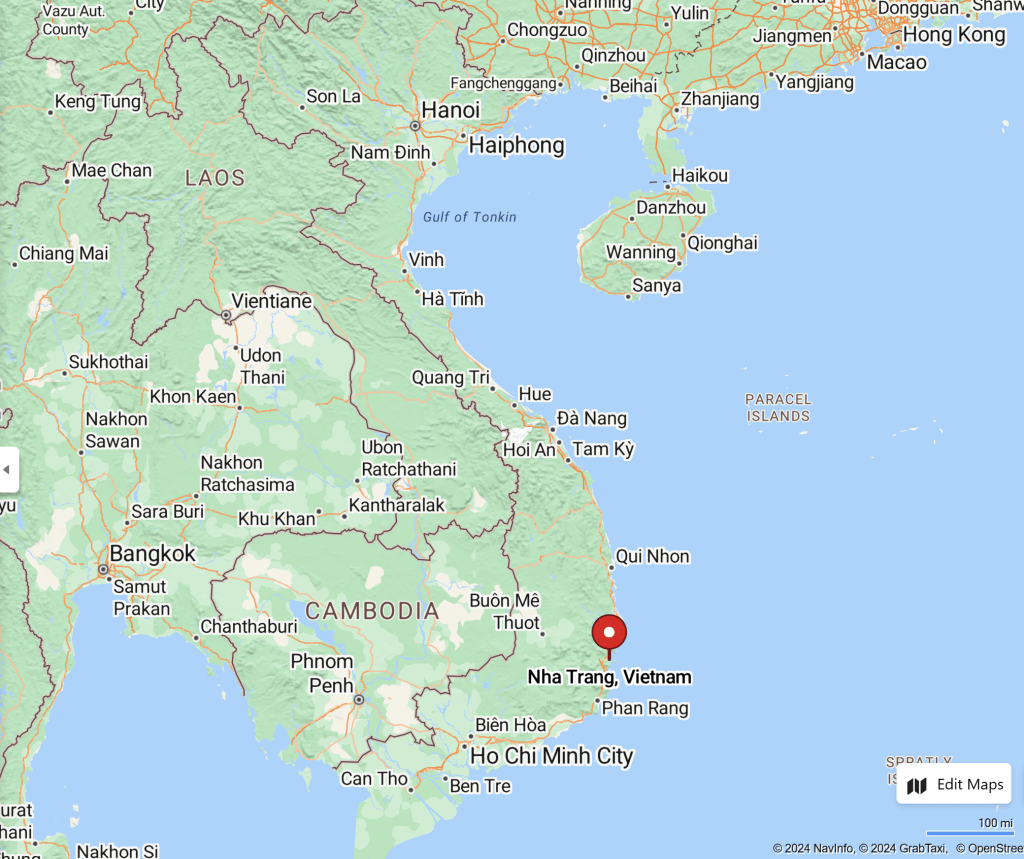
So what’s the importance of a place like Nha Trang; why are we stopping here, as opposed to one of the larger or more historically significant locations?

Well, for starters, the place isn’t exactly small or obscure (except to us geographically illiterate Americans, I suppose). At just under half a million people, it’s actually equal to or larger than half the places in Japan that we’ve visited, in fact. And as far as density is concerned, it’s almost the same as at home, at about 4,400 per square mile. With all that being said, I’d ask why I haven’t heard about this place, but if I had information about all the places that fit those qualifications in my head, it would swell up like a balloon… which, now that I think about it, was pretty much how I was feeling about a week or two ago.
Coincidence? Yeah, probably.
Anyway, it’s not as if the city doesn’t have a fair amount of cultural significance. Under its original name of Kauthara, it was a major hub within the kingdom of Champa. The Cham built the Po Nagar towers there in the late 700s A.D., which are still used as a holy site by Buddhist monks to this day. We’ll actually be visiting this site as part of tomorrow’s shore excursion, in fact. Oddly enough, the Cham – the indigenous people of Vietnam, separate from the ethnic Vietnamese (the former being Austronesian, the latter being Asian) – are nowadays primarily Muslim, with a minority practicing Hinduism, and almost no mention of Buddhism in their current religious demography at all. Then again, with less than two hundred thousand of their number throughout Vietnam, the remaining Cham (as with so many indigenous peoples throughout the world, it would seem – the American experience proving to be hardly unique as I travel from one country to the next) are a fractional minority in what used to be their own country, and that was long before the so-called “colonial powers” entered the stage.
And with that being said, let’s talk about those colonial powers. To be sure, with Saigon (and I’ll use that name in its historical context, since under French rule – and indeed, throughout the Vietnam conflict we were involved in – it always was known by that name) there was a much greater French influence, as it was considered the economic capital of French Indochina, whose strategic importance led to more significant French investment and development compared to Nha Trang. However, the French did invest in infrastructure like roads, railways, and ports, in an effort to integrate all Indochinese cities into the colonial economy, and Nha Trang was no exception. The construction of the Trans-Indochinese Railway during the colonial period integrated Nha Trang into the broader Indochinese transportation network; they introduced Western-style education, establishing schools and other educational institutions that taught subjects that helped produce a generation of Vietnamese who were bilingual and had exposure to Western ideas and culture; they even influenced the cuisine of the nation (which, considering that these are the French, can hardly be anything but a good thing). For example, the Vietnamese baguette (banh mi) is a fusion of Vietnamese and French culinary traditions. They also introduced coffee cultivation to Vietnam, and today, Vietnam is the second-largest coffee producer in the world.
Of course, Indochina thought of itself as having been promised independence for resisting the Axis powers (specifically the Japanese) during WWII, especially with the government in Vichy being little more than a puppet of the same Axis. For us as Americans to come down on the side of the colonial power – particularly after releasing our own “colony,” the Philippines, after the war – must have seemed a bit hypocritical, to say the least. I understand that there were probably some geopolitical machinations between Truman and DeGaulle on this subject that might have tied the former’s hands on the subject, but I suspect that this is a knot that only a sword could untie, and we had (and still have) no Alexanders in this world – and if we did, the cut ravelings would offer that much less in terms of understanding the root causes of the whole historical mess. That being said, the U.S. Army’s First Field Force, Vietnam was headquartered in Nha Trang during the late 1960s, but the city was captured by the Vietcong in April of 1975.
Today, however, Nha Trang is more likely to be invaded by tourists, as its economy relies largely upon them. A shipbuilding industry has developed and contributed significantly to the local economy in the suburban areas, but the city is one of the most important tourist hubs throughout Vietnam, thanks to its beaches with fine, clean sand and the clear ocean water with mild temperatures all year round.
Which, I suppose brings me to tomorrow’s itinerary. Along with the Po Nagar, we’ll be visiting the Oceanography Institute, where we’ll be wandering around viewing thousands of preserved marine species and learning about underwater ecosystems through colorful imagery. We’ll also get to admire the magnificent driftwood works at the local craft village – it sounds like your dad would have loved that, aside from the possibility that he might think that he could make better stuff than what’s on offer for sale – as well as knitted fishing nets, woven mats, hand-made conical hats, as well as other local cultural artistic items. Then, we finish up at a local beach club, although it’s not so much a question of doing stuff there as just straight up relaxing, I suppose, before returning to the ship.
All of which sounds like a pretty full five and a half hours, I’d say. So, with that, I’d ask you as usual to keep an eye on me, and wish me luck; I’m sure I’m going to need it.

 Letters to Rachel