Dearest Rachel –
After pranking myself with Okinawa, it would have to be that we get another destination where the question becomes “is it the city or the island?” This time around, I at least have a hint in the form of my excursion ticket, titled ‘Jeju City Highlights.’ So, I suppose, the city it is… this time.

Although… I probably ought to discuss the island, too, and where it is, before I go any further.
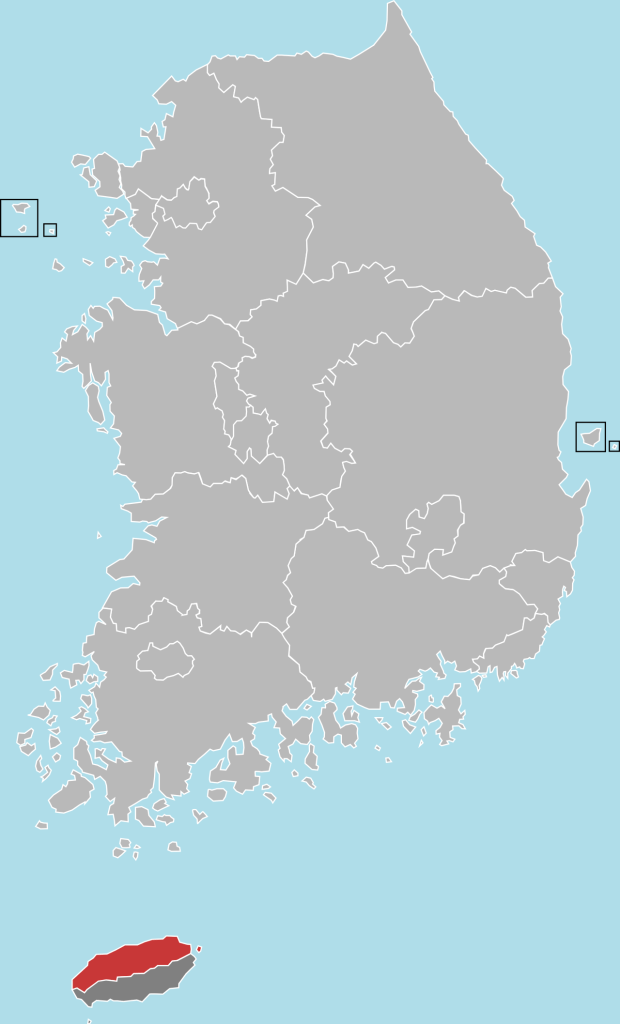
As you can see, Jeju city is on the north side of the island – the largest by far throughout South Korea – which is some distance off of the southwestern coast of the Korean peninsula. Even by taking up only half of the island, the city is still pretty large, at just under a thousand square kilometers. Although with a population of just under half a million, the city is thereby considerably less dense than our hometown, by a factor of somewhere between three and four.
Its subtropical climate makes it a magnet for tourism, particularly from China, Japan, and of course, South Korea. In fact, the number of travelers between Seoul and Jeju is so large, this particular air route is the busiest in the world, with just under ten million passengers carried between the two airports in 2011 (the latest year with available figures). While this may have dropped off during Covid, between the craving for travel spurred by the past few years of confinement, as well as the short time and distance involved to fly there (around an hour – and it’s not as if one can drive there, after all), it would seem reasonable to expect it to have rebounded since then, and then some.
The island has its own distinct culture, as could be expected from a place that appears to have been inhabited since before recorded history. Right in the center of the city is the Samseonghyeol, a trio of holes from whence three demigods are said to have emerged, thousands of years ago. They eventually found themselves brides – delivered to them mysteriously by unknown forces, but presumably the gods – and became the ancestors of the Tamna people, who lived in and ruled the island as a kingdom separate from that of Korea proper until, as with the Ryukyus and Japan, the larger nation invaded and absorbed the smaller island nation; in this case, in the early fifteenth century. So again, there is a certain amount of separate culture between Jeju and peninsular Korea, although half a millennium is ample time for the Jeju to assimilate into general Korean society – or vice versa, as Koreans came over and settled in Jeju.
There are certain traditions that are unique to Jeju, partly due to its separate history, partly due simply to its geography as a volcanic island. The island is known for its traditional Jeju houses, known as hanok, wooden boats referred to as taeu, as well as its distinctive folk culture, including music, dance, and cuisine. One of the most iconic cultural practices of Jeju Island is the tradition of the haenyeo, skilled female divers who harvest seafood, such as abalone, sea urchins, and seaweed without the use of modern diving equipment. While we may not be watching these divers in action, our visit to the Folklore & Natural History Museum can be expected to cover many of these things in more detail.
Jeju also has a number of natural landscapes and features, even within the city. Along with the Samseonghyeol, there is also Yongduam Rock, a 32-foot-tall stone worn down by time into a shape resembling a dragon’s head, an auspicious sign throughout eastern culture. It rises out of Yongyeon Pond, a lake in which the sea meets fresh water, fed into it by nearby springs.
And while there is nothing extant from the Tamna kingdom (aside from those in archeological finds), we will be visiting the Gwandeokjeong Hall, a historic building dating back to the early 17th century, during the Joseon Dynasty period. The hall served as a government office and a venue for various official functions during that time. As one of the oldest surviving structures on Jeju Island, it serves as a representation of the traditional architectural style, features a tiled roof, wooden pillars, and decorative elements characteristic of traditional Korean architecture.
Finally, our excursion will wrap up at the Dongmun Traditional Market, known for its selection of Jeju-specific products, including hallabong citrus fruit (a hybrid of the mandarin orange and the pomelo), green tea, honey, and other local specialties. Supposedly, Dongmun is a great place to sample traditional Korean snacks and street food, including hotteok (sweet pancakes), tteokbokki (spicy rice cakes), kimbap (seaweed rice rolls), and more. It also offers a variety of clothing, accessories, and souvenirs, such as traditional Korean clothing (hanbok), handicrafts, ceramics, and other locally made goods. While I don’t have anything specific to look for at the moment, that’s at least something to consider, I suppose.
In any event, I do still have to prepare myself for the day, so I will sign off for now, asking you to continue to keep an eye on me, and wish me luck. I’m still going to need it.

 Letters to Rachel