Dearest Rachel –
Every port we visit these days, I find myself having to apologize for not having done my homework weeks in advance, like I’m used to having done. Considering the changes that happen in some cases (such as the fact that we weren’t ever pulling into Cairns at all, nor did I manage to visit the town in any event), that may have actually been a good thing. No point in wasting research on a place I couldn’t expect to actually see. Still, it’s embarrassing to have to admit so often that I know nothing about this place or that; it rather has me longing for when we get back to Japan – but that’s a whole segment (or two!) away from now.
At least in Australia, I can speak the language, more or less. Indonesia is a whole different story, and one I’m utterly unprepared for.
One thing I’m particularly surprised about is the fact that we’re not stopping at, or even near, the capital city of Jakarta. In fact, we’re not bothering with the island of Java at all, but rather these two fairly small islands just to the east of it. Bali, I understand, as it’s been a fabled tourist destination for generations, but what is this Lombok place?
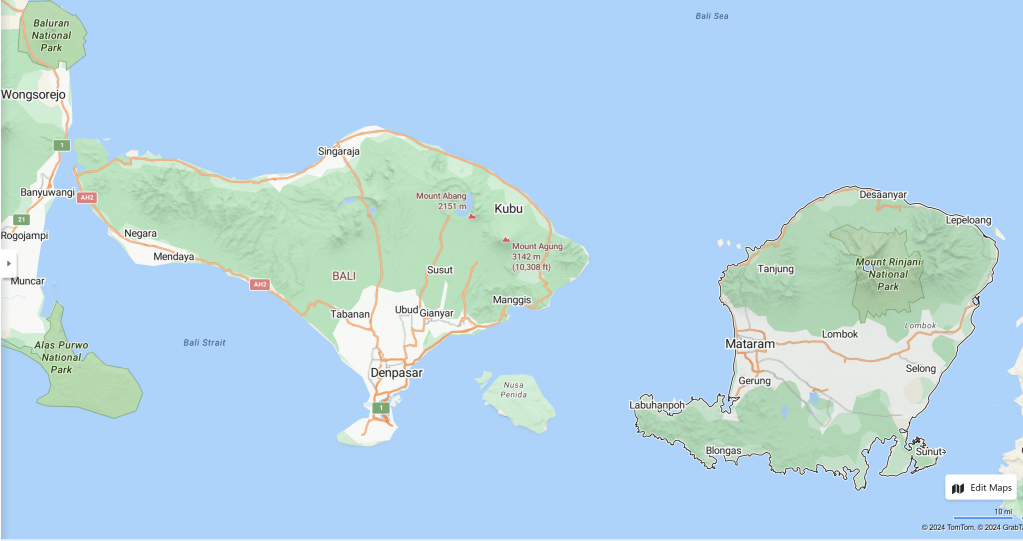
As you can see, it’s an island just to the east of Bali, whose administrative capital, Mataram, is about eighty miles by ferry to Bali’s own provincial capital of Denpasar (which means that tomorrow’s sail will be decidedly brief, not unlike the one between Mo‘orea and Pape‘etē. The two islands share some cultural heritage, but are part of separate provinces, Bali and its surrounding island being one of its own, and Lombok combining with the island of Sumbawa to the east to form West Nusa Tenggara. This is not due simply to administrative convenience, however, as they are home to separate people groups, the Sasak (whose word “lomboq,” meaning “straight” or “honest,” gave their home island its name) and the Balinese.
The Sasak have little written history of their own prior to the seventeenth century (which I’ll get to in a moment). There is some historical record of a colossal volcanic eruption in 1257 – the caldera created by the eruption forms the lake you see in Mount Rinjani National Park, although this eruption was of Mount Samalas, to the west of Mount Rinjani – in Majapahit (the suzerains of Lombok, and indeed much of modern-day Indonesia and Malaysia) records, but apart from that, little is recorded. The Sasak themselves had various princes and fiefdoms throughout the island, and were not particularly unified amongst themselves.
This made them vulnerable to other people groups who had more of a unified identity. The Balinese invaded from the west in the early seventeenth century, while the Makassarese meanwhile invaded eastern Lombok from their colonies in neighboring Sumbawa. With the arrival of the Dutch in 1674, the Sasak cut a treaty with them in exchange for assistance, not unlike the Ngāti Whātua requesting succor from the British regarding the Ngāpuhi in northern New Zealand. However, the Balinese still managed to take over the whole island by 1750, but Balinese infighting resulted in the island being split into four feuding Balinese kingdoms. In 1838, the Mataram kingdom brought its rivals under control. While relations between the Balinese and the Sasak were reasonably cordial in the west, peasant rebellions against the Balinese were fairly common in the east. Near the end of the nineteenth century Sasak chiefs – who had been reduced to roles of virtual tax collectors for their Balinese overlords – sent envoys to the Dutch in Bali and invited them to rule Lombok. In June 1894, the governor general of the Dutch East Indies, Van der Wijck, signed a treaty with Sasak rebels in eastern Lombok. He sent a large army to Lombok and the Balinese raja capitulated to Dutch demands. To this day, the Dutch are remembered fondly as liberators much more so than colonizers.
So yes, the islands have a shared history of sorts, but it hasn’t always been the most friendly. Today, there is the additional wedge between them of religion, as Bali is one of the few outposts of Hinduism in what is largely a Muslim nation. However, it would seem that the southeast Asian variant of Islam is not the, let’s just say, militantly theocratic form we think of when the term comes to mind; in fact, it’s usually a surprise to discover that Indonesia is by far the largest Muslim nation in the world, in terms of population. Islam is generally associated with the Middle East and all the lovely and ‘mostly peaceful’ goings-on over there, some of which are currently serving to force Royal Caribbean to re-route the entire third leg of the Serenade of the Seas’ Ultimate World Cruise to circumnavigate Africa rather than deal with the wars and rumors of wars in the Red Sea and Suez Canal areas. I wouldn’t go so far as to claim that Indonesia has a second deity in the almighty rupiah – for one thing, at about Rp15,600 per one U.S. dollar, it’s not particularly mighty at all – but the struggle to keep oneself financially sound in such an economy may divert attention from the sorts of absolutism that appear to dominate the minds of the mullahs of Iran or the sheiks of Arabia, while the fact that they have an economy (and they are working to sustain and grow it) prevents them from wallowing in victimhood like certain groups that refer to themselves as ‘Palestinian,’ despite there never having been such a nation throughout history.
Now, since I don’t know my way around the culture of Indonesia, I’ve decided to take a look into this economic side of life while in Lombok. More to the point, my shore excursion focuses on the Epicentrum Mall – which, if ChatGPT is to be believed, is but one of several malls by that name, including one in Jakarta itself. To be sure, we’ll also make our way through the Old Town of Ampenan, the original commercial hub of the city set up by the Dutch during the colonial period, as well as the Masjid Hubbul Wathan Islamic Center, the largest mosque in West Nusa Tenggara province. But overall, the day is likely to be devoted to seeking (and hopefully finding) a few bargains, particularly regarding clothes and a suitcase in which to bring them home. We’ll have to see how things go.
And with that being said, honey, keep an eye on me, and wish me luck. I’m going to need it, I’m sure.

 Letters to Rachel