
Dearest Rachel –
I’m no more going to be able to write to you about my experience driving a quad than I could film it; at least, I could tell you about it immediately after the fact:
After our adventure with the quad bikes, we had a snack and a go through of the Murrook Cultural Centre. It so happens that everyone running both establishments has some amount of aboriginal heritage and descent; these are moneymaking ventures for the Worimi tribe, as well as certain investments. Essentially, the tribe has learned the white man’s economic game, and is beginning to win at it – with legitimate businesses, no less, as opposed to, say, tribal casinos like we have in the States.

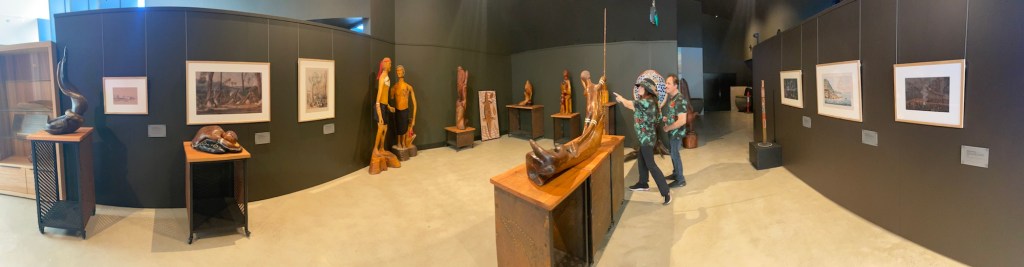
Interestingly, there is a story of preservation that our guide tells us that sounds like it could be a legend of old, but is scientifically documented. Still, let me see if I can tell it in the style of the old legends, because it seems somehow fitting for it:
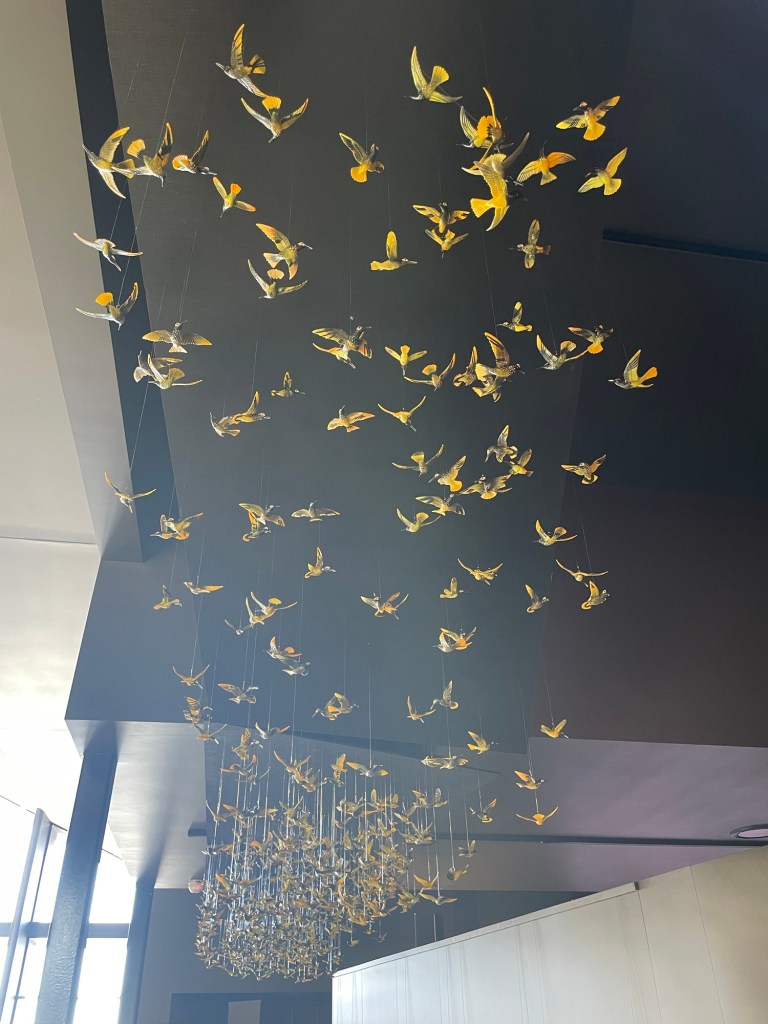
In the ancient Dreaming, when the land was young and the spirits roamed freely, there lived flocks of honeyeaters throughout the eastern part what we know now as Australia. These birds were known for their melodious songs that echoed through the trees, filling the air with sweetness and joy. But as time passed, the land changed, and the numbers of honeyeaters began to dwindle. Their once vibrant songs grew faint, and their presence in the wild became scarce. There came a time when their numbers could be counted on a single man’s hands and toes.
Concerned for the future of these beloved birds, those of great wisdom – we would call them scientists in the West, but if there is a comparable word for them in the Worimi tongue, it passed my notice – attempted to breed the honeyeater in captivity, in hopes of releasing them at some point back into the wild, and restoring their rightful presence in the world at large. However well-intentioned, it was discovered that the captive honeyeaters, bred as they were in confinement for their own safety, had lost touch with their true song. Separated from the wild, they had grown accustomed to a different melody, one that echoed the walls of their cages instead of the heart of the forest.
Determined to restore the balance of nature, these scientists decided on a course of action. They would release the captive honeyeaters into the wild and entrust them to the care of their wild brethren. But they wondered: would the captive birds remember their true song, or would they remain forever separate from their wild brethren, as if speaking a separate language between them? Would they be considered a whole separate species or breed, and be rejected, thereby dooming their wild cousins to extinction? There was nothing the scientists could do about this but to release the captive honeyeaters into the wild, and see how they would fare, hoping for the best while fearing the worst
After a period of several months, they returned to the places where the wild honey eater had considered their home, and attempted to listen for the song; which one would it be? Would there be two separate songs? Would the song of the captive honeyeater prevail? Would the song of the wild ones still exist?
And while they could not demonstrate the song for us at the cultural center, it was with joy that they realized that the captive honey eaters had learned the song of the wild, and had found their true voice from their brief venture into the open world. As they had listened to the songs of their wild kin, something stirred within them. Slowly but surely, they began to mimic the melodies of the forest, their voices blending with the chorus of the trees. The wild honey eaters welcomed them with open wings, and taught them the song of the wild, and the former captives had learned the song and embraced it. With each passing day, the captive honeyeaters grew stronger and more confident, their songs echoing through the valleys and across the mountains. As they soared through the skies, they carried with them the spirit of the forest, a testament to the power of nature and the enduring bond between all living beings.
And through this, the species had been brought back from the brink, and the honey eater had found its song once more.
To be sure, that’s well and truly embellished, but it was the story that stood out to me as I heard it, and I thought I might relate it to you; a mix of the modern and the ancient, an attempt to preserve what was dying out – and the potential for setbacks in such efforts. And the wildest thing is, the basic story is quite true, including the (for now, although given the current climate toward ecological preservation, I should think the foreseeable future looks bright for the honeyeater) successful ending to the story. We may think of “happily ever afters” as being the stuff of fairy tales, but we’re still gratified to find them in real life, regardless.
Anyway, that’s my recap from our time outside Newcastle. On to Brisbane, on to the end of this first leg (and first month) of this journey – although that’s a whole other essay, assuming I can get to it. For now, honey, keep an eye on me, and wish me luck; I’m going to need it.

 Letters to Rachel
One thought on “How the Honeyeaters Found Their Song: A Non-Legend”