Dearest Rachel –
Well, this destination is more familiar than that of Mo‘orea, but not by all that much, to be honest. I know of it as the island of temptation that caused the mutineers of the Bounty to revolt against Captain Bligh (and that, based on historical record, he was actually too lax with his crew compared to the Royal Naval standards of the day – Fletcher Christian and the others thought they could get away with pushing him around, and eventually, off the boat entirely. As it turns out, Bligh and those loyal to him, actually made it back to England in the longboat they were set adrift in, a testament to his seamanship and leadership. The mutineers? Not so much. Sure, there’s a remnant of their descendants on Pitcairn Island, but it’s not exactly a legacy to be proud of), and the home of Paul Gauguin, as well as the subject of many of his works.
As the capital city of French Polynesia, it is the primary center of Tahitian and French Polynesian public and private governmental, commercial, industrial and financial services, the hub of French Polynesian tourism and a commonly used port of call.
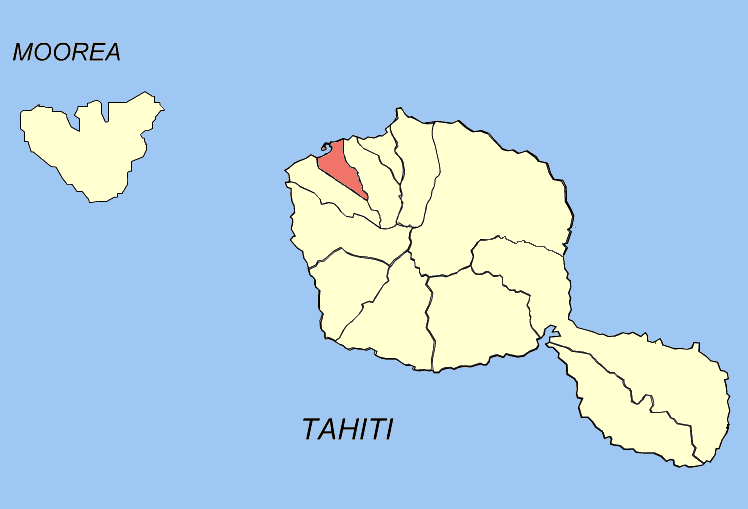
At a population of just under twenty-seven thousand, Pape‘etē’s population density could be considered comparable to back home. However, its eleven quartiers, or wards, vary wildly amongst each other; Taunoa and Fāriʻipiti have a density in excess of five thousand per square kilometer (although neither amounts to even half that size), while Tepapa and Pic Rouge aren’t anywhere close to a thousand per square kilometer. For reference, our hometown has a density of about eighteen hundred people per square kilometer.

Pape‘etē is a vibrant and cosmopolitan city that serves as the economic, political, and cultural center of French Polynesia. It has a rich history influenced by Polynesian, European, and other Pacific cultures. Interestingly, the growth of the city was boosted by the decision to move the French nuclear weapon test range from Algeria, which had become independent, to the atolls of Moruroa and Fangataufa, some 1,500 km (930 mi) to the east of Tahiti. This was motivated, in particular, by the construction of the Fa‘a‘ā International Airport, the only international airport in French Polynesia, near Pape‘etē. In late 1995 the government of Jacques Chirac conducted the first of a series of nuclear test detonations off the shores of Moruroa. A resulting riot in Pape‘etē lasted for two days and damaged the international airport, injured 40 people, and scared away tourism for some time. Clearly, the relationship between Polynesia and its mother country has been rather fraught in the past, although with the signing of the Comprehensive Test Ban Treaty in 1996, there have been no such tests since the beginning of that year, allowing matters to settle considerably since.
One of the highlights of Pape‘etē is its vibrant municipal market, known as Le Marché de Pape‘etē. Located on Boulevard Pōmare, a popular destination for both locals and tourists named named after the Tahitian Royal Family of the 19th century, it is a vibrant market known for its colorful stalls selling a variety of fresh produce, local crafts, souvenirs, and traditional Tahitian foods. The market, as well as the waterfront in general, is a popular destination for both locals and tourists looking to experience Tahitian culture and cuisine. Visitors can stroll along the waterfront, enjoy views of the harbor and surrounding mountains, and relax in waterfront parks and gardens. The Place Vai’ete is a lively area along the waterfront where visitors can dine al fresco at food trucks serving a variety of local and international cuisine. In addition to the municipal market, there are boutique shops, art galleries, and souvenir stores on the waterfront and throughout the city.
Surrounding Pape‘etē are opportunities for outdoor activities such as hiking, snorkeling, and exploring the island’s lush interior. Visitors can take guided tours to waterfalls, botanical gardens, and archaeological sites, or simply relax on one of Tahiti’s beautiful beaches. As it happens, I’ll be taking a catamaran tour in the morning to the Taapuna Passage, along the western coast of the island. The passage is characterized by its relatively calm waters and gentle currents, making it an ideal location for water sports enthusiasts of all skill levels. Surfers particularly enjoy Taapuna Passage for its consistent waves, which provide excellent opportunities for both beginners and experienced surfers (which admittedly, doesn’t interest me in the slightest – I’ve never been about to master a skateboard, so I’ve no illusions regarding my surfing ‘ability’). In addition to water sports, Taapuna Passage offers beautiful scenery and is surrounded by lush greenery and palm-fringed shores. Visitors can relax on the beach, soak up the sun, or simply admire the tranquil surroundings, including, according to the blurb for the excursion, the possibility of spotting dolphins or other wildlife.
Hopefully, there will be more for us to do during the afternoon than this. I’ll have to get back with you about it, as I’ve gotten in pretty late from Mo‘orea (wouldn’t have had the time to present this at dinner, even if I made it there!), and need to process all of that now. Looks like it might be rather a late night, to be honest. Thankfully, I’ve gotten enough exercise (and lost enough water weight) that I don’t think it will be necessary to burn an hour at the gym.
But for now, keep an eye on me, honey, and wish me luck; I’m going to need it.

 Letters to Rachel