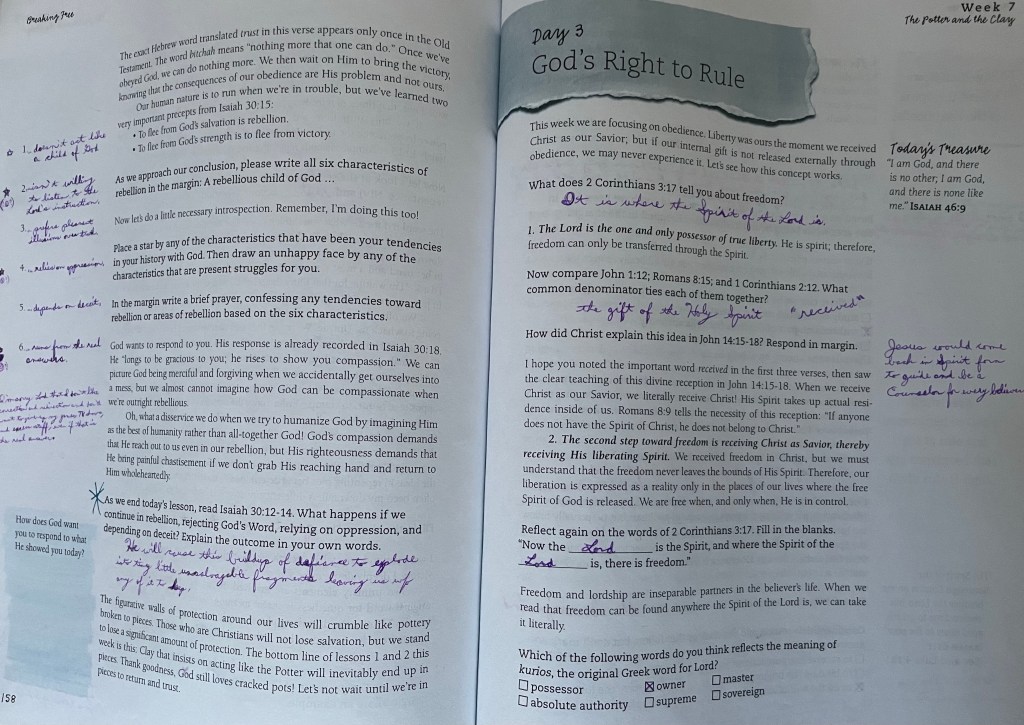

What does 2 Corinthians 3:17 tell you about freedom?
“It is where the Spirit of the Lord is.”
Now compare John 1:12; Romans 8:15; and 1 Corinthians 2:12. What common denominator ties each of them together?
“The gift of the Holy Spirit ‘received’”
How did Christ explain this idea in John 14:15-18?
“Jesus would come back in Spirit form to guide and be a counselor for every believer.”
Reflect again on the words of 2 Corinthians 3:17. Fill in the blanks. ‘Now the “Lord” is the Spirit, and where the spirit of the “Lord” is, there is freedom.’
Which of the following words do you think reflects the meaning of kurios, the original Greek word for Lord? “owner”
Have you noticed that you can experience freedom in part of your life while you are still in bondage in another? “Yes” Describe a time when you were free in one are while bound in another.
“When I am out at church and in friends’ homes doing God’s will, I feel very free, but when I come home I relax right back into my comfortable bondage of lazy procrastination.”
Based on our third step to freedom, how could you have been free in one area while being bound in the other?
“I guess I need to yield to God’s authority at home more thoroughly and more deliberately.”
How, then, can we be fully liberated? “withhold no part of our lives from His authority”
How can we apply Philippians 3:12 to the obedient life?
“We keep striving to become the people God wants us to be and Jesus died for us to be able to become.”
How did Christ refer to His Father in Isaiah 61:1? “the Sovereign Lord”
What was Christ’s ultimate purpose in His earthly life? “to do the will of His Father”
Read each of the following Scriptures and record Christ’s attitude toward His Father’s desires.
Matthew 26:42 – “‘may Your will be done’”
John 4:34 – “His Father’s will sustained Him like food.”
John 6:38 – “They were His purpose for being on earth.”
What is God’s will according to John 6:39-40?
“God’s will is that everyone who looks to the Son and believes in Him shall have eternal life.”
In the following exercise write phrases and references in four categories from Isaiah 40:12-28; 45:5-25; 46:1-13
Creation:
“He marked off the heavens with the breadth of His hand (40:12)
“He held the dust of the earth in a basket; He weighed the mountains on scales and the hills in a balance (40:12)
“He weighs the islands as though they were fine dust (40:15)
“He stretches out the heavens like a canopy and spreads them out like a tent to live in (40:22)
“He brings out the starry host one by one, and calls them each by name. Because of His great power and mighty strength not one of them is missing (40:26)
“He is the everlasting God, the creator of the ends of the earth (40:28)”
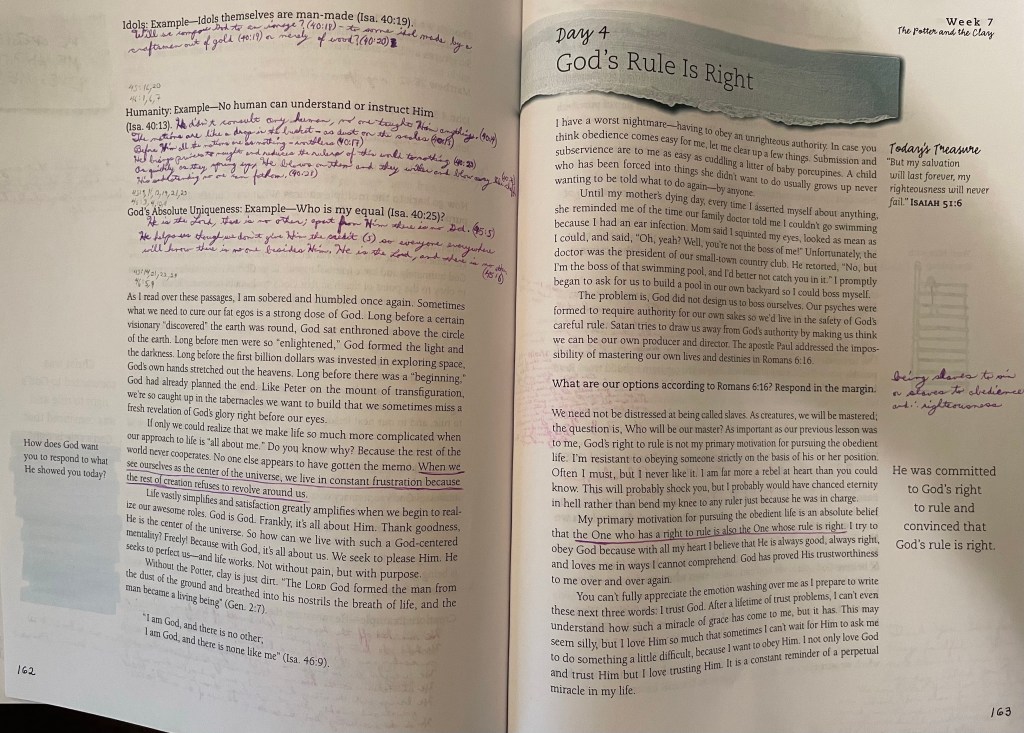
Idols:
“Will we compare God to an image? (40:18)
“– to some idol made by a craftsman out of gold? (40:19) or merely of wood? (40:20)”
Humanity:
“He didn’t consult any human, no one taught Him anything (40:14)
“The nations are like a drop in the bucket – as dust on the scales (40:15)
“Before Him all the nations are as nothing – worthless (40:17)
“He brings princes to naught and reduces the rules of this world to nothing (40:23)
“As quickly as they” [the rulers] “spring up, He blows on them, and they wither and blow away like chaff (40:24)
“His understanding no one can fathom (40:28)”
God’s Absolute Uniqueness:
“He is the Lord; there is no other; apart from Him, there is no God. (45:5)
“He helps us though we don’t give Him the credit (v.5) so everyone everywhere will know there is no one beside Him. He is the Lord, and there is no other (45:6)”
When we see ourselves as the center of the universe, we live in constant frustration because the rest of creation refuses to revolve around us.
Dearest Rachel –
That last line in this day’s study sticks out to me. If for no other reason, there’s the fact that I meant for these letters to focus on you, and yet, it’s rather been turned around such that variations of the first-person pronoun (I, me, my…) are probably the most common words used throughout this collection. While I (and anyone else accused of self-centeredness, which is basically all of humanity) might argue that my first-person perspective is all I have to work with – I literally can’t see life through another person’s eyes, absorb their history, and understand what and why they’re thinking something in any given moment – none of it is any excuse for me to expect the world to revolve around me (even on my birthday). I’m just not that important.
Of course, that goes equally for everyone around us, too. In God’s eyes, every one of us is just as insignificant as another – or, if you want to be an optimist about it, just as important as the next person, since each of us has a place in His plans. But by and large, we can only be ‘important’ to those who we come in contact with, those whose lives we affect. Meanwhile, God should be important to all of us, as He created and sustains every last one of us – not that it occurs to us to notice much of the time, even for those of us who are aware of His presence.
To this day, I’m no more sure that I’m listening to Him than you claimed to be when you filled this study out; free in His will in some places and situations, but bound by your own compulsions in others. For all that we keep striving to do better, we never succeed, and even if we do for a moment or two, we can’t sustain it for a lifetime, imperfect as we are. I wish I had more encouragement to write here – or that you could contribute to these letters, as you might have plenty of that to add from your side, if you could – but I’ll have to leave things as they are for now.
Take care, honey; keep an eye on me, and wish me luck. I’m going to need it.

 Letters to Rachel